What Is Relationship Mapping Software?
Relationship mapping tools visualize the people inside a target account and the connections between them. At a basic level, that means building an org chart. But the best tools go far beyond hierarchy. They capture buying roles such as decision maker, economic buyer, technical evaluator, and blocker. They record the strength of each relationship, often on a scale from unknown to advocate. They map influence lines that do not follow formal reporting structures, because the person who actually sways a decision is rarely the one with the biggest title.
Beyond the org chart
A real relationship map answers questions a static chart cannot. Who do we have no coverage with? Which stakeholders are detractors, and who can neutralize them? If our champion leaves, do we have a backup? Where is the political risk in this deal? Tools that surface these answers turn relationship mapping from a documentation exercise into a strategic one.
Connection to deal execution
The strongest platforms link maps to opportunities and account plans. When a relationship map shows that you have zero contact with the economic buyer on a six-figure deal, that should trigger an action. Tools that connect mapping to whitespace analysis, action planning, and forecasting close the loop between insight and execution. That linkage is what separates a serious revenue tool from a drawing app.
Why Salesforce-Native Matters
If your company runs on Salesforce, where your relationship mapping tool lives is the single most important architectural decision you will make. A Salesforce-native tool is built on the Salesforce platform itself, using native objects, permissions, and reporting. A connected or integrated tool runs on its own infrastructure and syncs data back and forth.
Data integrity and adoption
Native tools read and write directly to Contact and Opportunity records, so your maps stay current without manual entry. Sellers do not have to update two systems. Admins do not have to manage a separate security model. When a contact changes roles or leaves, the map reflects it because it is the same data. With non-native tools, sync lag and data drift are constant headaches, and every integration is a point of failure.
Total cost of ownership
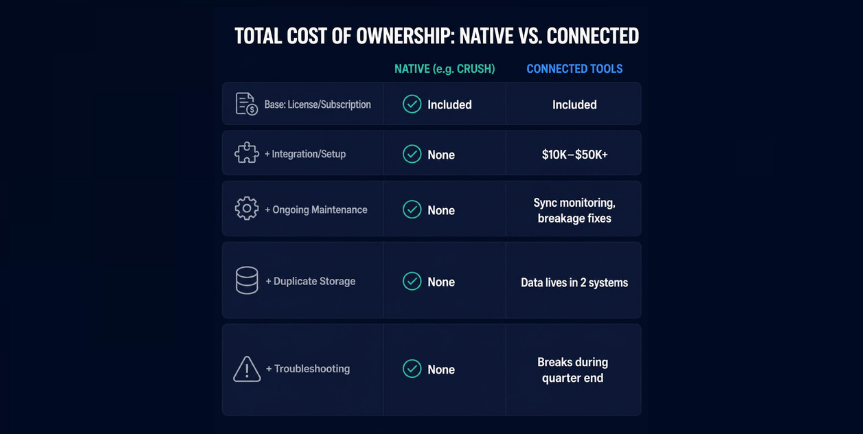
Connected tools often look cheaper on the sticker price but cost more over time. You pay for the integration, the maintenance, the duplicate storage, and the inevitable troubleshooting when the sync breaks during a quarter end. Native tools like Prolifiq CRUSH avoid that overhead entirely because there is nothing to integrate. This is why Salesforce-heavy organizations in regulated industries like life sciences and financial services strongly favor native architecture.
The Best Relationship Mapping Tools in 2026
Below are the leading platforms for B2B revenue teams. We have focused on tools that map stakeholders at depth and connect mapping to broader account strategy, not generic diagramming apps.
Prolifiq CRUSH

CRUSH is a fully Salesforce-native account planning platform with relationship mapping at its core. Because it is built on Salesforce, maps pull directly from Contact and Opportunity data with no integration. CRUSH lets teams visualize org structures, score relationship strength, tag buying roles, and overlay influence lines. It ties maps to whitespace analysis and action plans so coverage gaps become tasks. For organizations that already standardized on Salesforce, CRUSH is the most direct path to disciplined relationship mapping without adding a second platform to maintain.
Altify
Now part of Upland Software, Altify is a long-established account planning and opportunity management suite with relationship mapping included. It offers robust methodology tied to the Altify selling framework. It is Salesforce-connected rather than fully native, and pricing skews enterprise. Teams that want a heavy methodology overlay and have budget for a larger platform consider Altify, though some find it complex to deploy.
DemandFarm
DemandFarm specializes in key account management with strong org charting and relationship intelligence features. Its digital relationship maps and influence mapping are well regarded. It integrates with Salesforce rather than being native. DemandFarm is popular with strategic account teams that want visually rich maps and account scorecards.
ARPEDIO
ARPEDIO is a Salesforce-native account based selling platform with relationship mapping, whitespace, and stakeholder management. As a native tool, it shares the data integrity advantages of CRUSH. It has gained traction in European markets and with teams wanting native architecture plus opportunity scoring.
Revegy
Revegy focuses on account planning and value mapping with relationship and influence mapping built in. It is strong on visualizing buying committees and political maps. Revegy is Salesforce-connected and aimed at larger enterprise sales organizations with complex deals.
Kapta
Kapta is a key account management platform geared toward customer success and account growth rather than new logo acquisition. It includes relationship mapping but emphasizes account health and voice of customer. Teams focused on retention and expansion in existing accounts often evaluate Kapta.
Comparing the Leading Tools
The right choice depends on your CRM, your selling motion, and your appetite for platform complexity. Here is how the leaders stack up on the dimensions that matter most.
Architecture
Prolifiq CRUSH and ARPEDIO are Salesforce-native. Altify, DemandFarm, Revegy, and Kapta are connected or integrated. If you run heavily on Salesforce and care about data integrity and low maintenance, native should be a hard requirement, not a nice to have.
Depth of mapping
All six map stakeholders and influence. DemandFarm and Revegy are known for visually rich maps. CRUSH and ARPEDIO tie maps tightly to whitespace and action planning. Altify layers in formal methodology. Kapta leans toward health scoring over deal navigation.
Breadth of platform
If you want relationship mapping as part of a full account planning system, CRUSH, Altify, DemandFarm, ARPEDIO, and Revegy all qualify. If you only want mapping, you may find these tools broader than you need, but that breadth pays off as your program matures.
Pricing Benchmarks for Relationship Mapping Software
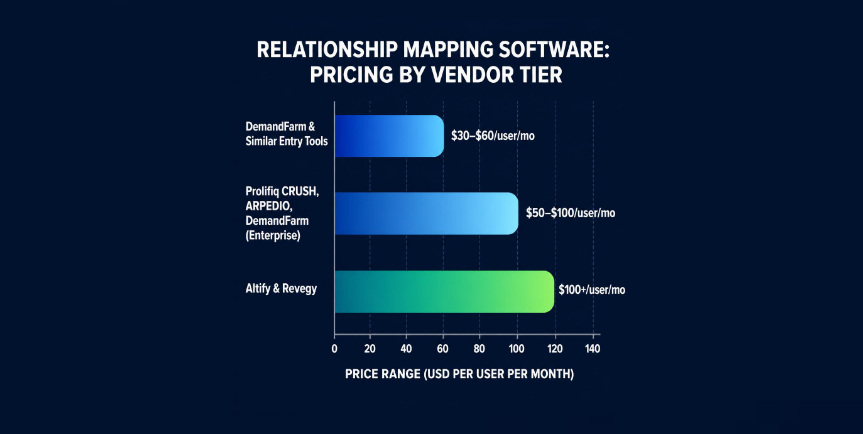
Pricing in this category is almost always per user per month, billed annually, and most vendors do not publish rates publicly. Based on market benchmarks, expect the following ranges.
Entry level account planning tools with relationship mapping typically run 30 to 60 dollars per user per month. Mid market and enterprise platforms like Prolifiq CRUSH, ARPEDIO, and DemandFarm commonly land in the 50 to 100 dollars per user per month range depending on modules and volume. Larger enterprise suites like Altify and Revegy can exceed 100 dollars per user per month, particularly when bundled with broader opportunity management and methodology.
Watch for implementation fees. Native tools generally have lower setup costs because there is no integration to build. Connected tools may add 10,000 to 50,000 dollars or more in onboarding and integration work for larger deployments. Always model total cost of ownership over three years, not just the per seat price.

Key Features to Evaluate
When you run a comparison, score each tool against the features that drive real outcomes rather than demos that look impressive but never get used.
Automatic data population
Maps that require manual data entry die within a quarter. Prioritize tools that pull contacts and roles from your CRM automatically. This is where native architecture wins decisively.
Influence and relationship scoring
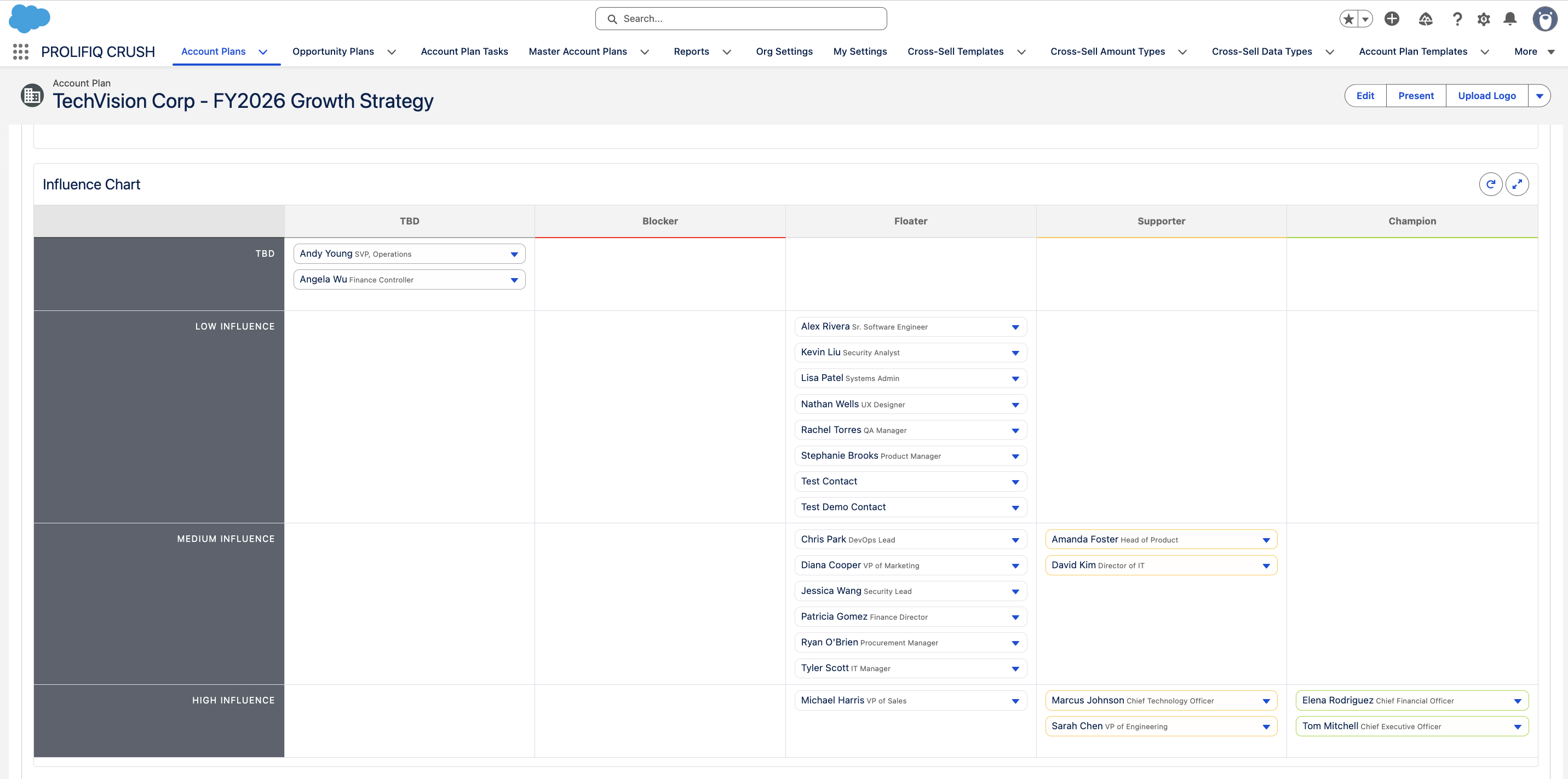
Look for the ability to score relationship strength and influence separately. A senior person you barely know is different from a junior advocate. Good tools let you capture both.
Whitespace and gap analysis
The map should tell you where you are blind. Tools that flag uncovered decision makers and weak relationships turn mapping into a prioritized action list.
Reporting and rollup
Managers need to see relationship coverage across the portfolio, not just one account at a time. Native tools report through standard Salesforce dashboards, which is a significant advantage for ops teams.
Stakeholder Mapping Tools vs Relationship Mapping Tools
These two categories overlap heavily but are not identical, and buyers searching for "stakeholder mapping tool" or "stakeholder management software" are often evaluating a slightly different shortlist than buyers searching for relationship mapping specifically. Stakeholder mapping tends to be broader and more project or program oriented, covering anyone with an interest in an initiative, including internal teams, regulators, and community groups. Relationship mapping, in the B2B sales context this guide focuses on, is narrower and deal oriented: it maps the specific buying committee inside a target account and how those people connect to each other.
If your evaluation criteria lean toward stakeholder management software, look for the same core capability set covered above: automatic data population from your CRM, separate scoring for influence and relationship strength, and gap analysis that flags who you have not engaged. This is also where the term relationship intelligence comes in. It describes the same underlying discipline, capturing the strength and sentiment of a relationship as structured data rather than as a static chart, and it is the layer that connects a stakeholder or relationship map to actual deal execution.
Common Mistakes Teams Make
Buying a tool does not fix a relationship mapping problem on its own. The most common failure mode is treating mapping as a one time documentation task. Maps must be living artifacts updated through the deal lifecycle, ideally during deal reviews and QBRs.
A second mistake is mapping only titles and reporting lines. The org chart is the easy part. The hard and valuable part is mapping influence, sentiment, and political risk. If your tool only shows hierarchy, you are missing the insight that wins deals.
A third mistake is choosing a tool that lives outside your CRM and then wondering why adoption stalls. Sellers will not maintain two systems. Whatever you buy, make it part of the workflow they already use every day.
How to Choose the Right Tool for Your Team
Start with your CRM. If you run Salesforce, narrow your shortlist to native or tightly integrated tools and weight native heavily. Next, define your selling motion. New logo acquisition with large buying committees favors deal navigation features. Expansion and retention favor health and account growth features like those in Kapta.
Then run a real pilot. Pick five to ten of your most complex active accounts and have your best reps build maps in two finalist tools. Measure how long it takes, how complete the maps are, and how easily managers can see coverage gaps. The tool that produces useful maps fastest with the least friction is your winner. Demos lie. Pilots tell the truth.
Finally, confirm the platform connects mapping to action. A map that does not generate tasks and inform forecasts is decoration. The best relationship mapping tools make the next move obvious.
Frequently Asked Questions
What is a relationship mapping tool?
A relationship mapping tool visualizes the people inside a target account, their reporting structure, their buying roles, and the influence and sentiment between them. The best tools also flag coverage gaps and tie maps to account plans and opportunities so the insight drives action rather than sitting in a static chart.
What is the best relationship mapping tool for Salesforce users?
For Salesforce-centric organizations, native tools are the strongest choice because they avoid integration overhead and keep data current automatically. Prolifiq CRUSH and ARPEDIO are both Salesforce-native. CRUSH is widely used in life sciences, financial services, manufacturing, and technology for its tight link between mapping, whitespace, and action planning.
How much do relationship mapping tools cost?
Most tools price per user per month billed annually. Entry level options run 30 to 60 dollars, mid market and enterprise platforms typically run 50 to 100 dollars, and larger suites can exceed 100 dollars per user per month. Factor in implementation fees, which are lower for native tools because there is no integration to build.
Is relationship mapping different from an org chart?
Yes. An org chart shows formal reporting structure. A relationship map adds buying roles, relationship strength, influence lines that cross hierarchy, sentiment, and coverage gaps. The org chart is a subset of a true relationship map and the least valuable part of it.
Why does Salesforce-native architecture matter?
Native tools read and write directly to your Salesforce data, so maps stay current without manual entry and without sync issues. They also share the Salesforce security model and report through standard dashboards. Connected tools introduce integration maintenance, data drift, and higher total cost of ownership over time.
How do I drive adoption of a relationship mapping tool?
Embed it in workflows reps already use, ideally inside the CRM. Make map updates part of deal reviews and QBRs rather than a separate task. Tie maps to whitespace and action plans so the tool produces a clear next move. Tools that require maintaining a second system rarely get adopted.
Which industries benefit most from relationship mapping?
Any B2B organization selling into large, complex buying committees benefits. Life sciences, financial services, manufacturing, and technology see the strongest returns because deals involve many stakeholders, long cycles, and significant political risk where mapping influence is decisive.
Is there a relationship mapping app?
Most vendors in this category are web-based platforms accessed through a browser, plus a companion mobile app for reviewing maps and logging updates on the go. Prolifiq CRUSH is accessible from any device through Salesforce, including the Salesforce mobile app, so reps can check relationship coverage before walking into a meeting without needing a separate download. Standalone tools vary here, and a dedicated native app is more common among the connected, non-Salesforce platforms.
What is executive relationship intelligence?
Executive relationship intelligence is the practice of mapping and tracking the strength, sentiment, and influence of senior stakeholders specifically, rather than just the working-level contacts on a deal. It answers a narrower question than general relationship mapping: does this account have a real relationship at the top, and would that person pick up the phone for us. Teams building this into partner and channel programs use the same discipline one level up, mapping the relationships between executives at each partner organization so a channel manager can see coverage gaps before a joint account stalls, not after.
Map Your Accounts With Confidence Using Prolifiq CRUSH
If your team runs on Salesforce and you are tired of stale org charts and relationship insight trapped in someone's head, Prolifiq CRUSH gives you relationship mapping built natively into the platform you already use. Maps stay current automatically, coverage gaps turn into action, and managers see relationship health across the entire portfolio through standard Salesforce reporting. No integration to maintain, no second system for reps to update, no data drift.
See how disciplined relationship mapping changes the way your team navigates complex deals. Explore Prolifiq CRUSH and start turning the invisible web of stakeholders into a strategic asset that closes deals.