Your existing customers are the most credible sales asset you have. A reference call speeds up a stuck deal, a peer review brings in inbound demand, and a champion willing to vouch for you carries more weight than any rep. Yet most B2B teams run advocacy out of spreadsheets, one-off email asks, and the same five overused customers. Deals wait while reps hunt for a reference, and the best advocates burn out.
Customer advocacy software fixes that by turning advocacy into a repeatable system. This guide covers what these tools do, the main types of customer advocacy platforms, the features worth paying for, leading vendors and pricing, and how to choose one your sellers will actually use inside Salesforce.
What Is Customer Advocacy Software?
Customer advocacy software is a platform that helps B2B companies find satisfied customers, manage reference requests, collect reviews and testimonials, and reward advocates, so the right customer voice reaches the right deal at the right time. It replaces ad hoc asks with a tracked, repeatable program.
Most customer advocacy tools cover four jobs:
- Advocate identification: using NPS, product usage, support sentiment, and renewal history to flag who is happy enough to help.
- Reference management: tracking which customers take calls, how often they have been used, and which deals they are matched to.
- Content and review capture: turning happy customers into case studies, quotes, video testimonials, and reviews on G2, TrustRadius, and Gartner Peer Insights.
- Engagement and rewards: keeping advocates active with recognition, perks, and exclusive access.
If you are new to the concept, start with our guide to what customer advocacy is. The rest of this article assumes you are evaluating tools.
Why B2B Revenue Teams Need It
B2B deals are decided by groups, not individuals. Gartner found that buying groups range from five to 16 people across as many as four functions, and most of them never talk to your rep. They read reviews, ask peers, and look at what similar companies did. A structured advocacy program puts credible customer voices in front of every member of the buying committee, not just your champion.
The Reference Fatigue Problem
The most common reason teams buy advocacy software is reference fatigue. A handful of loyal customers get asked for every call, case study, and analyst briefing until they stop answering. Good tools fight this with usage caps, willingness scoring, and a wider advocate pool, so the load spreads across dozens of accounts instead of five.
Types of Customer Advocacy Tools
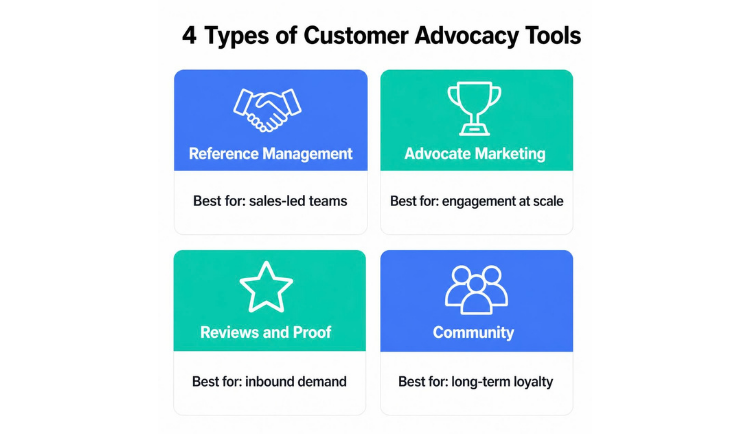
"Customer advocacy tools" covers several different product types that rarely compete head to head. Know which job you are solving before you shortlist.
Reference Management Tools
Built for sales teams that run high-volume reference programs. They match advocates to opportunities by industry, use case, size, region, and competitor displaced, and track fatigue. Best fit for sales-led companies with long enterprise cycles.
Advocate Marketing Platforms
Also called advocacy marketing platforms: gamified hubs where advocates complete challenges (share content, write reviews, join events) to earn points and rewards. Strong for engagement at scale and usually owned by customer marketing.
Review and Customer Proof Tools
Tools that drive ratings on review sites and generate survey-based proof points and statistics. Best fit for product-led companies that need third-party validation and inbound demand.
Community Platforms
Online customer communities where users answer each other's questions and build loyalty over time. Community is the long game: it grows advocates rather than matching them to deals today. B2C and retail brands often pair community or referral tools with loyalty programs, while B2B teams lean on reference management.
Customer Advocacy Platform Features to Evaluate
Not every customer advocacy platform does every job well. Use these features to separate marketing-led tools from sales-led ones.
Reference Matching and Fatigue Tracking
The most underrated feature. Sellers should be able to filter advocates by industry, use case, company size, geography, and competitor, then request a reference themselves without filing a ticket with marketing. Usage caps and last-used dates protect your best customers.
Review and Testimonial Generation
If demand generation matters, check how the platform drives reviews to G2, Capterra, TrustRadius, and Gartner Peer Insights at scale. Look for native integrations and automated nurture sequences, not manual outreach.
Engagement and Rewards
Advocates stay active when participation feels valued. Points, tiers, early product access, executive attention, and co-marketing exposure keep the roster warm. Check whether rewards fulfillment is built in or needs a separate vendor.
Salesforce Native vs. Standalone
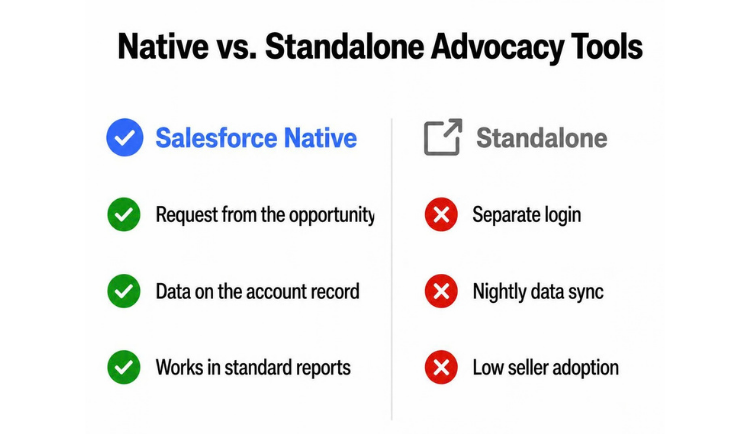
This is the most consequential choice and the one buyers most often underweight. Standalone platforms have their own login, data model, and dashboards. Sellers must leave Salesforce to find a reference, so they email the CSM instead and the platform becomes a customer-success-only tool. Salesforce native tools put the request on the opportunity, keep advocate records next to the account, and write usage back into reports RevOps already trusts.
Push vendors on integration depth, not just "we integrate with Salesforce," which often means a nightly sync. Ask:
- Can a seller request a reference from the opportunity record?
- Does advocate usage write back to the account and contact?
- Does the data show up in standard Salesforce reports and dashboards?
- How does the tool handle your custom objects?
- Where is advocate data stored? (Critical for life sciences and financial services security reviews.)
Best Customer Advocacy Software Vendors and Pricing
These are the names you will run into most often. Each fits a different motion.
Leading Vendors
- Influitive: one of the original advocate marketing platforms, known for its gamified AdvocateHub. Strong on engagement and community; marketing-owned and lighter on sales reference matching.
- Point of Reference (ReferenceEdge): reference management built inside Salesforce, strong on matching and fatigue tracking for reference-heavy enterprises.
- Upland RO Innovation: reference and sales content management aimed at high-volume enterprise reference programs.
- SlapFive: combines customer voice, story capture, references, and advocacy for B2B customer marketing teams.
- Base: a newer advocacy platform focused on sales-aligned reference matching and tying advocacy to revenue.
- UserEvidence and TechValidate: survey-based customer proof and statistics at scale; great for content, narrower than full advocacy.
- Higher Logic, Gainsight Community, and Khoros: community platforms that support advocacy as part of a broader customer community.
Pricing Benchmarks
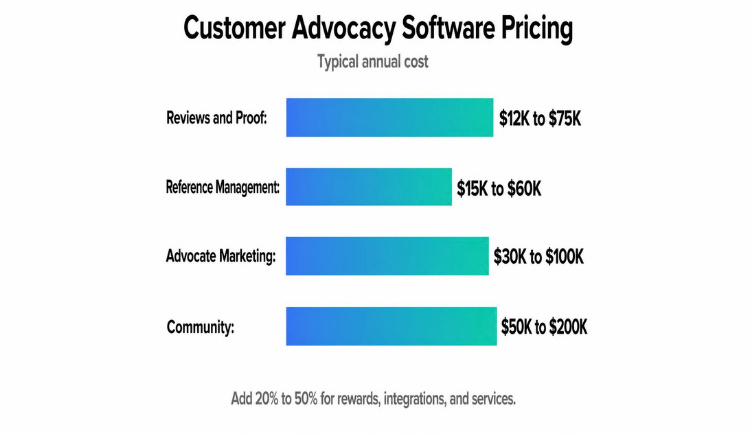
Pricing is rarely public and almost always annual. Use these ranges for planning, not as quotes:
- Review and proof tools: about $12,000 to $75,000 per year, depending on survey and content volume.
- Reference management: about $15,000 to $60,000 per year for mid-sized teams, often priced per Salesforce user.
- Advocate marketing platforms: about $30,000 to $100,000 per year, depending on advocate volume and modules.
- Community platforms: about $50,000 to $200,000 per year for enterprise deployments.
Hidden Costs
Rewards fulfillment, premium integrations, extra advocate seats, and launch services are often billed separately, and can add 20% to 50% to the license. The biggest hidden cost is people: a tool without a dedicated customer advocacy manager rarely produces value. Model the fully loaded cost over three years, since programs take 6 to 9 months to reach steady state and switching vendors mid-program is painful.
How Advocacy Connects to Account Planning
This is the part most buyers miss. Advocacy is not a standalone marketing program. It is a signal of account strength and a lever in account planning.
Advocates come from accounts with strong multithreaded relationships, proven business value, and an invested executive sponsor. Those are exactly the things a serious account plan tracks. If your relationship mapping lives in one system and your advocacy data in another, account planners never see one of the clearest health signals you have.
Advocates as Expansion and Risk Signals
A customer who agrees to be a public reference has made a reputational bet on you. That is the strongest possible sign of satisfaction and the best opening for an expansion conversation, so treat your advocate list as a prioritized white space pipeline. The reverse matters too: an advocate who suddenly declines every request often shows up in your customer health score a quarter later. Accounts with active advocates also tend to post stronger net revenue retention.
Spreading the Load With Relationship Maps
When advocacy data sits on the same account record as the relationship map, you can spot strong relationships that have never been asked, spread requests across more contacts, and protect your best advocates from burnout.
How to Evaluate and Launch Customer Advocacy Software
Run a Structured Evaluation
Write down the single most acute pain you are solving (reference fatigue, missing reviews, or no community) and shortlist vendors that solve that job, not the broadest suite. Insist on a proof of concept inside your own Salesforce org, with your real objects and opportunity workflow. Involve the sellers who will use it, not just the marketing team that will run it, and score vendors on adoption likelihood as heavily as features.
Build a Program That Lasts
Software does not create advocates; programs do. Define the asks you will support (reference calls, case studies, reviews, speaking slots, advisory boards) and segment advocates by what they are willing to do. Give before you take with early access, recognition, and real roadmap influence. Then close the loop: tell advocates when their call helped close a deal, and tie every activity to a pipeline or retention outcome so the program can defend its budget. Our guide to building a customer advocacy program walks through the first 90 days, and these customer advocacy examples show what good asks look like.
Measure What the Software Delivers
Track advocacy like a revenue program, not a marketing activity. The metrics that matter:
- Sales impact: win rate and sales cycle length on deals that used a reference versus deals that did not.
- Demand impact: review volume and ratings on G2 and TrustRadius, and the inbound they drive.
- Retention impact: renewal and expansion rates among active advocates versus the rest of the base.
- Program health: active advocates, asks per advocate per quarter, and request fulfillment time.
If your platform cannot tie a reference call to the opportunity it influenced, you cannot prove ROI, and advocacy budgets are the first thing cut in a downturn.
Common Mistakes to Avoid
- Buying a tool before defining the program. An empty advocacy platform is worse than none.
- Running advocacy only in marketing. If the workflow does not serve the account executive in the deal, sellers will not use it.
- Chasing review volume over reference quality. One credible peer in the prospect's industry beats a hundred generic reviews in an enterprise deal.
- Ignoring burnout. Without usage caps and constant recruiting, you will exhaust your best customers within a year.
- Choosing standalone in a Salesforce-centric org, then wondering why adoption is low.
Frequently Asked Questions
What is the difference between customer advocacy software and reference management software?
Reference management is a subset of customer advocacy software. Reference tools focus on matching customers to sales opportunities and tracking fatigue. Customer advocacy software is broader and also covers reviews, testimonials, case studies, community, and rewards. Many teams start with reference management and expand as the program matures.
What are the best customer advocacy tools?
It depends on your motion. Sales-led enterprise teams usually start with reference management tools such as Point of Reference or Upland RO Innovation. Marketing-led programs often choose advocate marketing platforms like Influitive or SlapFive. Product-led companies focused on reviews look at UserEvidence or TechValidate. Teams building a long-term community look at Higher Logic or Gainsight Community.
How much does customer advocacy software cost?
Most tools cost $15,000 to $100,000 per year, with enterprise community platforms reaching $200,000. Add 20% to 50% for rewards, integrations, and launch services, plus the cost of a program manager.
How do you measure ROI on customer advocacy software?
Compare win rates and cycle length on reference-assisted deals against deals without a reference, track inbound from reviews, and compare renewal and expansion rates for active advocates against the rest of your customers. Log every advocacy activity against an opportunity so the program can defend its budget.
Do I need a Salesforce native advocacy tool?
If your revenue team lives in Salesforce, native architecture sharply improves adoption because sellers can request references from the opportunity instead of switching systems. Standalone tools tend to become customer-success-only platforms.
How do I prevent advocate burnout?
Set usage caps, recruit new advocates continuously from healthy accounts, match each ask to what the advocate is willing to do, and always tell advocates the impact of their help. Recognition keeps advocates engaged longer than cash incentives.
Who should own customer advocacy software?
Usually customer marketing, with a dedicated advocacy manager who works closely with sales and customer success. What matters most is one accountable owner and sellers who can reach advocates inside their daily workflow. For the bigger picture, see our customer advocacy strategy playbook.
Can I run advocacy without dedicated software?
Small teams can start with a spreadsheet, but it breaks as deal volume grows: no fatigue tracking, no matching, and no reporting. Once you are placing references across multiple deals each month, software pays for itself.
Turn advocacy into a revenue signal inside Salesforce. Customer advocacy only pays off when it lives where your sellers work and connects to how you plan your most important accounts. A reference no one can find mid-deal is worthless, and an advocate signal that never reaches your account planners is a missed expansion opportunity. Prolifiq CRUSH brings account planning, relationship mapping, and whitespace analysis natively into Salesforce, so the champions and advocates behind your healthiest accounts show up right where your team builds strategy.