Demand generation is where revenue starts. Before a sales rep ever opens an opportunity, demand generation tools have already done the work of identifying accounts, capturing interest, nurturing buyers, and routing the right signals to the right people. The problem is that the category has bloated. There are tools for advertising, tools for email, tools for intent data, tools for landing pages, tools for attribution, and tools for orchestration. Most B2B revenue teams end up with eight to twelve overlapping products, none of which talk to each other cleanly, and a CRM that becomes the dumping ground for half-formed data.
That fragmentation is expensive. Gartner's 2022 marketing technology survey found that marketers use just 42 percent of the capabilities in their martech stack, and overlap between tools was the most cited reason. The deeper cost is not money. It is the gap between demand generation and the revenue team that has to act on it. A lead scored as hot in your marketing automation platform means nothing if the account team has no plan for the account it belongs to. Demand becomes noise without a system to translate it into account strategy.
This guide breaks down the demand generation tool landscape for B2B revenue teams operating in Salesforce-centric organizations. We cover the major categories, name specific vendors with pricing benchmarks, explain how to evaluate fit, and show where account planning closes the loop between marketing-generated demand and sales execution. The goal is not to sell you on more tools. It is to help you build a stack that actually produces pipeline you can close. If you are still defining the program itself, start with our practical guide to demand generation, then come back here to choose the right demand generation software for each job.
What Demand Generation Tools Actually Do
Demand generation tools cover the full motion of creating and capturing buyer interest at the account and contact level. That spans several distinct jobs that often get lumped together. Awareness tools put your brand in front of target accounts through advertising and content syndication. Capture tools convert that interest into known contacts through forms, landing pages, and gated content. Nurture tools keep those contacts engaged through email sequences and behavioral triggers. Intelligence tools tell you which accounts are actually in-market through intent signals and engagement scoring.

The mistake most teams make is treating these as one purchase. They buy a marketing automation platform and assume it covers everything. It does not. A platform like Marketo handles nurture and scoring well but does almost nothing for intent data or account identification. You end up buying point solutions to fill the gaps, and then you need orchestration to make them work together.
Demand generation versus lead generation
These terms get used interchangeably and they should not be. Lead generation is about volume of contacts. Demand generation is about creating genuine market interest that converts to revenue. A team optimizing for lead generation will celebrate 10,000 form fills. A team optimizing for demand generation will ask how many of those came from target accounts with budget and buying intent. The second number is the one that matters, and the right tools help you see it. Our breakdown of demand generation vs lead generation goes deeper on the difference.
The Best Demand Generation Tools by Category
The demand generation stack breaks into roughly six categories. Each has clear leaders and clear price points. Understanding the categories prevents you from buying three tools that do the same thing.
Marketing automation platforms
This is the backbone. Adobe Marketo Engage, HubSpot Marketing Hub, Salesforce Marketing Cloud Account Engagement (formerly Pardot), and Oracle Eloqua dominate the enterprise space. Pricing ranges widely. HubSpot Marketing Hub Professional starts around 800 dollars per month and scales with contacts. Marketo enterprise deployments typically run 30,000 to 100,000 dollars per year. Pardot Advanced sits around 4,000 dollars per month for the higher tiers. For Salesforce-native organizations, Pardot offers the tightest CRM integration since it lives inside the platform.
Intent data providers
Bombora, 6sense, Demandbase, and ZoomInfo lead here. These tools tell you which accounts are researching topics related to your product. 6sense and Demandbase have evolved into full account-based platforms with pricing that often exceeds 60,000 to 120,000 dollars per year. Bombora sells intent data as a feed you can pipe into other systems, typically starting around 25,000 dollars annually.
Advertising and content syndication
LinkedIn Campaign Manager, Google Ads, and content syndication networks like NetLine and TechTarget fall here. Content syndication can cost 30 to 90 dollars per lead depending on the seniority and account criteria you specify.
Intent Data: The Signal That Changes Everything
Intent data is the single biggest shift in demand generation over the past decade. Instead of waiting for buyers to raise their hand, intent data lets you identify accounts showing buying signals before they ever contact you. When a target account spikes in research activity around your category, you can prioritize it, route it, and build a plan around it.
The catch is that intent data without action is just a report. Most teams buy 6sense or Bombora, watch the dashboards light up, and then fail to convert those signals into coordinated outreach. The signal arrives in marketing but the action has to happen in sales, and the two systems rarely connect.
First-party versus third-party intent
First-party intent comes from activity on your own properties.
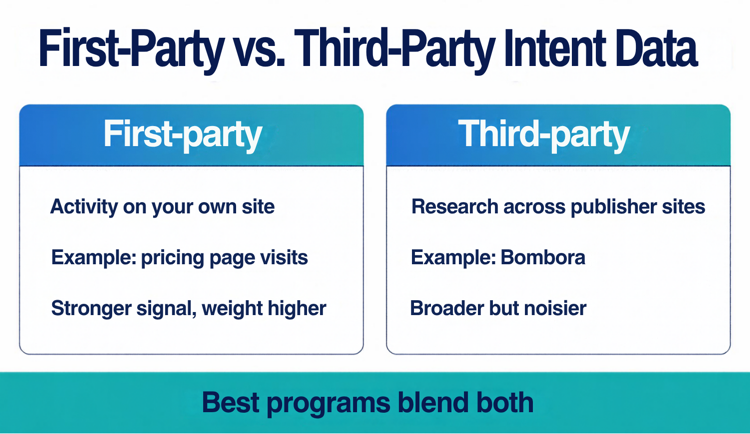
Someone visits your pricing page three times in a week. That is a strong signal and you own it. Third-party intent comes from networks like Bombora that track research activity across thousands of publisher sites. Third-party intent is broader but noisier. The best demand generation programs blend both, weighting first-party signals higher because they reflect direct interest in your specific solution.
Account-Based Marketing Platforms
ABM platforms have absorbed much of the demand generation category. 6sense, Demandbase, RollWorks, and Terminus orchestrate advertising, intent, and engagement at the account level. They answer the question marketing automation cannot: which accounts should we focus on right now, and what should we do about them? For a deeper comparison, see our roundups of the best account-based marketing platforms and account based marketing tools.
These platforms are powerful and expensive. A mid-market 6sense deployment runs 60,000 to 100,000 dollars per year. Demandbase is comparable. RollWorks and Terminus sit lower, often in the 25,000 to 50,000 dollar range. The value depends entirely on whether your sales team acts on what the platform surfaces. An ABM platform that identifies 200 in-market accounts is worthless if your reps have no structured way to plan and execute against those accounts.
Demand Generation Tool Pricing Benchmarks and Integration Costs
Here is a realistic picture of what a B2B demand generation stack costs annually. A marketing automation platform runs 15,000 to 100,000 dollars depending on size and vendor. Intent data adds 25,000 to 60,000 dollars. An ABM platform layers on another 50,000 to 120,000 dollars. Advertising budgets vary but a serious B2B program spends 100,000 to 500,000 dollars per year on paid channels. Add attribution tools like Bizible or Dreamdata at 20,000 to 50,000 dollars.
The total for a mid-size enterprise easily reaches 300,000 to 800,000 dollars per year before headcount. That spend is justified only if the demand it generates converts to closed revenue. Teams that track demand generation cost per closed dollar, rather than cost per lead, make far better stack decisions. They cut tools that produce volume without revenue and double down on the ones that produce pipeline that closes.
The Integration Problem Nobody Warns You About
Every demand generation vendor promises seamless integration. Reality is messier. Your marketing automation platform syncs leads to Salesforce, but field mapping breaks. Your intent data provider pushes scores, but they sit in a custom object no rep ever opens. Your ABM platform identifies hot accounts, but that intelligence never reaches the account plan where decisions get made.
For Salesforce-centric organizations, the integration question should drive purchasing decisions. Tools that are Salesforce-native, meaning they run inside the platform rather than syncing to it, eliminate an entire class of data problems. There is no nightly sync to break, no duplicate records, no lag between when a signal fires and when a rep sees it. This is why native architecture matters more than feature checklists for enterprise teams.
Where Demand Generation Breaks Down at the Handoff
The biggest failure point in B2B revenue is the handoff from demand generation to sales execution. Marketing generates an MQL, scores it, routes it, and considers the job done. Sales receives a name and a score with no context about the account, the buying committee, the competitive situation, or what the next move should be.
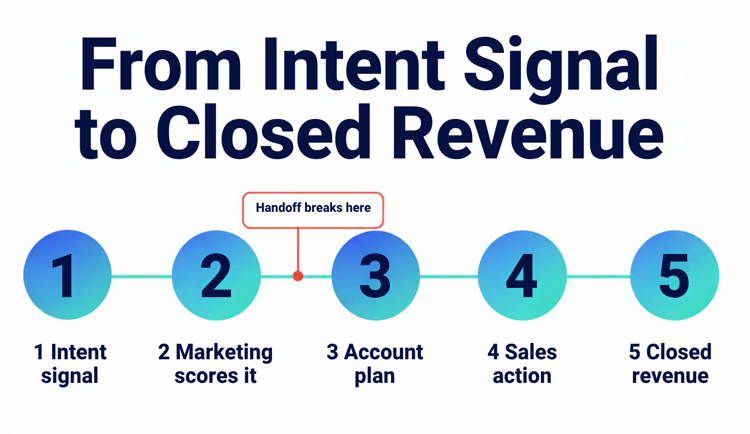
This is where most demand generation investment leaks away. SiriusDecisions research has long shown that the majority of marketing-generated leads never get worked properly by sales. The problem is not lazy reps. It is the absence of a system that translates demand signals into account strategy. A hot intent signal needs to land in an account plan that the rep is actively managing, complete with relationship maps, opportunity strategy, and clear next steps.
Why scoring alone fails
Lead scores tell you something is interesting. They do not tell you what to do. A score of 95 on an account means the account is engaged, but it does not identify the economic buyer, the blockers, the competitive incumbent, or the path to a deal. Account planning provides that layer. Without it, your demand generation tools produce signals that die in a queue.
Connecting Demand Generation to Account Planning
The teams that get the most from demand generation tools share one trait: they have a system that turns demand signals into account action. When an ABM platform flags an account as in-market, that signal flows into a living account plan. The rep sees the intent, the engagement history, the relationship map, and the recommended next steps in one place. The demand investment converts to revenue because there is a structured place for it to land.
This is the missing layer in most stacks. You can spend 500,000 dollars on demand generation and still leave most of the value on the table if your sales team has no operational home for the intelligence those tools produce. Account planning that lives natively in Salesforce, where the demand data already exists, is what makes the whole stack pay off.
How to Evaluate Demand Generation Tools
Use four criteria when assessing any demand generation tool. First, does it integrate natively with your CRM or does it require a fragile sync? For Salesforce shops, native beats integrated every time. Second, does it close the loop to revenue, or does it stop at lead volume? Demand tools that cannot connect their activity to closed deals are hard to justify. Third, will your team actually use it? The best intent platform is useless if reps ignore the signals. Fourth, what is the total cost including implementation and ongoing administration? Enterprise demand tools often require dedicated ops headcount that doubles the real cost.
Run a structured pilot
Never buy a demand generation platform on a demo alone. Run a 90 day pilot with a defined target account list, clear success metrics tied to pipeline, and a small group of reps committed to acting on the output. Measure whether the tool produced pipeline that would not have existed otherwise. If you cannot draw that line, the tool is not earning its cost. Our guide to demand generation metrics covers which numbers to track during the pilot.
Frequently Asked Questions
What is the difference between demand generation tools and lead generation tools?
Demand generation tools create and capture genuine market interest at the account level and measure success by revenue. Lead generation tools focus on volume of contacts. The categories overlap but optimizing for demand generation produces higher-quality pipeline because it prioritizes target accounts with real buying intent over raw form fills.
How much should a B2B company spend on demand generation tools?
A mid-size enterprise typically spends 300,000 to 800,000 dollars per year across marketing automation, intent data, ABM platforms, advertising, and attribution. The right number depends on your average deal size and sales cycle. Track cost per closed dollar rather than cost per lead to know if your spend is justified.
Do I need an ABM platform if I already have marketing automation?
Often yes. Marketing automation handles nurture, email, and scoring but does little for account identification, intent data, or coordinated account-level orchestration. ABM platforms like 6sense and Demandbase fill that gap. The value depends on whether your sales team acts on the accounts the platform surfaces.
Which demand generation tools work best with Salesforce?
Salesforce Marketing Cloud Account Engagement (Pardot) offers the tightest native integration since it lives inside the platform. For account planning and execution on the demand these tools generate, Salesforce-native solutions like Prolifiq CRUSH eliminate sync problems entirely by running inside Salesforce. For the wider app ecosystem, see our list of the best Salesforce apps for B2B revenue teams.
Is intent data worth the cost?
Intent data is worth it only if your team acts on it. The signal identifies in-market accounts before they raise their hand, which is valuable. But intent data without a system to convert signals into coordinated account action is just an expensive dashboard. Pair it with structured account planning to realize the value.
How do I prevent demand generation leads from being ignored by sales?
The fix is structural, not motivational. Route demand signals directly into living account plans where reps already work, complete with context like relationship maps and recommended next steps. When demand intelligence lands in the operational system reps use daily, it gets acted on instead of dying in a queue.
What is the best demand generation software for B2B teams?
There is no single best demand generation software, because the category covers several different jobs. Most B2B teams pair a marketing automation platform such as HubSpot, Marketo, or Pardot with an intent or ABM platform such as 6sense or Demandbase, then add a Salesforce-native account planning layer for the handoff to sales. Match each tool to one job and one owner before you compare features.
How do demand generation tools differ from ABM tools?
ABM tools orchestrate advertising, intent, and engagement at the account level. Demand generation tools are the broader category and include ABM platforms alongside marketing automation, intent data, and content syndication. Our guide to account based marketing tools covers the account-based slice in more depth.
Turn Demand Into Closed Revenue With Prolifiq CRUSH
The best demand generation stack in the world still fails if the demand it produces has nowhere to go. Intent signals, engagement scores, and identified accounts only become revenue when your sales team has a structured place to act on them. That place is the account plan.
Prolifiq CRUSH is Salesforce-native account planning that closes the loop between demand generation and sales execution. Because it runs inside Salesforce, the demand intelligence your tools generate flows directly into account plans, relationship maps, and opportunity strategy with no fragile syncs. Your reps see the in-market accounts, the engagement context, and the next best action in one place. The demand investment finally converts to pipeline you can close. See how account planning turns demand generation spend into revenue.