Most enterprise deals are won or lost above the line, in the room where budgets get approved and priorities get set. Yet the average B2B sales team spends 80 percent of its time talking to the same two or three friendly contacts who lack the authority to sign a seven figure contract. They mistake access for influence and activity for progress. When the deal stalls or the renewal slips, they are surprised. They should not be. They were never mapped to power in the first place.
Executive relationship mapping is the discipline of identifying, documenting, and actively managing the relationships between your organization and the senior decision makers inside a target account. Some teams call this sales relationship mapping, key account mapping, or strategic account mapping, but the intent is the same. It goes far beyond a contact list in Salesforce. It captures who reports to whom, who influences whom, who is your champion and who is your blocker, and how strong each relationship actually is. Done well, it turns an opaque buying committee into a navigable map. Done poorly, or not at all, it leaves you guessing.
For revenue teams selling into life sciences, financial services, manufacturing, and technology, where deal cycles run 9 to 18 months and buying committees can include 10 or more stakeholders, this is not optional. Gartner reports that the typical enterprise B2B purchase now involves 6 to 10 decision makers. If you can name only two of them, you do not have a forecast. You have a hope. This guide breaks down how to build executive relationship maps that hold up under scrutiny and drive measurable revenue outcomes.
What Executive Relationship Mapping Actually Is
Executive relationship mapping is a structured visual and data driven representation of the people who matter inside an account and the connections between them. At its core it answers four questions. Who are the executives that control budget and strategy? What is the formal reporting structure between them? What is the informal influence that does not appear on any org chart? And how strong is each relationship between your team and theirs?
The difference between a relationship map and a stakeholder list is the relationships themselves. A list tells you that Maria is the CFO and Daniel is the VP of Operations. A map tells you that Daniel trusts Maria implicitly, that Maria is skeptical of new vendors after a failed implementation two years ago, and that your champion reports to Daniel but has no direct line to Maria. That context changes everything about how you sell.
The components of a complete map
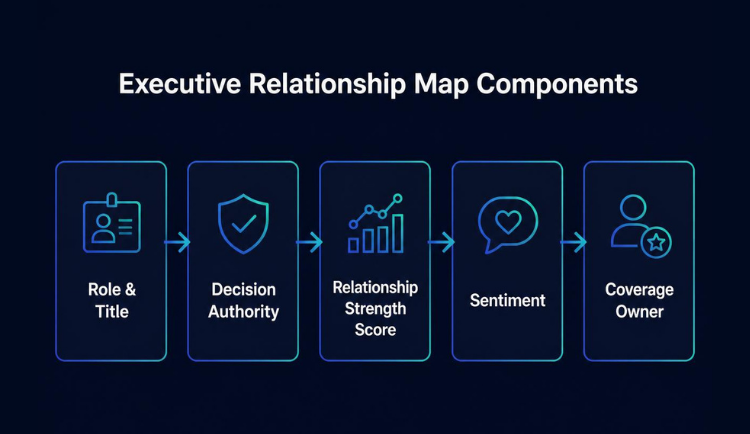
A usable executive relationship map includes role and title, decision making authority, relationship strength scored on a consistent scale, sentiment toward your solution, and the influence connections between individuals. The best maps also overlay your coverage, meaning which person on your team owns each relationship, so gaps become obvious. A CFO with no relationship owner on your side is a risk you can see and act on. If you need a starting structure for capturing these fields, a stakeholder mapping template gives you the columns to fill in before you overlay influence and sentiment.
Why Relationship Mapping Drives Revenue
The business case is direct. Deals with mapped executive sponsors close at higher rates and renew more reliably. When CEB studied complex B2B buying, it found that deals supported by a credible internal champion who could mobilize the buying group were dramatically more likely to reach a decision rather than ending in no decision, which remains the most common outcome in enterprise sales.
Relationship mapping also protects revenue you already have. Single threaded accounts, where your entire relationship rests on one or two people, are renewal time bombs. When that champion changes jobs, and roughly one in five enterprise contacts changes roles every year, your access evaporates overnight. A map that shows you are single threaded gives you months to multithread before the relationship walks out the door.
From reactive to proactive
Teams without maps react to events. A champion leaves and they scramble. A competitor gets introduced and they find out during the loss review. Teams with living maps anticipate. They see thin coverage in the CFO suite and they assign an executive sponsor, often through a formal executive sponsor program, to build it before the renewal conversation. This shift from reactive to proactive is where mapping pays for itself.
The Difference Between Org Charts and Influence Maps
Every account has two structures. The formal org chart shows reporting lines, titles, and the official chain of command. The influence map shows who actually shapes decisions, which often looks nothing like the org chart. A director three levels down may carry more weight on a technology purchase than the SVP who signs the paperwork, because that director is the trusted technical authority everyone defers to.
Selling to the org chart alone is a classic mistake. You spend months cultivating the senior title only to discover the real decision was made by a committee of practitioners who never appeared on your radar. Influence maps capture the dotted lines, the historical loyalties, and the informal coalitions that determine outcomes.
How to surface hidden influence
You find informal influence by asking better questions during every interaction. Who else needs to weigh in on this? Whose opinion does your boss trust most on decisions like this? Who championed the last successful project here? The answers reveal the influence map that no LinkedIn search will ever show you. Document these insights immediately, because they fade from memory within days.
Scoring Relationship Strength Consistently
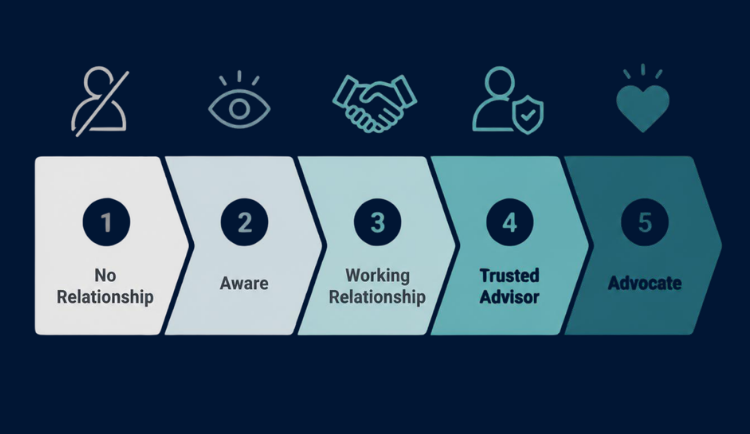
A relationship map is only useful if the strength scores mean the same thing across reps and accounts. Vague labels like good or strong invite optimism bias, and reps routinely overrate relationships they want to believe are solid. A consistent scoring framework forces honesty.
A practical scale runs from no relationship, to aware, to working relationship, to trusted advisor, to advocate. Each level has defined criteria. A working relationship means the person takes your calls and shares information. A trusted advisor means they proactively seek your perspective and defend your interests internally. An advocate actively sells on your behalf when you are not in the room. Tying scores to observable behavior removes the guesswork.
Mapping sentiment alongside strength
Strength and sentiment are different dimensions. A powerful executive might have a strong relationship with you but a negative view of your specific proposal because it threatens their budget. Capturing sentiment as supporter, neutral, or detractor, separately from relationship strength, prevents the dangerous assumption that a strong relationship guarantees a yes.
Identifying Champions, Blockers, and Coaches
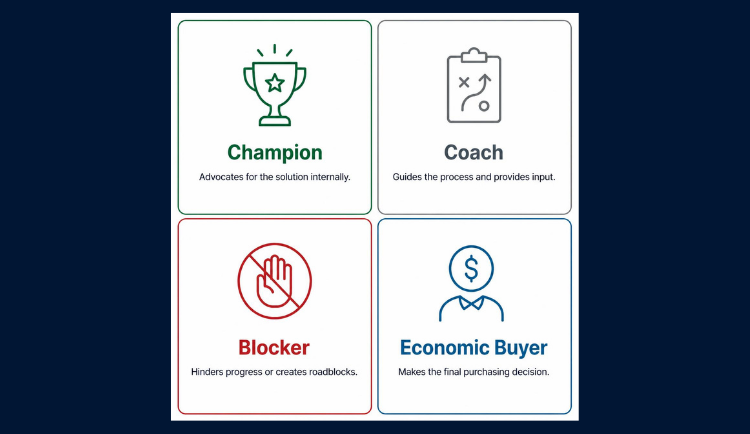
Not every stakeholder plays the same role. A champion has power and actively wants you to win. A coach gives you information and guidance but lacks the authority to drive the decision. A blocker, whether for political, budgetary, or personal reasons, works against you. And the economic buyer holds the budget regardless of how they feel about you.
The most expensive error in enterprise sales is mistaking a coach for a champion. Coaches are valuable, but they cannot mobilize the buying group. They will happily share intelligence while the deal quietly dies because no one with real power was ever advocating for it. Your map must distinguish between the people who tell you things and the people who can make things happen.
Converting coaches into champions
Sometimes a coach can become a champion if you give them a personal win, a reason to attach their reputation to your success. Sometimes they cannot, and you need to find another path to power. Mapping the difference tells you which strategy to pursue rather than assuming your friendly contact will carry the deal.
Where Most Teams Get Relationship Mapping Wrong
The first failure is treating mapping as a one time exercise. A map built at the start of a deal is obsolete within a quarter because people change roles, reorganizations happen, and new stakeholders emerge. Maps must be living documents updated continuously, not artifacts created for a single QBR slide.
The second failure is keeping maps in disconnected tools. A relationship map in a slide deck or a standalone whiteboard tool that lives outside your CRM is invisible to managers, lost during territory changes, and never updated. The map needs to live where the work happens, inside Salesforce, tied to the account and opportunity records that drive your pipeline.
The single threading trap
The third and most common failure is single threading. Reps build one strong relationship and stop, because that relationship feels safe and productive. The map exposes this complacency by visually showing that your entire account rests on one person. Smart teams set coverage standards, such as requiring active relationships with at least three members of the buying committee for any deal above a revenue threshold.
Building Maps Inside Salesforce
The strongest relationship maps live natively in your CRM rather than in separate applications. When the map is Salesforce native, it inherits your contact data, stays current as records change, and becomes visible to every manager and executive sponsor without exporting anything. The relationship between people, accounts, and opportunities stays connected.
This is the architectural difference that separates serious account planning platforms from drawing tools. A Salesforce native solution like Prolifiq CRUSH builds the relationship map on top of your existing Contact and Account objects, so updating a contact updates the map automatically. There is no parallel database to maintain and no synchronization to break.
Why native beats bolt on
Bolt on tools that sync to Salesforce introduce lag, data conflicts, and adoption friction. Reps will not maintain a map in a separate login. Native tools embed the map in the workflow reps already use every day, which is the only way mapping survives past the initial enthusiasm. Adoption is the whole game, because a beautiful map that no one updates is worse than no map at all.
Relationship Mapping Tools Compared
The account planning and relationship mapping market includes several established vendors. Altify, now part of Upland, offers relationship maps within a broader opportunity and account management suite and tends to appeal to large enterprises with heavy methodology requirements. DemandFarm focuses specifically on account based selling with strong org charting and white space visualization. ARPEDIO is a Salesforce native option emphasizing relationship and stakeholder mapping. Revegy provides visual account planning with relationship and influence mapping. Kapta targets customer success and account management with relationship tracking.
Prolifiq CRUSH differentiates as a fully Salesforce native account planning platform where relationship mapping is integral rather than a separate module, with particular strength in regulated verticals like life sciences and financial services where data residency and CRM integration matter.
What to evaluate
When comparing tools, weigh native architecture against bolt on, total cost including implementation and training, time to value, and adoption rates among reps. A platform that costs less but never gets adopted delivers zero return. Pricing across this category typically ranges from roughly 30 to 150 dollars per user per month depending on functionality and scale, with enterprise agreements negotiated on volume.
Operationalizing Maps in Your Sales Process
A map only creates value when it changes behavior. Tie relationship mapping to your deal review cadence. Every account review should ask whether coverage exists across the buying committee, where the gaps are, and what the plan is to close them. Make single threaded deals a flagged risk that requires a mitigation plan.
Assign executive sponsors deliberately based on map gaps. If a strategic account has no relationship at the CFO level, pairing your own CFO or VP with that account creates a peer to peer connection that an account executive cannot replicate. The map tells you exactly where executive air cover is needed.
Making it a habit
Embed map updates into existing rituals rather than creating new meetings. After every executive interaction, the rep updates relationship strength and sentiment in two minutes. Managers review maps during one on ones. The map becomes part of how the team thinks about accounts, not a compliance task done once a year before a renewal.
Measuring the Impact of Relationship Mapping
Track metrics that connect mapping to revenue. Measure the average number of mapped relationships per closed won versus closed lost deal. Track multithreading depth across your strategic accounts over time. Monitor renewal rates for accounts that are single threaded versus multithreaded. Watch how often champion departures lead to lost revenue, which good mapping should reduce.
Teams that adopt disciplined relationship mapping commonly report higher win rates in competitive deals, fewer no decision losses, and stronger net revenue retention. The mechanism is simple. More relationships with the right people means more access, more intelligence, and more resilience when individuals leave.
FAQ
How is executive relationship mapping different from a stakeholder list?
A stakeholder list names people and titles. A relationship map adds the connections between them, the strength of your relationships, sentiment toward your solution, and the influence dynamics that determine decisions. The relationships are the entire point and a flat list lacks them.
How often should relationship maps be updated?
Continuously. Update strength and sentiment after every significant executive interaction, and review the full map during deal reviews and quarterly account planning. Because roughly one in five enterprise contacts changes roles each year, a map left untouched for six months is largely obsolete.
What is single threading and why is it dangerous?
Single threading means your entire relationship with an account depends on one or two contacts. It is dangerous because if those people change jobs or turn against you, your access disappears with no backup. Multithreading across the buying committee protects deals and renewals.
Do I need a dedicated tool or can I use spreadsheets?
Spreadsheets and slides work for a single deal but fail at scale. They live outside your CRM, go stale, get lost during territory changes, and stay invisible to managers. A Salesforce native tool keeps maps current, connected to live data, and visible across the team, which is what drives sustained adoption.
What is the difference between a champion and a coach?
A coach provides information and guidance but lacks the authority to drive a decision. A champion has power and actively works to make your deal happen, including selling internally when you are not present. Mistaking a coach for a champion is a frequent and costly error.
How do I score relationship strength objectively?
Use a defined scale tied to observable behavior, such as aware, working relationship, trusted advisor, and advocate, with clear criteria for each level. Tying scores to behavior rather than gut feel removes the optimism bias that leads reps to overrate relationships.
Map Your Path to Power with Prolifiq CRUSH
Executive relationship mapping only delivers results when it lives where your team works and stays current without manual effort. Prolifiq CRUSH is a fully Salesforce native account planning platform that builds relationship and influence maps on top of your existing Salesforce data, so they stay accurate, visible, and actionable across every deal review and renewal. Identify champions, expose single threading, and assign executive coverage where it matters most, all without leaving your CRM. See how teams in life sciences, financial services, manufacturing, and technology use relationship mapping to win and keep more enterprise revenue. Learn more about Prolifiq CRUSH and start mapping your path to power.