Healthcare is one of the hardest places to run key account management. The buying committee for a single integrated delivery network (IDN) can include surgeons, pharmacy directors, supply chain leaders, a value analysis committee, IT, compliance, and a procurement team that answers to a parent system three layers up. A surgeon cares about clinical outcomes. The CFO cares about cost per case. The supply chain VP cares about contract compliance. Treat them as one buyer and you lose.
Yet most medtech, diagnostics, and life sciences teams still run their biggest health system accounts out of spreadsheets, slide decks, and the memory of a few tenured reps. When those reps leave, the account intelligence leaves with them. This guide covers what healthcare key account management requires, why provider accounts are so complex, and how to run it inside Salesforce so account plans stay current.
What Is Healthcare Key Account Management?
Healthcare key account management is the practice of growing and protecting your most valuable provider accounts, such as health systems, IDNs, academic medical centers, and large pharmacy chains, as multi-year relationships rather than one-time deals. The goal is to expand revenue across facilities and departments while defending the account from competitors.
It differs from transactional selling in three ways:
- The unit of focus is the account, not the deal. One IDN might buy capital equipment, consumables, service contracts, and software at the same time.
- The time horizon is years. Work runs on annual planning cycles and quarterly business reviews.
- Success is measured in share of wallet and relationship strength, not just bookings.
Healthcare adds a layer most verticals do not have: clinical evidence and regulation shape every conversation. A strong key account manager in healthcare or medical devices works almost like a consultant who carries a quota, proving clinical value, navigating committees, and aligning to standardization initiatives. The fundamentals are the same as any key account management program. The buying environment is not.
Healthcare KAM for Pharma vs. Medtech Teams
Healthcare key account management looks different depending on what you sell. Pharma and biotech KAMs work through payers, formularies, and market access teams, while keeping commercial and medical affairs conversations separate for compliance. Medtech, diagnostics, and health IT KAMs sell directly into health systems, where GPOs, value analysis committees, and capital budgets decide what gets bought. Both need the same core discipline: a mapped buying committee, a living account plan, and relationships across many stakeholders. This guide focuses on the health system side. For the payer and market access side, see our guide to pharma key account management.
Why Health System Accounts Are So Complex
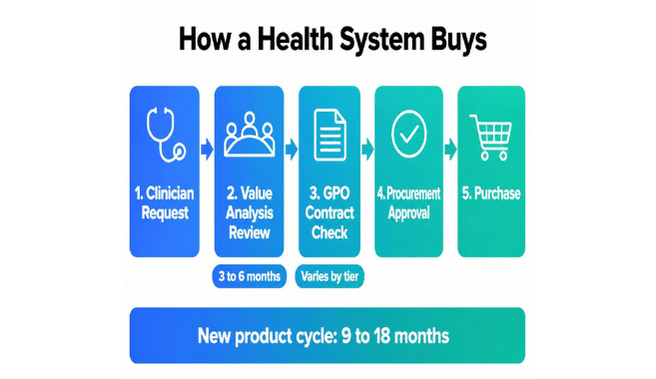
The complexity starts with the buying structure. A system that has consolidated 12 hospitals under one parent will centralize purchasing but leave clinical decisions at the facility level. You have to win clinicians locally and procurement corporately, and those two groups are often in tension.
Group Purchasing Organizations
GPOs like Vizient, Premier, and HealthTrust negotiate contracts on behalf of thousands of member facilities. According to the Healthcare Supply Chain Association, GPOs save providers an average of 10% to 18% on products and services, which is why health systems lean on them so heavily. If your product is on contract, you have pricing leverage and access. If it is not, you may be locked out no matter how much a clinician wants it. Map each account's GPO affiliation and whether it is on a committed or non-committed tier.
Value Analysis Committees
Most health systems send new product requests through a value analysis committee (VAC) that weighs clinical evidence, cost, and operational impact. VAC review can add 3 to 6 months to a sales cycle. Key account managers who know the committee calendar, the submission requirements, and which internal champion needs to sponsor the request close faster than those who do not.
Long Sales Cycles
Put GPO contracting and VAC review together and new product cycles commonly run 9 to 18 months. Expansion inside an account where you already have clinical advocates moves faster. That gap is why protecting and growing existing accounts is worth more than chasing new logos.
How to Map the Healthcare Buying Committee
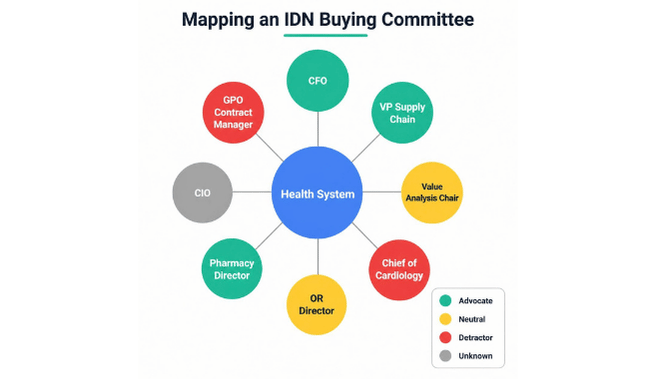
The highest-leverage activity in healthcare key account management is relationship mapping. In a large IDN you may need to map 15 to 30 named stakeholders across clinical, financial, operational, and IT functions.
Give each stakeholder a role and a sentiment. Roles include economic buyer, technical buyer, clinical champion, user, and blocker. Sentiment runs from advocate to detractor. Once it is visual, the gaps are obvious. Strong clinical advocacy with no relationship to the CFO who controls capital budgets tells you exactly where to spend next quarter. Our guide to the B2B buying committee goes deeper on role mapping.
Mapping also de-risks the account. Executive turnover in health systems is high and physician champions move between systems. If the whole relationship rests on two people, one departure can put millions at risk. Multithreading across at least four to six stakeholders per major account is the baseline for durability.
How to Build a Healthcare Key Account Plan
A real account plan is not a slide built once a year for a QBR. It is a working document with the account profile, relationship map, whitespace, competitive landscape, and specific actions with owners and dates. If you are starting from scratch, our key account management plan template lays out every section.
Account Profile and Segmentation
Start with the facts: bed count, facility count, ownership structure, GPO affiliations, current contracts and expiration dates, EHR system, and annual procedure volumes where relevant. This tells you the size of the prize and the structural constraints.
Whitespace Analysis
Whitespace is the gap between what an account buys and what it could buy. You might sell to three of eight hospitals, or hold the imaging contract but not the consumables. Mapping product penetration by facility and department shows expansion paths that are far easier to win than net new logos. Our white space analysis guide shows how to build the matrix.
Action Planning
Every plan needs specific actions tied to objectives. Not "deepen the relationship with cardiology" but "secure a clinical evaluation at the Memorial campus by end of Q2, sponsored by Dr. Chen, targeting the March value analysis committee." Specificity makes a plan executable and reviewable.
QBRs and Annual Planning
Quarterly business reviews are where healthcare KAM gets sharper or turns into theater. A good QBR checks progress against the plan, surfaces stalled VAC submissions, and reassigns effort. It works best when the relationship map, whitespace, and actions already live in Salesforce, so the meeting runs on real data instead of a deck built the night before. Annual planning then decides which accounts get a dedicated key account manager and where clinical support goes, aligned to fiscal years that often do not follow the calendar at academic and government systems.
Healthcare KAM Metrics and Common Mistakes
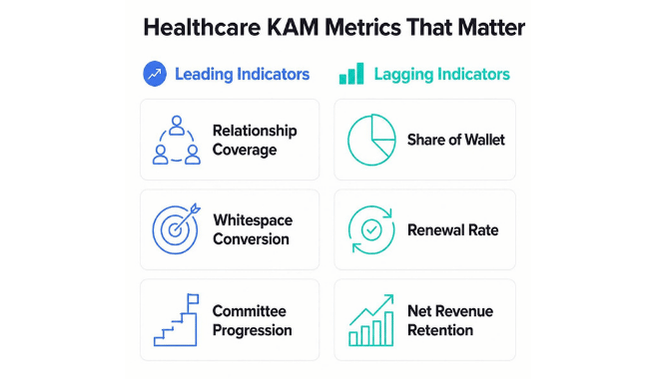
Bookings alone do not tell you whether key account management is working. Track leading and lagging indicators together. The full list lives in our key account management KPIs guide; these are the ones that matter most in healthcare.
Leading Indicators
- Relationship coverage: mapped and engaged key roles per account. Six or more multithreaded relationships is a reasonable target for a large IDN.
- Whitespace conversion: how much of the identified expansion opportunity you capture over a year.
- Committee progression: how many VAC submissions move from request to approval, and how long each stage takes.
Lagging Indicators
Share of wallet, contract renewal rate, and net revenue retention by account. A standardized contract that renews and expands signals real relationship strength. A flat or declining account often points to single threading or a competitor quietly building clinical advocacy underneath you.
Three Mistakes That Lose Healthcare Accounts
- Single threading. One great champion feels safe until they retire or change systems.
- Confusing activity with progress. Dozens of logged meetings mean nothing without a plan tied to whitespace and committee milestones.
- Keeping intelligence outside the CRM. A plan in a personal deck cannot be coached, scaled, or recovered when the rep leaves. When one rep can own $40 million in account value, that is an unacceptable risk.
Choosing Key Account Management Software for Healthcare
The biggest decision is architecture: does the tool run natively inside Salesforce, or in a separate app that syncs data back and forth? Native key account management software keeps account plans, relationship maps, and whitespace on the same record reps already use. Bolt-on tools make reps leave the CRM, and adoption drops. In healthcare, where reps are stretched across long cycles and complex committees, a plan no one updates is worthless.
The market includes Altify, DemandFarm, ARPEDIO, Revegy, Kapta, and Prolifiq. Altify brings strong methodology with a heavier implementation. DemandFarm has historically operated as a layer on top of Salesforce. Revegy and Kapta offer solid relationship mapping, with Kapta leaning standalone. ARPEDIO is Salesforce native. Prolifiq is fully native, fast to deploy, and built for regulated verticals like life sciences and medtech. Teams on Health Cloud should also read our breakdown of Salesforce Health Cloud for KAM.
For a healthcare team standardized on Salesforce, native architecture should be a requirement, not a preference. Every hour spent reconciling data between systems is an hour not spent with a clinical champion. It is also what makes KAM repeatable: a standard plan template, a set update cadence, and managers coaching from the same record turn one great rep's instincts into an organizational capability.
Frequently Asked Questions
What does a key account manager do in healthcare?
A healthcare key account manager owns the long-term relationship with a strategic provider account, such as a health system or IDN. They map the buying committee, manage GPO and contract positioning, guide products through value analysis committees, find whitespace across facilities, and coordinate clinical, sales, and service teams around one account plan.
What is the difference between key account management and sales in healthcare?
Sales closes individual opportunities. Key account management grows and protects a strategic account over years, across departments, contracts, and stakeholders. In healthcare it also means handling value analysis committees, GPO contracts, and clinical evidence requirements that a deal-by-deal approach ignores.
How long are healthcare key account sales cycles?
New products entering a health system commonly take 9 to 18 months because of VAC review, clinical evaluations, and GPO contracting. Expansion within an existing account where you have clinical advocates is often 3 to 6 months.
How many stakeholders should I map per healthcare account?
For a large IDN, map 15 to 30 stakeholders across clinical, financial, operational, and IT functions, and keep active relationships with at least six of them.
How do GPOs affect key account management?
GPOs negotiate contracts for member facilities, which can decide whether your product is even eligible for purchase. A strong clinical champion cannot override a missing GPO contract, so map every account's GPO affiliation and contract tier.
Do I need Salesforce native account planning software?
If your team runs on Salesforce, native is strongly preferred. It removes context switching and drives adoption. Bolt-on tools that sync between separate apps see lower update rates, so plans go stale.
Bring your healthcare account plans into Salesforce. Healthcare key account management fails when account intelligence lives in spreadsheets no one updates. It works when relationship maps, whitespace, and action plans live inside the system your team already uses. Prolifiq CRUSH puts buying committee maps, whitespace, and account actions directly on the Salesforce record, built for life sciences and medtech teams, so plans stay current and account knowledge never walks out the door. For related guides, see pharma key account management and what a key account manager does.