Most sales metrics measure activity and closed revenue. Key account management KPIs have to measure something harder: whether your most important customer relationships are getting stronger or quietly eroding. A new logo either signs or it does not. A strategic account can renew on paper while the relationship rots underneath, and by the time the churn shows up in your pipeline, it is too late to fix.
In this guide we break down the 12 key account management KPIs that matter, how to benchmark them, how to build them into an account management scorecard, and which metrics are vanity numbers that look good in a QBR but predict nothing. If you are new to the discipline, start with our guide to key account management, then come back here to measure it.
What Are Key Account Management KPIs?
Key account management KPIs are the metrics that show whether your strategic accounts are healthy, growing, and likely to renew. Unlike general account management KPIs, which often track activity across a large book of business, key account management metrics focus on a small number of high value customers and measure four things: revenue, relationships, engagement, and customer outcomes.
Most B2B revenue teams track only the lagging indicators, like annual recurring revenue and renewal rates, then act surprised when a multi million dollar account leaves after three quarters of declining engagement that nobody flagged. The data was there. The KPIs were not built to surface it.
Good KPIs for account managers do three things:
- They quantify the current health of the relationship.
- They predict where revenue is heading 6 to 12 months out.
- They give each key account manager a concrete list of what to improve this quarter.
These are different from the metrics you use to judge the account plan itself. If you want to measure plan quality and adoption, see our breakdown of account planning KPIs. This guide covers the account.
The Four Categories of Key Account KPIs
Before listing individual metrics, organize them into four categories. Mixing them up is why so many account scorecards feel cluttered and useless.
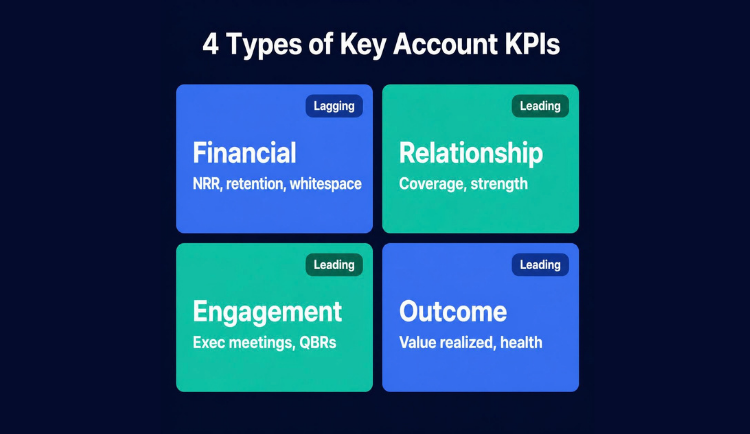
Financial KPIs
These measure the money: revenue, growth, retention, and expansion. They are lagging indicators, meaning they tell you what already happened. They matter most to leadership and finance.
Relationship KPIs
These measure the strength of the human connections inside the account: how many decision makers you know, how senior they are, and how many of them would advocate for you. They are leading indicators that predict the financial KPIs.
Engagement KPIs
These measure activity quality and cadence: executive sponsor meetings, quarterly business reviews completed, and joint planning sessions. They are the most operational and the easiest to influence this week.
Outcome KPIs
These measure whether the customer is actually succeeding with your product: adoption, value realized against the business case, and goal attainment. A customer hitting their outcomes renews almost automatically.
A complete key account management program tracks at least two metrics from each category. Tracking only financial KPIs is the most common mistake, and it leaves you blind until the damage is already done.
Financial and Expansion KPIs
1. Net revenue retention (NRR)
Net revenue retention measures how much recurring revenue you keep and grow from an existing account over a period, including expansion, contraction, and churn. The formula is starting ARR plus expansion minus contraction minus churn, divided by starting ARR. An account that renews flat shows 100% NRR. An account that expands 30% shows 130%.
Measure NRR per account, not just in aggregate. Aggregate NRR can look healthy at 115% while hiding the fact that three of your top ten accounts are contracting. Set a floor: any strategic account below 100% NRR gets a recovery plan and executive attention immediately. For the full calculation and worked examples, see our guide to net revenue retention.
2. Gross revenue retention (GRR)
Gross retention measures only the revenue you kept, capped at 100%, with expansion stripped out. It isolates pure churn and contraction, so it tells you whether growth in a few accounts is masking losses in others. Track NRR and GRR together, and read our comparison of churn rate vs retention rate if your team uses the terms interchangeably.
3. Whitespace penetration
Whitespace measures the gap between what an account currently buys and what it could buy. Quantify it as products or business units penetrated divided by total addressable products or business units within that account. If a global manufacturer uses your platform in two of its eight divisions, your penetration is 25% and your expansion runway is enormous. Our guide to white space analysis walks through how to build the matrix.
4. Expansion velocity
Expansion velocity is how long it takes to convert an identified whitespace opportunity into closed expansion revenue. Track it alongside the number of named expansion opportunities per account. Slow velocity usually points to weak champions or missing executive sponsorship, which loops straight back to your relationship KPIs.
The trap with all four financial KPIs is that they lag. By the time an account drops below 100% NRR, the relationship problems that caused it started months earlier. That is why they must be paired with the leading indicators below.
Relationship and Engagement KPIs
5. Stakeholder coverage
Stakeholder coverage measures how many of the relevant decision makers and influencers inside an account you have an active relationship with, divided by the total number that exist. If a buying committee has 12 people who touch renewal and expansion decisions and you know 4 of them, your coverage is 33%. That is dangerously thin.
The most common cause of surprise churn is single threading: relying on one or two champions. People move constantly. Median tenure with a current employer is just 4.1 years, according to the U.S. Bureau of Labor Statistics, and when your champion leaves, the account can go dark overnight. Strategic accounts should have relationships across at least three functions and two levels of seniority. A structured stakeholder mapping exercise is the fastest way to find the gaps.
6. Relationship strength score
Coverage alone is not enough. Score each relationship on a simple scale: unknown, identified, engaged, supporter, advocate. A relationship map that shows 12 contacts who are merely identified is weaker than a map with 6 contacts who are active supporters. Track the percentage of mapped stakeholders rated supporter or advocate, aim for at least 40% on strategic accounts, and make sure at least one advocate sits at the executive level.
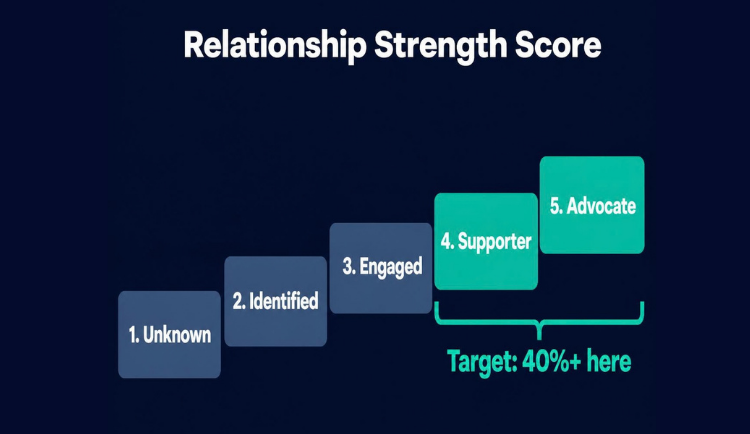
Seeing coverage and relationship strength side by side is much easier when the map lives in your CRM instead of a slide.
7. Executive sponsor cadence
A healthy strategic account should have a documented executive touchpoint at least once per quarter. Track the percentage of your portfolio that met that bar last quarter. Accounts without a named, active executive sponsor on both sides are the ones that stall at expansion time.
8. QBR completion rate
Track the percentage of strategic accounts that completed their scheduled quarterly business review on time. If that number is below 80%, your team is firefighting instead of managing relationships. Our guide to QBRs for sales covers how to run reviews that customers actually want to attend.
9. Proactive to reactive ratio
Compare conversations about future goals with responses to problems and support escalations. If most of your interactions with an account are reactive, the relationship is in maintenance mode at best and crisis mode at worst. Strong accounts have more conversations about next year than about this week's fires.
Outcome KPIs and the Customer Health Score
Outcome KPIs measure whether the customer is getting the result they bought your product to achieve. This is the most overlooked category and often the most predictive of renewal.
10. Business case coverage
Every strategic account should have a documented business case with measurable outcomes, for example "reduce procurement cycle time by 20%" or "cut compliance reporting effort in half." Track the percentage of strategic accounts that have one. In most organizations this number is shockingly low, which means most account teams cannot prove value at renewal time and end up defending price instead. A key account plan template with a business case section fixes this at the source.
11. Value realization
Value realization tracks progress against those documented outcomes. An account hitting its outcomes renews and expands almost regardless of relationship friction. An account missing its outcomes churns even if everyone likes each other.
12. Customer health score
A customer health score rolls multiple KPIs into one composite number that flags risk before the financial metrics react. Typical inputs are product adoption trend, stakeholder coverage, engagement recency, support sentiment, NRR trajectory, and value realization. Weight them by what actually predicts churn in your business; usage decline and champion departure are usually the strongest signals.
The discipline matters more than the formula. Define green, yellow, and red thresholds and review every strategic account against them weekly. A health score nobody acts on is just decoration. For weighting models and examples, see our guide to building a customer health score.
Building a Key Account Management Scorecard
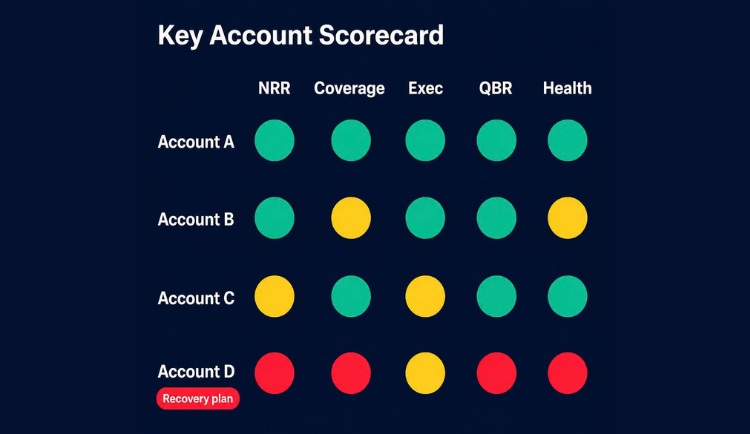
A scorecard turns 12 KPIs into one view each account manager and executive sponsor can act on. Build it as a key account management dashboard with one row per strategic account and one column per KPI, color coded against the targets below.
Benchmarks for key account management KPIs
These targets reflect strong enterprise B2B programs, though exact numbers vary by industry and contract size. For context, SaaS Capital's retention benchmarks put median net retention for private B2B SaaS companies only slightly above 100%, with higher NRR at larger contract sizes, so strategic accounts should clear the median by a wide margin.
Every red account needs an active recovery plan with a named owner and a date.
Vanity metrics to avoid
Some commonly tracked numbers look impressive and predict nothing. Emails sent and calls logged measure activity, not relationship quality. Total contacts in the CRM means little if most are inactive or junior. Aggregate portfolio revenue hides per account decline. Meeting count without meeting quality rewards people for booking calls that accomplish nothing.
Replace volume metrics with quality metrics. Instead of meetings booked, track executive meetings that advanced a documented account plan. Instead of contacts in the CRM, track active supporters and advocates. The shift from counting to weighting is what separates a real KAM program from a CRM hygiene exercise.
Tracking key account KPIs in Salesforce
KPIs that live in a spreadsheet die in a spreadsheet. The metrics that change behavior are the ones surfaced where account managers already work, which for most B2B teams is Salesforce.
Salesforce has improved here. Its native Account Plans feature, released in Winter '25, adds objectives, SWOT, and basic relationship maps to the account record. What it still does not do is score relationship strength, calculate stakeholder coverage, or build a whitespace matrix, which are three of the leading indicators above. We cover the gap in detail in our guide to Salesforce account planning.
That is where Salesforce native key account management software earns its keep. Tools like Prolifiq CRUSH, along with alternatives such as Altify, DemandFarm, ARPEDIO, and Revegy, build relationship maps, whitespace grids, and account plans directly on Salesforce data, so coverage, penetration, and health scores update automatically and roll into the dashboards leadership already uses.
Frequently Asked Questions
What are the most important key account management KPIs?
The most important are net revenue retention, stakeholder coverage, customer health score, value realization, and whitespace penetration. Together they cover financial results, relationship strength, leading risk signals, proven value, and expansion potential. No single metric is sufficient on its own.
What is the difference between account management KPIs and key account management KPIs?
Account management KPIs usually track activity and revenue across a large book of customers. Key account management KPIs go deeper on a handful of strategic accounts, adding relationship metrics like stakeholder coverage and outcome metrics like value realization that would be too costly to track for every customer.
How do you measure account manager performance?
Measure account manager performance on outcomes they can influence: NRR and gross retention for their book, stakeholder coverage and relationship strength on each strategic account, QBR completion rate, and the share of accounts in green on the health score. Avoid scoring them on raw activity counts.
How often should I review key account KPIs?
Review relationship and engagement KPIs weekly so you can act before problems compound. Review health scores and whitespace monthly. Financial KPIs like NRR and the formal business review run quarterly. The more a metric lags, the less often it needs review, but leading indicators need constant attention.
What is a good stakeholder coverage percentage?
Aim for at least 60% of the relevant buying committee mapped and engaged, with 40% or more rated as supporters or advocates. You also need relationships across multiple functions and seniority levels so the account does not collapse when one champion leaves.
Turn your key account KPIs into action
Knowing which KPIs matter is only half the job. The teams that retain and grow their strategic accounts are the ones who make these metrics live where the work happens: inside Salesforce, updated automatically, and visible to every account manager and executive sponsor. If you are building the program from scratch, pair this scorecard with a clear key account management strategy.
Prolifiq CRUSH is built natively on Salesforce to do exactly that. It turns relationship maps, whitespace grids, account plans, and health scores from static slides into living data, so your stakeholder coverage, expansion runway, and risk signals stay current without spreadsheets. If you are ready to stop measuring key accounts after they slip and start managing them before they do, see how Prolifiq CRUSH brings key account management KPIs into Salesforce.
Sources: DemandFarm, Kapta, Brooks Group, ExecViva, BLS Employee Tenure, SaaS Capital