Most B2B companies say they practice key account management. Very few actually do. What usually happens is that sales reps assign the label "key account" to whichever customers spend the most money today, then keep selling to them the same way they sell to everyone else. That is not a strategy. It is a spreadsheet with a fancy column header.
Real key account management is a deliberate operating model. It means picking a small set of accounts where deep investment will produce outsized return, then organizing people, plans, and metrics around growing those relationships over years rather than quarters. The math is compelling. Research from Bain and Gartner consistently shows that retaining and expanding existing strategic accounts costs a fraction of new logo acquisition, and that the top 10 to 20 percent of accounts often generate 60 to 80 percent of profit in mature B2B businesses.
The problem is execution. Account plans live in slide decks nobody updates. Relationship maps exist in one rep's head. Whitespace goes unsold because no one can see it. When that rep leaves, the institutional knowledge walks out the door with them. This article lays out a complete key account management strategy you can actually run: how to select accounts, build plans that stay current, map stakeholders, find expansion revenue, measure what matters, and choose tooling that lives where your team already works. Whether you are formalizing key account management for the first time or rebuilding a program that stalled, the goal is the same. Turn your most important relationships into a repeatable growth engine instead of a set of hopeful guesses.
What Is Key Account Management?
Key account management is a structured approach to growing your most valuable customer relationships through coordinated, long term investment. It treats a small set of accounts as a portfolio to be developed, not a list of deals to be closed. The distinction matters because the behaviors are different.
Transactional selling optimizes for the next deal. Key account management optimizes for lifetime value, share of wallet, and strategic partnership. A KAM strategy asks different questions: What does this customer's three year roadmap look like? Which divisions have we never touched? Who are the decision makers we have no relationship with? Where does our solution map to their stated business priorities?
KAM versus account based marketing
People conflate KAM with account based marketing, but they operate on different timescales and owners. ABM is a demand generation discipline focused on landing or expanding accounts through coordinated marketing and sales motions. KAM is a revenue management discipline focused on the post sale relationship and multiyear growth. The best programs connect the two, with marketing feeding the named account list and KAM owning the long term plan.
Why Most KAM Programs Fail
The graveyard of failed KAM programs is large, and the causes are predictable. The first is treating size as strategy. Companies designate their biggest current spenders as key accounts and call it done, ignoring growth potential, fit, and switching dynamics. A large account with no expansion runway and high churn risk is not a key account. It is a liability you are over investing in.
The second failure is the static plan. A team builds a beautiful 40 slide account plan during an offsite, presents it to leadership, and never opens it again. Three months later the org chart has changed, two champions have left, and the plan is fiction.
The third is the lone wolf problem. Knowledge about the account lives entirely with one senior rep. There is no shared system of record, so when that person is out, on vacation, or gone, the account goes dark. The fourth is missing metrics. Without leading indicators tied to account health, leaders cannot tell which accounts are growing, stalling, or at risk until renewal arrives and it is too late.
Selecting and Tiering the Right Key Accounts
Account selection is the single highest leverage decision in your KAM strategy. Pick wrong and even flawless execution wastes resources. Most companies should designate no more than 10 to 30 key accounts per dedicated manager, because the model depends on depth, not coverage.
A scoring framework
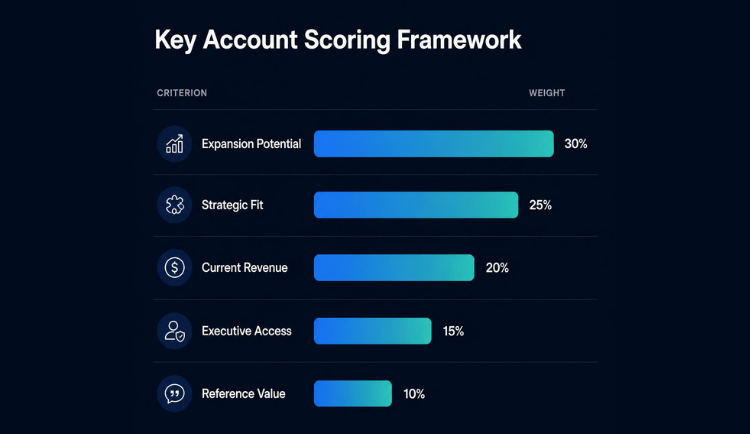
Build a weighted scorecard rather than relying on gut feel. Useful criteria include current revenue, three year expansion potential, strategic fit with your roadmap, executive access, competitive position, and reference value. Score each candidate account from 1 to 5 on every dimension, weight the dimensions according to your business model, and rank the results.
A practical weighting might be expansion potential at 30 percent, strategic fit at 25 percent, current revenue at 20 percent, executive access at 15 percent, and reference value at 10 percent. The exact numbers matter less than the discipline of forcing a transparent, defensible decision instead of a popularity contest.
Tiering your accounts
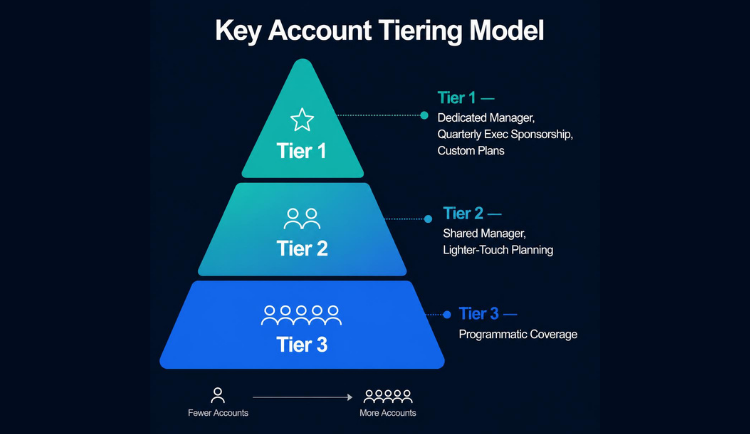
Not every key account deserves equal investment. Tier them. Tier 1 accounts get a dedicated manager, quarterly executive sponsorship, and custom plans. Tier 2 accounts get a shared manager and lighter touch planning. Tier 3 accounts get programmatic coverage. This lets you match cost of service to potential return rather than spreading senior talent uniformly.
Building the Account Plan, Relationship Map, and Whitespace Analysis
The account plan that stays alive
An account plan is only valuable if it reflects reality. The single biggest improvement most teams can make is moving the plan out of slides and into the CRM where it updates as the relationship moves. A living plan has a few essential components.
Start with a situation summary: the customer's business priorities, financial pressures, and strategic initiatives in their own words, pulled from earnings calls, annual reports, and direct conversations. Add a relationship map showing every stakeholder, their role, their disposition toward you, and the gaps. Document the whitespace, meaning every product or division where you could expand. Define specific growth objectives with revenue targets and dates. Finally, list the action plan: who does what by when. Use a ready-to-use account planning template if you want a starting structure instead of building one from scratch.
The discipline that separates working plans from dead ones is cadence. The plan should be reviewed and updated on a fixed rhythm, monthly for Tier 1 accounts, and every update should be tied to actual activity recorded in the CRM rather than a separate document someone has to remember to maintain.
Mapping influence, not just titles
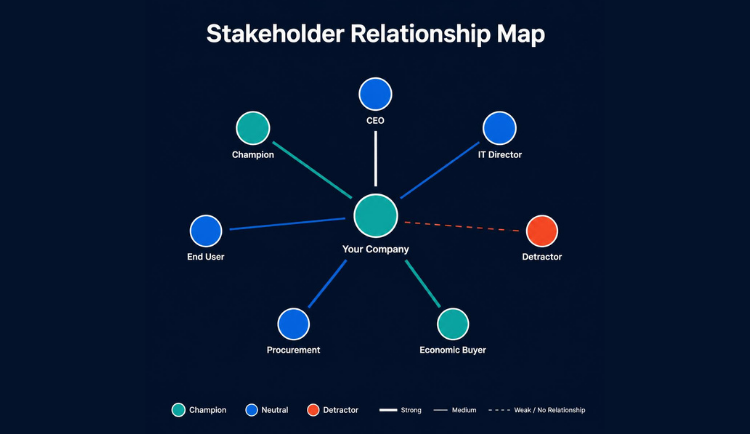
Enterprise deals and expansions are won or lost on relationships, and Gartner research shows B2B buying groups now range from five to sixteen people across as many as four functions. If your relationship map shows two contacts in a company with eleven stakeholders, you have nine blind spots, any one of which can derail a renewal or block expansion.
A good relationship map captures more than names and roles. It records who influences whom, who has budget authority, who are your champions, who are detractors, and where coverage gaps exist. Mark each contact's sentiment and the strength of your relationship. The map should immediately show you where to invest: which detractor needs neutralizing, which champion needs developing, which power player you have never met. Identifying the economic buyer specifically is one of the highest-value entries on this map, since that's the stakeholder who ultimately controls budget approval.
The single threaded account risk
If your entire relationship with a key account runs through one champion, you are one job change away from losing it. Executive and champion turnover happens more often than most account teams plan for. Multithreading, meaning building relationships across multiple stakeholders and levels, is the single most effective protection against this risk. Make multithread coverage an explicit, measured objective in every Tier 1 plan.
Finding and selling whitespace
Whitespace is the gap between what a customer could buy from you and what they currently buy. In existing accounts it is the cheapest revenue you will ever find, because trust, contracts, and procurement paths already exist. Yet most teams cannot see their whitespace because nobody has mapped it.
The exercise is straightforward. Build a grid with the customer's business units or geographies on one axis and your product lines on the other. Fill in current adoption. The empty cells are your whitespace. Now prioritize them by deal size, fit, and the presence of an internal champion who can sponsor the expansion.
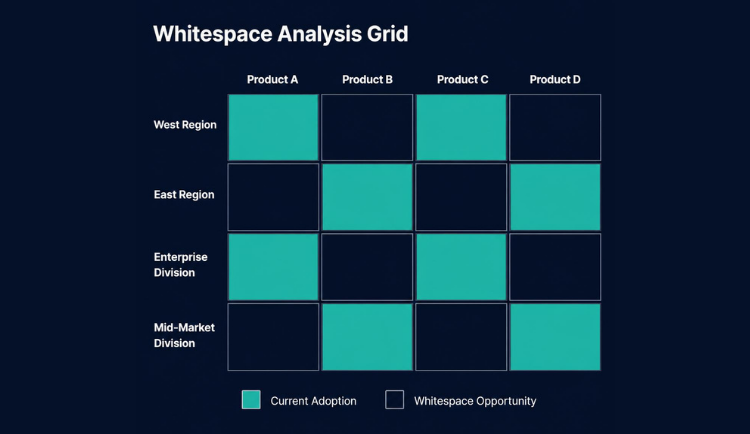
The teams that win at this make whitespace a standing agenda item in account reviews. Every quarter they ask: which empty cells did we move on, what blocked us, and what is the plan for next quarter. Expansion does not happen by accident. It happens because someone owns a specific whitespace target with a date attached.
Governance, Cadence, and Metrics That Predict Account Health
A KAM strategy without governance drifts. You need a defined operating rhythm that holds the program accountable and surfaces problems early. The cadence usually has three layers.
At the account level, the account manager updates the plan and reviews activity monthly. At the program level, KAM leadership reviews the full portfolio quarterly in a QBR, examining account health scores, pipeline, and at risk accounts. At the executive level, sponsors meet with their assigned key accounts on a quarterly or biannual basis to reinforce the relationship and demonstrate commitment.
Executive sponsorship that works
Executive sponsorship is one of the most cited and least executed KAM practices. It works when sponsors have real, recurring touchpoints and a clear role, and it fails when it is a name on a slide. Assign each Tier 1 account an executive sponsor, give them two or three specific objectives per year, and hold them accountable in portfolio reviews.
Metrics that actually predict account health
If you measure only revenue and renewal rate, you are driving while looking in the rearview mirror. A mature KAM strategy tracks leading indicators that predict outcomes months in advance.
Useful leading metrics include relationship coverage, meaning the percentage of key stakeholders with whom you have an active relationship; multithread depth; whitespace conversion rate; plan freshness, meaning how recently the plan was updated with real activity; and executive engagement frequency. Lagging metrics like net revenue retention, share of wallet, and account profitability tell you whether the strategy worked.
The benchmark to aim for is net revenue retention above 110 percent across your key account portfolio. Best in class B2B SaaS companies hit 120 percent or higher in their strategic accounts. If your key accounts are not expanding faster than your overall base, your KAM program is not earning its cost.
Choosing KAM Tooling and Rolling Out Your Program
The vendor landscape
Strategy without a system of record degrades into heroics. The tooling decision usually comes down to one question: where does the account plan live? If it lives in slides or standalone software disconnected from your CRM, it will rot. If it lives inside the CRM alongside the contacts, opportunities, and activity it depends on, it stays current with far less effort.
The account planning category includes Altify, DemandFarm, ARPEDIO, Revegy, and Kapta, alongside Prolifiq. They differ meaningfully in architecture. Some are standalone platforms that sync with Salesforce. Others, including Prolifiq CRUSH, are built natively on Salesforce, meaning the account plan, relationship map, and whitespace analysis live directly inside the records your team already uses every day.
Native architecture matters for adoption. Reps will not maintain a separate tool. They will maintain something that surfaces inside the account record they already open. When evaluating vendors, weight ease of adoption and data freshness as heavily as feature breadth, because the most feature rich tool delivers zero value if your team will not use it.
Rolling out without stalling
Do not boil the ocean. The fastest way to kill a KAM initiative is to mandate a heavy new process across the whole sales organization overnight. Start with a pilot: pick five to ten accounts and two or three of your best managers, run the full motion for a quarter, and capture wins and friction.
Use the pilot results to refine the process and build internal proof. Then expand in waves, tier by tier. Plan for 12 to 16 weeks to get a credible pilot producing measurable signal, and budget for ongoing enablement, because KAM is a behavior change, not a software install. Reinforce the new cadence in existing pipeline reviews rather than creating yet another meeting nobody wants to attend.
FAQs
What is the difference between key account management and regular sales?
Regular sales optimizes for the next transaction. Key account management optimizes for the lifetime value of a small set of strategic relationships through coordinated, multiyear investment in planning, relationship building, and expansion. KAM treats accounts as a portfolio to develop rather than deals to close.
How many key accounts should one manager handle?
For dedicated key account managers, the range is typically 10 to 30 accounts depending on complexity and tier. Tier 1 strategic accounts may justify a manager handling just three to five. The model depends on depth of investment, so resist the temptation to assign large books that force shallow coverage.
How do you select key accounts?
Use a weighted scorecard rather than current revenue alone. Score candidates on expansion potential, strategic fit, current revenue, executive access, and reference value, then rank and tier them. The goal is to invest where deep engagement will produce the highest long term return.
What metrics measure KAM success?
Track leading indicators like relationship coverage, multithread depth, whitespace conversion, and plan freshness, alongside lagging indicators like net revenue retention, share of wallet, and account profitability. Aim for net revenue retention above 110 percent in your key account portfolio.
How long does it take to see results from a KAM program?
A pilot of five to ten accounts can produce credible signal in 12 to 16 weeks. Meaningful portfolio level results, including measurable net revenue retention improvement, typically emerge over two to four quarters as plans mature and expansion motions convert.
Should account plans live in slides or in the CRM?
In the CRM. Slide based plans go stale because they are disconnected from the activity, contacts, and opportunities that drive the account. Plans that live inside the CRM update with real work and survive personnel changes, which is the core reason CRM native tools outperform standalone platforms on adoption.
What is an effective key account sales strategy?
An effective key account sales strategy combines account tiering, a living account plan reviewed monthly, multithreaded stakeholder relationships, and whitespace analysis tracked in every quarterly business review. It treats each key account as a growth program, not a single deal.
Turn Strategy Into a Repeatable Engine
A key account management strategy is only as strong as the system that keeps it alive. The teams that win do not have smarter people. They have account plans, relationship maps, and whitespace analysis that live where their reps already work, update with every interaction, and survive turnover. Prolifiq CRUSH is built natively on Salesforce so your key account plans never become stale slide decks. Relationship mapping, whitespace identification, and account planning live directly inside the records your team uses every day, which is exactly why adoption sticks and accounts grow. See how CRUSH turns your key account strategy into a repeatable revenue engine and browse case studies from teams already running this playbook, or stop letting your most valuable relationships run on guesswork and heroics.