Most sales managers think they coach. The pattern says otherwise. When a manager asks why a deal slipped, pushes for a number, and calls it a coaching session, that is not coaching. It is inspection dressed up as development.
One on one sales coaching is the single highest leverage activity available to a frontline sales manager. Korn Ferry's Sales Enablement Study found that companies with consistent sales coaching see 28% higher quota attainment and 32% higher win rates. A manager with eight reps cannot personally close deals at scale, but they can multiply the effectiveness of all eight people. The leverage is the point.
The problem is that coaching is hard to do well and almost impossible to do consistently when it is not built into a system. This guide gives B2B revenue teams a complete one on one sales coaching program: the cadence, a session template with coaching questions, the tiers, the metrics, and the tools that make it stick inside a Salesforce centric organization. For the wider picture, start with our guide to sales coaching.
What One on One Sales Coaching Actually Means
One on one sales coaching is a recurring, structured conversation between a manager and an individual rep focused on improving that rep's skills, behaviors, and outcomes over time. The key words are individual and over time. It is not a team meeting. It is not a forecast call. It is not a performance review that happens twice a year.
The distinction matters because organizations confuse three different activities. Deal coaching focuses on advancing a specific opportunity. Pipeline review focuses on the health of the whole book. Skill coaching focuses on the rep's repeatable abilities. All three are valuable, but only the third compounds. When you coach a rep through a single deal, you win or lose that deal. When you coach the underlying skill, you improve every future deal.
A quick note on naming. You will also see this practice called one to one sales coaching, 1 on 1 sales coaching, or individual sales coaching. The label changes from company to company, but the practice is the same: a private, recurring session between one manager and one rep. Whatever name your team uses, the sales coaching model behind it matters more than the title, and the GROW framework later in this guide gives you one you can run this week.
The best programs blend deal and skill coaching deliberately. Use the live deal as the raw material, then extract the transferable lesson. A rep struggling to reach an economic buyer is not just a problem on one account. It is a multi threading gap that will show up on every enterprise deal until you fix it.
Why Most One on One Coaching Programs Fail
Coaching programs fail for predictable reasons.
- Inconsistency. Managers schedule sessions, then cancel them whenever a quarter end fire breaks out. Once a rep learns the session is the first thing dropped, they stop preparing for it.
- Coaching the deal, not the rep. Every conversation becomes a status update. The manager leaves knowing more about pipeline, but the rep leaves having learned nothing about how to sell better.
- No documentation. If you cannot see what you committed to last week, you cannot follow up this week. Reps notice when commitments evaporate.
The Telltale Signs Your Coaching Is Broken
Your top reps say one on ones are a waste of time. Sessions run over because they are unstructured. The same skill gaps appear quarter after quarter. New hires take longer than 90 days to reach full productivity. Forecast accuracy does not improve even though you spend hours reviewing deals. Each of these points back to coaching that inspects rather than develops.
Build a One on One Coaching Cadence That Survives a Busy Quarter
Cadence is the foundation. Without a fixed rhythm, coaching becomes optional, and optional things do not happen in sales. A proven model is a weekly 30 to 45 minute one on one with every direct report, plus a monthly deeper development session that steps back from active deals.
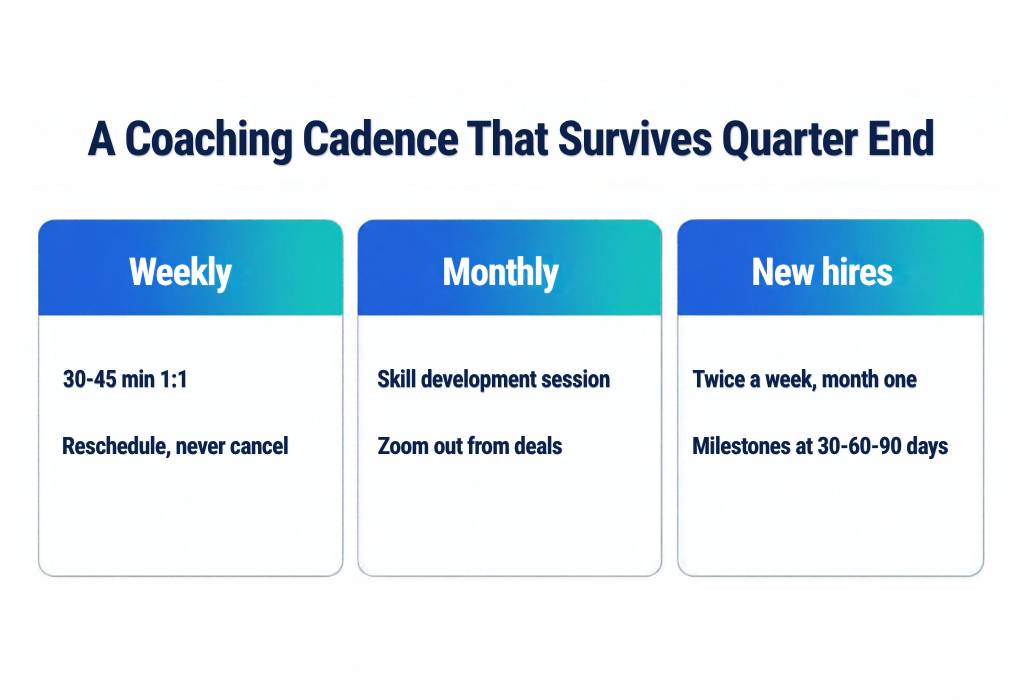
Protect the weekly session. Put it on the calendar as a recurring meeting and treat it like a customer commitment. If you must move it, reschedule within the same week rather than skip it. Managers who reschedule instead of cancel keep the perception that development matters.
The monthly session is where you zoom out. Ask what skill the rep wants to develop this quarter, review progress against that goal, and plan the next 30 days of practice. This is also where you connect day to day performance to career growth, which keeps strong reps engaged. If you are new to the role, our guide to sales coaching for first time managers covers how to start.
Onboarding and Ramp Coaching
The highest return coaching investment is during ramp. A new B2B enterprise rep often takes six to nine months to reach full productivity, and structured coaching in that window can compress ramp by weeks. Front load the cadence: meet new hires twice a week for the first month, then settle into the weekly rhythm. Use a milestone map so both manager and rep know what good looks like at 30, 60, and 90 days.
A One on One Sales Coaching Template
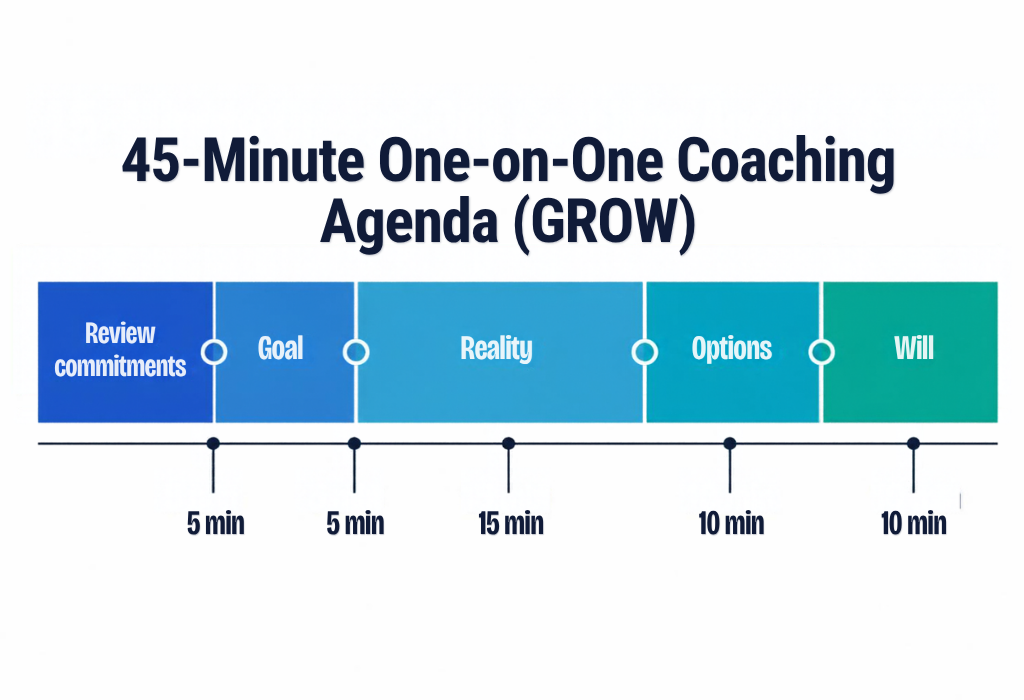
Improvised coaching produces inconsistent results. Use a template so every session has a predictable shape while leaving room for the rep to drive. The most durable structure is the GROW model: Goal, Reality, Options, Will.
A 45 Minute Session Agenda
- Review last week's commitments (5 minutes). Start with what the rep said they would do. Did it happen?
- Goal (5 minutes). Agree on what this session is about. Let the rep nominate the topic when possible.
- Reality (15 minutes). Get an honest picture using data: call recordings, opportunity stage, activity history, win rates.
- Options (10 minutes). Help the rep generate approaches rather than handing over the answer.
- Will (10 minutes). End with one specific commitment and a deadline. Write it down and review it next week.
Sales Coaching Questions to Ask at Each Stage
- Goal: What is the one thing you want to get better at this week? What would a good outcome look like?
- Reality: What have you tried so far? What did the buyer actually say? Where are you least sure?
- Options: What else could you try? What have you seen work on another deal? What would you do if you had no constraints?
- Will: What will you do, by when? What could get in the way? How will we both know it worked?
Good coaching is mostly questions. A rep who reaches the answer themselves retains it, and the instinct to solve for them is the one to resist. If the rep cannot name a goal, that is itself a coaching opportunity.
Document each session in one shared place, such as a Salesforce record or a shared doc, so commitments are visible the following week.
Coach Each Performance Tier Differently
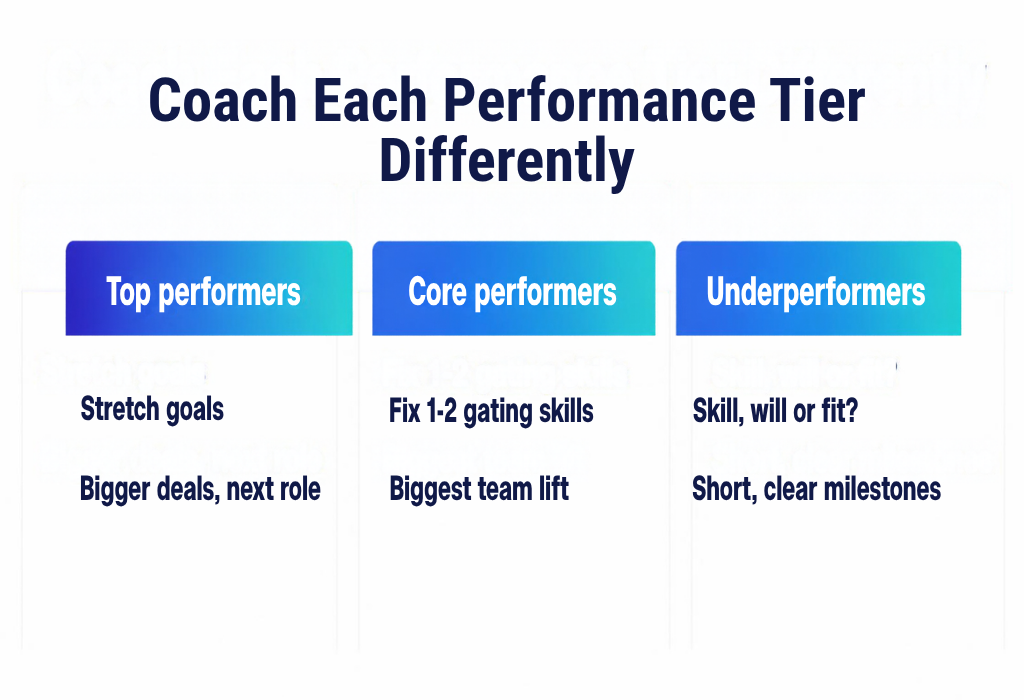
One size coaching wastes effort. Your top performers, core performers, and underperformers need different things.
Top Performers
Your best reps are the most under coached people on the team because managers assume they do not need help. They do. They need stretch goals, exposure to bigger deals, and a path to the next role. Coaching here is about acceleration and retention, not correction.
Core Performers
This is the largest group and where coaching produces the most aggregate lift. A core rep who improves win rate by five points moves the entire team's number. Focus on the one or two skills that gate their next level. Our guide to coaching sales reps goes deeper on which skills to pick.
Underperformers
Here coaching is intensive and time bound. Diagnose whether the gap is skill, will, or fit. Skill gaps respond to coaching. Will and fit problems usually do not, and dragging out the inevitable hurts the rep and the team. Set clear milestones and short timelines.
Use Data, Tools, and Metrics to Keep Coaching Objective
Coach on Leading Indicators
The biggest leap in modern sales coaching is the shift from opinion to evidence. Revenue is a lagging indicator that tells you what already happened. You want the behaviors that produce revenue: new opportunities created, multi threading depth on key accounts, conversion between stages, sales cycle length, and meeting frequency with economic buyers. For more on this approach, see our guide to data driven sales coaching.
Account planning data is especially powerful for enterprise reps. If you can see that a rep has identified only one contact at a 500,000 dollar account, you have a concrete coaching moment. You are not telling the rep they are not working hard enough. You are showing them a relationship map with a single dot on it.
Coaching the Pipeline Without Killing Trust
There is a tension between coaching and inspection. Reps know managers also evaluate them, and that makes them defensive. Separate the two explicitly. Use forecast calls and pipeline reviews for inspection, and one on ones for development. In the development conversation, frame the pipeline as shared problem solving. Instead of asking why a deal is stuck, ask what would need to be true for it to advance. The shift from prosecutor to partner changes how much the rep reveals, and you cannot coach what you cannot see.
The Tool Stack for Modern Coaching
Conversation intelligence platforms like Gong and Chorus capture calls so managers can coach on actual behavior instead of secondhand recaps. Learning platforms like Mindtickle and Highspot deliver reinforcement and certification. Account planning tools surface the relationship and whitespace data that makes enterprise coaching objective. See our roundup of sales coaching software for how these fit together.
The mistake is buying tools and assuming they create a coaching culture. A call recording is just a recording until a manager turns it into a conversation. Tools that live natively inside Salesforce reduce friction the most, because reps and managers do not have to leave the system of record.
Measuring Whether Coaching Works
Track three layers. First, activity: are sessions happening on cadence and are commitments being completed? Second, behavior: are the leading indicators you coached actually moving? Third, outcomes: are win rates, quota attainment, and ramp time improving for coached reps against a baseline?
Compare coached behavior change to results over a full quarter or two. If you coached multi threading and average contacts per opportunity went from two to five while win rates rose, you have evidence it worked. More benchmarks are in our sales coaching statistics.
Frequently Asked Questions
How often should one on one sales coaching happen?
Weekly for 30 to 45 minutes is the proven standard for frontline reps, supplemented by a monthly deeper development session. New hires during ramp benefit from twice weekly sessions for the first month. Consistency matters more than frequency. A reliable biweekly cadence beats an erratic weekly one that gets canceled half the time.
What should a one on one sales coaching template include?
A good template has a fixed agenda, a Goal, Reality, Options, Will structure, and a written commitment with a deadline. It should also record last week's commitments so each session starts by checking follow through.
What questions should I ask in a sales coaching session?
Ask open questions tied to each stage of the GROW model: what the rep wants to improve, what they have tried, what else they could do, and what they will do by when. Avoid questions that only ask for a status update.
What is the difference between coaching and managing?
Managing directs and evaluates. Coaching develops. A manager tells a rep what to do and assesses whether they did it. A coach helps the rep build the skill to figure out what to do themselves. Both are necessary, but they should happen in separate conversations because mixing them makes reps defensive and reduces honesty.
How do I run virtual sales coaching for reps I cannot see in person?
Virtual sales coaching works well when you lean on recorded calls and shared data. Conversation intelligence lets you review actual interactions rather than recollections. Keep video on, keep the cadence fixed, and document every session in a shared place both people can reference.
What should I do when a rep resists coaching?
Resistance usually signals that previous coaching felt like criticism or inspection. Reset the relationship by asking what would make the sessions valuable to them and letting them set the agenda. Focus on a skill they care about improving. Trust is rebuilt through consistency and through coaching that visibly helps them earn more.
Can you coach skill and pipeline in the same meeting?
You can, but separate the two phases clearly. Use the live deal as raw material, then explicitly shift to extracting the transferable skill. Many strong teams hold separate forecast inspection calls so the one on one stays focused on the rep rather than the number.
How do I measure coaching ROI?
Track whether sessions happen on cadence and commitments get completed, whether the leading indicators you coached are moving, and whether win rates, quota attainment, and ramp time improve for coached reps against a baseline.
How long should a 1 on 1 sales coaching session be?
Plan for 30 to 45 minutes weekly for frontline reps. A 1 on 1 sales coaching session shorter than 30 minutes rarely gets past status updates, and anything over an hour tends to lose focus. Use a longer monthly session for development planning and career conversations.
What are the best sales coaching models?
GROW (Goal, Reality, Options, Will) is the most widely used sales coaching model because it keeps the rep doing the thinking. The skill and will matrix is a useful companion for deciding how directive to be with each rep, and call review coaching works well when you need to improve a specific behavior. Pick one model, use it consistently for a quarter, and judge it by whether commitments get completed.
How do I coach sales staff who are already performing well?
Coaching sales staff who hit quota still matters. Shift the focus from fixing gaps to stretching strengths: bigger accounts, executive access, and teaching their approach to the rest of the team. See the top performer guidance above for how to structure those sessions.
Turn coaching into a system with Prolifiq
Great one on one sales coaching depends on objective data about what your reps are actually doing inside their accounts. You cannot coach multi threading, whitespace, or stakeholder strategy if that information lives in a rep's head or in scattered slide decks. Prolifiq CRUSH brings account planning natively into Salesforce, giving managers a clear, shared view of relationship maps, whitespace, and account strategy for every rep. That turns vague coaching conversations into specific, evidence based ones. See how it fits your coaching cadence.