Most sales compensation plans fail quietly. They do not blow up in a single quarter. They erode trust over time as reps discover the plan rewards the wrong behavior, finance discovers it overpays on deals that never close, and leadership discovers that the plan no longer maps to the strategy it was built around two years ago. By the time someone calls in outside help, the symptoms are obvious: rising comp costs as a percentage of revenue, top performers leaving for clearer plans, and a quota attainment curve that looks nothing like it should.
Sales compensation consulting exists to fix this. A good sales compensation consultant brings benchmark data, plan design experience across dozens of companies, and the political neutrality to tell a CRO that their favorite accelerator is destroying margin. The problem is that the category is crowded, from solo advisors to the global comp practices inside Korn Ferry and Alexander Group, and the advice ranges from genuinely transformative to expensive slides that sit in a shared drive forever.
This guide covers what sales compensation consultants actually deliver, the top sales compensation consulting firms, what an engagement costs, and how to make sure the plan you pay for survives contact with your CRM and your reps.
What Does a Sales Compensation Consultant Do?
Sales compensation consulting is the practice of designing, benchmarking, and governing the variable pay that drives a revenue team. It sounds narrow. It is not. A real engagement touches strategy, finance, HR, sales operations, and the systems that actually pay people. You will also see it sold as incentive compensation consulting or as part of broader sales performance management consulting, which adds territories, capacity, and quota planning to the scope.
The core deliverables usually include:
- Pay mix design: the split between base salary and variable pay for each role.
- Quota methodology: the rules for how territories and targets get assigned.
- Plan mechanics: rates, accelerators, decelerators, and caps.
- Plan governance: the dispute process and review cadence that keep a plan honest after launch.
The best engagements connect all of this back to company strategy. If your goal is land and expand into enterprise accounts, your plan should not pay the same on a 12 month renewal as it does on a new multiyear logo. A consultant who starts with rate tables instead of strategy is selling you the wrong thing. If you want the fundamentals before you hire anyone, start with our guide to sales compensation plans.
Strategic vs tactical engagements
Strategic engagements ask whether your go to market motion and your pay philosophy still match. Tactical engagements fix a broken accelerator or rebuild a quota model. Know which one you need. Paying a global firm for a full strategy review when you just need a rate adjustment is overkill. Hiring a solo advisor to harmonize a plan across 14 countries is underkill.
Pay mix, quotas, and plan mechanics
Three levers do most of the work. Pay mix: a 50/50 split suits transactional hunting roles, while 70/30 suits complex enterprise sellers with long cycles. Quotas: top down targets divided evenly ignore territory potential, so the best methodology anchors on a company number and adjusts for measurable territory differences (see our sales quota planning framework). Mechanics: accelerators, decelerators, and caps are all tradeoffs between motivation and cost control. A consultant earns their fee by making those tradeoffs deliberately rather than by accident.
Signs You Need a Sales Compensation Consultant
You do not need a consultant for every plan tweak. You do need one when the signals get loud.
Comp cost drift. If cost of sales as a percentage of revenue has climbed three points over two years without a strategy change to justify it, the plan is leaking money.
A distorted attainment curve. A common rule of thumb is that a healthy plan puts roughly 50 to 70 percent of reps at or above quota on a smooth curve. If 90 percent hit plan, quotas are too soft. If only 20 percent do, you have a quota or coverage problem comp cannot fix alone. Our guide to sales quota attainment shows how to diagnose which one it is.
Gaming behavior. When reps spend more energy gaming the plan than selling, when deals get pushed into the next period, or when discounting spikes at quarter end, the plan is teaching the wrong lesson.
Top performer attrition. This is the most expensive and least reversible symptom of all.
A major strategy shift. A move to recurring revenue, consumption pricing, or a new enterprise segment changes what the plan should pay for. That is the moment to bring in a sales compensation consultant, before the new plan launches, not after.
Top Sales Compensation Consulting Firms
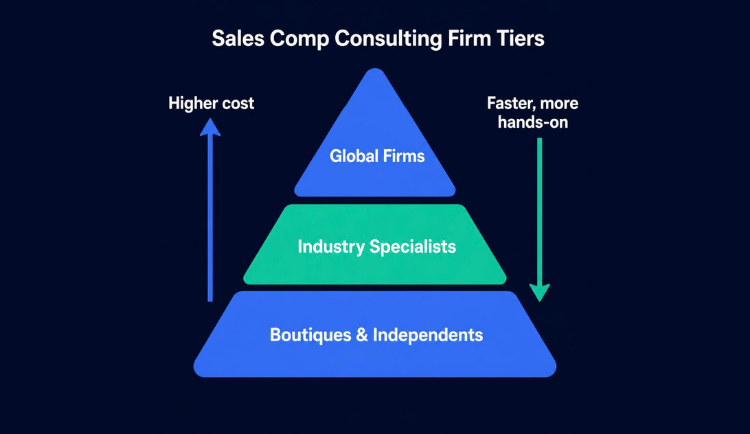
The market splits into three tiers: global firms with deep benchmark databases, industry specialists, and boutique or independent sales compensation plan consultants. The right choice depends on your size, industry, and how much implementation help you need.
Alexander Group
Alexander Group is the best known pure play revenue and sales compensation consultancy. They bring proprietary benchmark data across industries and run large go to market transformation projects. Expect engagements in the low to mid six figures. They are strongest for enterprise organizations rethinking their entire sales model.
Korn Ferry and WTW
Korn Ferry and WTW (formerly Willis Towers Watson) approach sales comp from the broader rewards and HR consulting angle. Their strength is survey data depth and tying sales comp to total rewards strategy. They fit when sales comp needs to align with a wider compensation philosophy across the company.
ZS Associates
ZS is dominant in life sciences sales comp, where territory alignment and incentive compliance are uniquely complex. If you sell pharmaceuticals or medical devices, ZS understands your regulatory and field force realities better than a generalist.
Bain & Company
Bain offers sales compensation work inside its go to market strategy practice. It is a fit when comp redesign is one part of a larger commercial strategy engagement rather than a standalone project.
Boutique and independent sales compensation consultants
Below the global firms sit dozens of boutique sales compensation consulting companies and independent advisors, including firms like SalesGlobe and Better Sales Comp Consultants, many founded by former practitioners. They cost less, move faster, and often deliver more practical plans. The risk is bench depth. A solo advisor cannot benchmark a 5,000 person global sales force the way a global firm can.
How Much Does Sales Compensation Consulting Cost?
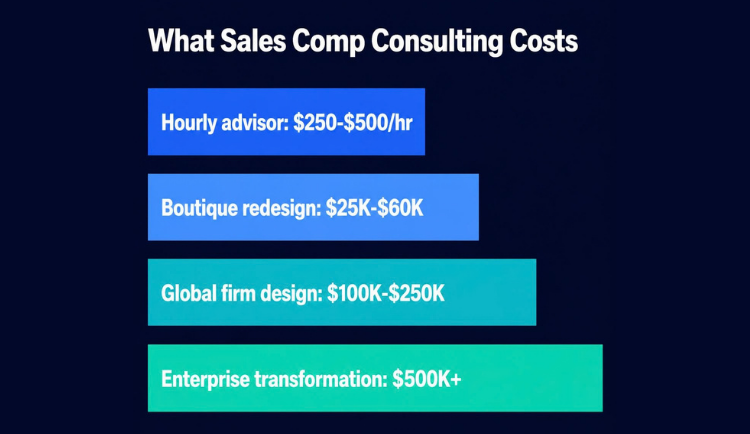
Pricing varies widely, and the range is honestly enormous. A focused plan redesign for a single sales team from a boutique firm runs 25,000 to 60,000 dollars. A full strategy and design engagement from a global firm for a mid market company runs 100,000 to 250,000 dollars. Large enterprise transformations involving multiple geographies, role types, and a multi quarter timeline can exceed 500,000 dollars.
Independent advisors often bill $250 to $500 per hour or package work into fixed fee phases. Day rates of 2,500 to 4,000 dollars are common for senior solo consultants. The cheapest option is not always the worst, and the most expensive is not always the best. What you are really buying is benchmark data quality, design experience, and the willingness to deliver uncomfortable conclusions.
Watch for the implementation gap
Many engagements price the design and stop. The plan lands as a slide deck and a spreadsheet, then someone internal has to translate it into your incentive compensation management system and your CRM. Ask explicitly what happens after the design is approved. The implementation gap is where most of the value leaks out.
How to Choose a Sales Compensation Consulting Firm
Build vs buy vs consult
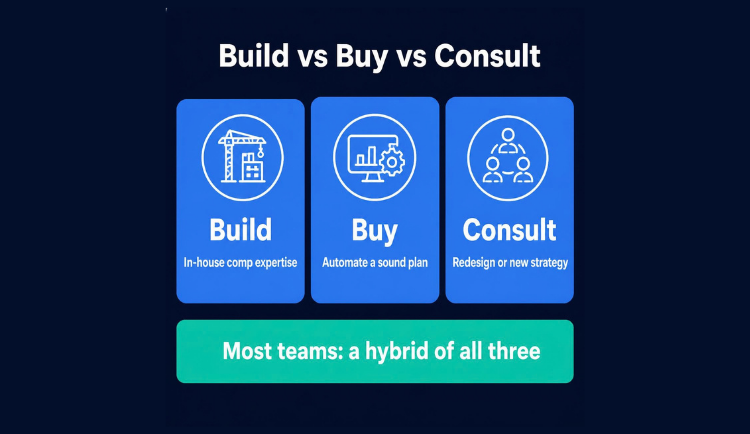
You have three paths, and they are not mutually exclusive:
- Build: design the plan internally with sales ops and finance. This works when you have experienced comp talent in house, like a dedicated sales compensation manager, and the plan is not undergoing a major shift.
- Buy: an incentive compensation management platform like Xactly, CaptivateIQ, or Varicent administers and calculates payouts. These tools run your plan; they do not design it. Buying software for a broken plan just automates the dysfunction. Our sales compensation software guide compares the options.
- Consult: bring in outside expertise for design and benchmarking.
For most growing companies the strongest approach is a hybrid: a consultant for strategy and design, software for administration, and internal governance to keep the plan honest.
Questions to ask before you sign
- What benchmark data do you own, and how current is it? Data more than two years old in a fast moving market is close to useless.
- Who actually does the work? Some firms sell with senior partners and deliver with junior analysts.
- What credentials does the team hold? The Certified Sales Compensation Professional (CSCP) designation from WorldatWork is a useful signal that a consultant knows the full body of sales comp practice.
- How do you handle implementation and CRM mapping? If the answer is "out of scope," budget for closing that gap yourself.
- What does success look like? A serious partner commits to outcomes like a healthier attainment curve or reduced cost of sales drift, not just deliverables.
- Can you share references in my industry and at my scale? A sales compensation consulting firm that excels with enterprise pharma may flounder with a 40 person SaaS team.
Match the firm to your industry
Comp plans do not transfer cleanly across industries. In life sciences, territory alignment and incentive compliance are legal matters, which is why specialists like ZS exist. In financial services, long cycles and relationship based revenue push toward conservative pay mix and credit sharing. In manufacturing, channel and distributor dynamics complicate crediting. In SaaS, paying on bookings versus ARR versus net revenue retention produces very different rep behavior; see our guide to SaaS sales compensation plans for the tradeoffs.
Making the Plan Work After Launch
The CRM connection most consultants ignore
A comp plan is only as good as the data that feeds it, and that data lives in your CRM. If your Salesforce instance does not cleanly track the deal attributes the plan pays on, like new logo versus expansion, product line, or multiyear term, the most elegant plan on paper becomes a manual reconciliation nightmare. Before you approve a plan, map every payout rule to a CRM field. If a rule depends on data you do not capture, the rule does not work.
Account planning feeds comp logic
If your plan rewards expansion within strategic accounts, your team needs structured account planning that lives where reps already work. Whitespace maps, stakeholder relationships, and expansion opportunities tracked natively in Salesforce give comp administrators clean data and give reps clarity on where the money is. A white space analysis is the fastest way to size that expansion opportunity per account. Without that structure, expansion comp becomes guesswork.
Govern and communicate the plan
Plans drift because nobody governs them. Set a quarterly review that examines attainment distribution, cost of sales, and dispute volume, with thresholds that trigger a deeper look, like disputes above five percent of payouts. Then communicate the plan relentlessly. Reps cannot be motivated by a plan they do not understand, so give each rep a clear view of how their pay is calculated and where they stand against quota, ideally inside the tools they already use.
Frequently Asked Questions
What does a sales compensation consultant do?
A sales compensation consultant designs and benchmarks the variable pay plans for a sales team. That covers pay mix, quota methodology, rates and accelerators, and plan governance, ideally tied back to company strategy and to the CRM data the plan pays on.
How long does a sales compensation consulting engagement take?
A focused plan redesign runs 6 to 10 weeks. A full strategy and design engagement runs 12 to 20 weeks. Large enterprise transformations across multiple geographies can run two to three quarters. Build in extra time for CRM and ICM implementation, which is frequently underestimated.
Should we hire a consultant or buy ICM software first?
Fix the plan design before automating it. Buying ICM software to administer a flawed plan just makes the dysfunction run faster. If the plan is sound and only administration is broken, software alone may be enough.
What is the difference between sales compensation consulting and incentive compensation consulting?
In practice the terms are used interchangeably. Incentive compensation consulting sometimes covers variable pay for non sales roles too, while sales compensation consulting focuses on quota carrying and sales support roles.
Do small sales teams need compensation consulting?
Teams under 20 reps can often design effective plans internally if they have sales ops or finance talent who understand comp. Bring in outside help when the plan must support a major strategy shift, when comp costs are drifting, or when you lack in house design experience.
How often should we change the comp plan?
Major redesigns should happen no more than once a year, ideally aligned to the fiscal year. Frequent changes destroy rep trust and invite gaming. Minor quota or rate adjustments can happen at planning cycles, but the core structure should stay stable.
Connect your comp strategy to the data that drives it
The best compensation plan in the world fails if the CRM data behind it is messy, incomplete, or disconnected from how your reps actually sell. A consultant can design the plan, but the data that feeds your crediting, expansion incentives, and strategic account targets has to live where your team works every day.
Prolifiq CRUSH delivers Salesforce native account planning that gives your comp logic clean, structured data on whitespace, expansion opportunities, and stakeholder relationships. When account plans live inside Salesforce instead of spreadsheets, comp administrators get the signals they need and reps get clarity on exactly where the money is. See how CRUSH gives your compensation plan the data foundation it needs.