
Sales engineers sit in one of the most valuable and least understood seats in B2B revenue organizations. They carry the technical credibility that closes complex deals, yet most companies struggle to compensate them in a way that is fair, motivating, and aligned with how they actually contribute to revenue. Pay them like an account executive and you create resentment when their effort does not map cleanly to a single quota. Pay them like an individual contributor engineer and you ignore the fact that their work directly drives bookings. The result is one of the highest sources of churn in technical sales: misaligned compensation.
This guide breaks down how sales engineer compensation actually works in 2026, with specific numbers, structures, and benchmarks you can use whether you are building a comp plan from scratch or auditing an existing one. We cover base salary ranges, on target earnings, the base to variable split that separates SE roles from quota carrying roles, how commission and accelerators are structured, and how compensation shifts across seniority levels from associate SE to director of sales engineering. We also address the recurring debates: should SEs be paid on team quota or individual deals, how to handle pre sales versus post sales splits, and what happens to comp when a sales engineer supports multiple AEs across overlapping territories. By the end you will have a clear framework for designing or evaluating an SE compensation plan that retains your best technical talent and ties their work to revenue without forcing them into a role they were never hired to play.
What Sales Engineers Actually Do and Why It Affects Pay
A sales engineer, sometimes called a solutions engineer or pre sales engineer, is the technical counterpart to the account executive. Where the AE owns the commercial relationship, the SE owns the technical sale: discovery of technical requirements, product demonstrations, proof of concept builds, RFP responses, security and architecture reviews, and answering the deep questions that make or break enterprise deals.
This matters for compensation because the SE influences revenue without directly closing it. The AE signs the contract and books the quota. The SE makes that contract possible by removing technical risk and establishing credibility. That indirect relationship to revenue is the single biggest reason SE comp plans look different from AE plans. You cannot simply hand an SE a number and a commission rate, because they rarely own a deal end to end and they often support several AEs and territories simultaneously.
Understanding the role also clarifies why base salary weighs more heavily for SEs than for AEs. The work is consistent and skill intensive regardless of whether a specific quarter closes well. An SE delivering excellent demos and clean POCs adds value even when external factors stall a deal. Compensation plans that recognize this consistency, rather than treating SEs as pure commission earners, produce far better retention.
The Base Salary and Variable Split
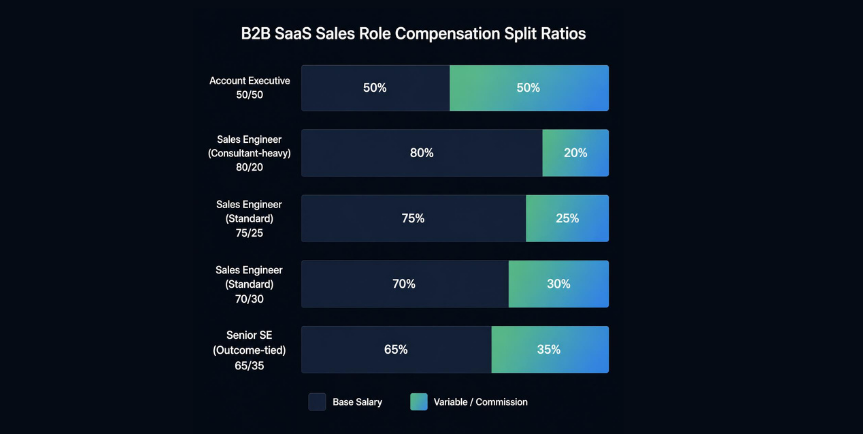
The defining feature of sales engineer compensation is the base to variable split. Account executives commonly sit at a 50/50 split, meaning half their on target earnings comes from base salary and half from commission. Sales engineers almost always carry a heavier base.
The most common SE splits in B2B SaaS are 70/30 and 75/25. A 70/30 split means 70 percent of on target earnings is guaranteed base salary and 30 percent is variable. Some organizations push to 80/20 for SEs who function more as technical consultants and less as deal closers. Conversely, senior SEs at high performing software companies sometimes run 65/35 when leadership wants to tie them more tightly to outcomes.
Why the heavier base makes sense
SEs do not control the close. Forcing a 50/50 split punishes them for variables outside their influence, like budget freezes or AE turnover. A heavier base recognizes that the SE delivers technical value continuously and reduces the volatility that drives talented engineers back into product or engineering roles where pay is predictable.
Sales Engineer Compensation Benchmarks by Level
Compensation scales sharply with seniority and the complexity of the product being sold. The following on target earnings ranges reflect US B2B SaaS companies in 2026. Adjust downward 15 to 25 percent for non US markets and upward for companies selling six and seven figure enterprise deals.
Third-party data backs up this range. The U.S. Bureau of Labor Statistics puts the May 2024 median sales engineer base salary at $121,520, with the bottom 10 percent under $70,580 and the top 10 percent over $202,670. RepVue's crowdsourced dataset of more than 1,600 verified sales engineer submissions puts the median at roughly $150,000 base and $205,000 in total on target earnings, which tracks closely with the mid-to-senior bands below. The gap between the BLS base-salary figure and the RepVue OTE figure is expected: one measures guaranteed base pay across all sales engineer titles, the other measures total compensation including variable pay at software and SaaS companies specifically.
Associate or Junior Sales Engineer
Base salary of 80,000 to 105,000 with OTE of 100,000 to 130,000. These are SEs in their first one to three years, often supporting SMB or mid market deals and learning the product depth required for enterprise.
Sales Engineer (Mid Level)
Base salary of 110,000 to 145,000 with OTE of 150,000 to 190,000. This is the core IC role, owning technical discovery and POCs for mid market and lower enterprise deals.
Senior Sales Engineer
Base salary of 150,000 to 185,000 with OTE of 200,000 to 260,000. Senior SEs handle the most complex enterprise deals, mentor junior team members, and often own technical relationships with strategic accounts.
Principal or Staff Sales Engineer
Base salary of 175,000 to 210,000 with OTE of 250,000 to 320,000. These individuals operate as technical authorities, support the largest deals, and influence product direction without managing people.
Manager and Director of Sales Engineering
Base salary of 180,000 to 230,000 with OTE of 270,000 to 350,000 for managers and 320,000 to 420,000 for directors, who carry team quotas and own SE hiring, enablement, and process.
How Sales Engineer Commission Is Structured
Because SEs rarely own individual deals, their variable compensation is structured differently from an AE's. There are three dominant models.
Team or pooled quota
The most common approach. The SE is paid against the combined quota of the AEs they support. If an SE covers three AEs with a combined annual quota of 4 million, the SE earns variable comp based on attainment against that pooled number. This model rewards the SE for lifting the performance of every rep they support and avoids disputes over which specific deals the SE touched.
Individual deal attribution
Less common but used where SEs are dedicated to a single AE or a small set of named accounts. The SE earns commission only on deals they directly worked. This can sharpen focus but creates problems when an SE is pulled into deals they get no credit for.
MBO or management by objectives
Some companies allocate part of the variable component to qualitative goals: demo quality scores, POC win rates, enablement contributions, or competitive displacement. A typical split might be 70 percent of variable tied to revenue attainment and 30 percent tied to MBOs. This rewards the technical excellence that pure revenue numbers miss.
Accelerators and Caps for Sales Engineers
Accelerators increase the commission rate once an SE or their supported AEs exceed quota. Because the variable portion of SE pay is smaller, accelerators tend to be more modest than those for AEs. A common structure pays the standard rate up to 100 percent of pooled quota, then 1.25x to 1.5x on attainment above target.
Caps are a contentious issue. Many organizations cap SE variable pay to protect against situations where an SE supports an unusually strong territory and earns far beyond their target through no special effort of their own. Others argue caps demotivate and that uncapped plans drive better behavior. The pragmatic middle ground is no cap on revenue tied variable, but a clear policy that quotas are reset annually to reflect territory strength. This prevents permanent windfalls while keeping the upside motivating.
Pre Sales Versus Post Sales Compensation
Some SE roles extend beyond the close into implementation, onboarding, or technical account management. When the role blends pre sales and post sales work, compensation should reflect both. A common approach splits the variable component, paying a portion on new bookings the SE helped close and a portion on retention, expansion, or successful implementation milestones for accounts the SE continues to support.
The mistake to avoid is loading post sales responsibilities onto a pre sales comp plan without adjusting the structure. An SE who spends 40 percent of their time supporting existing customers but earns only on new deals will quietly disengage from the implementation work, which damages renewal rates. Map the comp to the actual time and outcomes you expect.
Geographic and Industry Variations
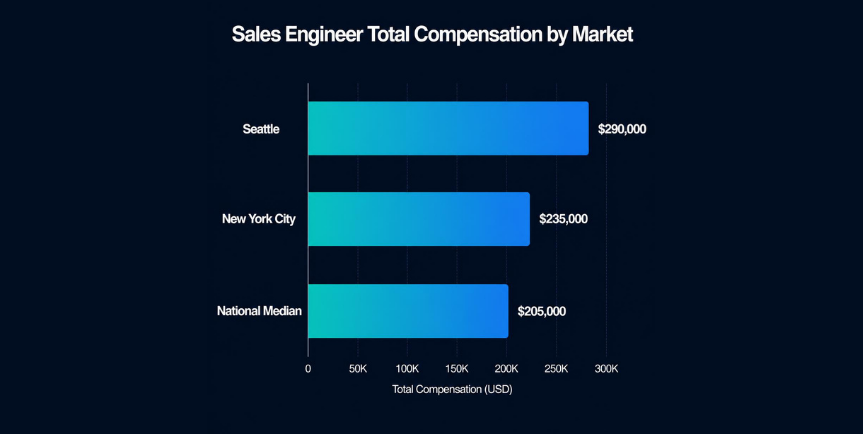
Location still affects pay even in a remote first world. SEs in the San Francisco Bay Area, New York, and Boston command 10 to 20 percent premiums over the national median. Remote SEs hired into national bands often land between coastal and secondary market rates. RepVue's location breakdowns put total compensation for sales engineers in Seattle around $290,000 and in the New York City metro around $235,000, both well above the roughly $205,000 national median, which illustrates just how wide the coastal premium can be at the individual-market level.
Industry matters as much as geography. SEs selling into highly technical or regulated verticals earn more because the role demands deeper expertise. A sales engineer in life sciences who must speak fluently about validation and compliance, or one in financial services navigating security and data residency requirements, carries scarcity value that lifts both base and OTE. SEs selling commodity SaaS products with shallow technical requirements sit at the lower end of every band.
Equity and Long Term Incentives
At venture backed and pre IPO companies, equity is a meaningful part of SE compensation. Senior and principal SEs at growth stage startups often receive equity grants worth 25,000 to 100,000 or more annually in expected value, refreshed periodically. At public companies, restricted stock units replace options and form a predictable part of total compensation, typically 15 to 30 percent of total comp for senior individual contributors.
When evaluating an SE offer or building a plan, treat equity as a retention lever rather than a substitute for fair cash compensation. SEs who feel underpaid in cash rarely stay long enough to vest, no matter how attractive the equity story looks on paper.
Common Mistakes in Sales Engineer Comp Plans
The most frequent error is copying the AE comp plan and applying it to SEs. The 50/50 split, the deal level attribution, the aggressive accelerators, none of these fit a role that supports rather than owns the close.
The second mistake is murky attribution. When SEs do not know how their variable pay is calculated or feel that credit is assigned arbitrarily, trust evaporates. Document exactly which AEs and quotas an SE is tied to and update it when territories shift.
The third mistake is ignoring the consistency of SE value. SEs who deliver flawless technical work in a quarter where deals stall for commercial reasons still deserve to be paid fairly. Plans that swing too hard toward variable punish good work and drive churn among exactly the people you most want to keep.
Aligning SE Compensation With Account Strategy
The best SE comp plans connect technical work to account outcomes that the entire revenue team can see. This requires shared visibility into which accounts an SE is supporting, what stage each opportunity sits in, and how technical milestones like a completed POC map to deal progression. When that data lives in disconnected spreadsheets, attribution becomes a fight and comp becomes a source of friction.
Revenue teams that run account planning inside their CRM solve much of this. When SEs, AEs, and managers all work from the same account plans, the technical contributions become visible, attribution becomes obvious, and compensation conversations become grounded in shared facts rather than competing memories of who did what.
Frequently Asked Questions
What is a typical base to variable split for a sales engineer?
Most B2B SaaS sales engineers run a 70/30 or 75/25 split, meaning 70 to 75 percent of on target earnings is guaranteed base salary. This contrasts with the 50/50 split common for account executives and reflects the SE's supporting rather than closing role.
How much does a sales engineer make in the US?
Mid level sales engineers typically earn 150,000 to 190,000 in on target earnings, with senior SEs reaching 200,000 to 260,000 and principal level SEs exceeding 300,000. Associate SEs start around 100,000 to 130,000. Ranges vary by industry, deal complexity, and location.
Should sales engineers be paid on individual deals or team quota?
Team or pooled quota is the more common and generally fairer model because SEs usually support multiple AEs and rarely own a single deal end to end. Individual deal attribution works only when an SE is dedicated to one AE or a small named account set.
Do sales engineers earn accelerators?
Yes, though typically more modest than AE accelerators given the smaller variable component. A common structure pays the standard rate to 100 percent of pooled quota and 1.25x to 1.5x above target. Some companies cap SE variable pay while others reset quotas annually instead.
How should compensation change for SEs who do post sales work?
Split the variable component so the SE earns on both new bookings and post sales outcomes like retention, expansion, or implementation milestones. Loading post sales work onto a pure pre sales comp plan causes SEs to disengage from the implementation work that protects renewals.
Is equity an important part of sales engineer compensation?
At venture backed and pre IPO companies, equity is meaningful for senior and principal SEs, often worth tens of thousands annually in expected value. Treat it as a retention lever, not a substitute for competitive cash, since underpaid SEs rarely stay long enough to vest.
Build Comp Plans on Shared Account Visibility
Fair sales engineer compensation depends on clear attribution, and clear attribution depends on everyone working from the same account data. When SEs, AEs, and sales leaders share a single view of account strategy, opportunity stages, and technical milestones, comp conversations stop being arguments and start being grounded in facts. Prolifiq CRUSH brings account planning directly into Salesforce, so the contributions of your technical sellers are visible to the whole revenue team and tied to the accounts and opportunities that drive bookings. If you want to align your sales engineers, account executives, and leadership around the accounts that matter most, explore Prolifiq CRUSH and see how Salesforce native account planning makes compensation, attribution, and strategy work together.