Sales quota management is where strategy meets accountability. You can build the most sophisticated territory plan in the world, but if your quotas are set with a spreadsheet, distributed over email, and tracked in a CRM report nobody trusts, your revenue forecast is fiction. Most B2B organizations still run quota management this way. The result is predictable: reps argue about fairness, finance argues about attainment, leadership argues about the forecast, and everyone wastes the first six weeks of every quarter reconciling numbers instead of selling.
Sales quota management software exists to end that cycle. At its core, the category covers how you set quota targets, allocate them across teams and territories, track attainment against those targets in real time, and tie the whole system to compensation and forecasting. Some teams call this a quota management system rather than software, but the function is the same: a single version of the truth for revenue leaders, and a clear, credible number for reps to chase. Done poorly, it becomes another disconnected tool that data has to be copied into and out of.
This guide is for revenue operations leaders, sales operations managers, and CROs who are evaluating how to manage quotas more rigorously. We will cover what the software actually does, the difference between standalone quota tools and platforms that connect quota to planning and execution, the vendors worth knowing, realistic pricing benchmarks, and the implementation pitfalls that quietly kill these projects. We will also be honest about where a dedicated quota tool helps and where it just adds another system to maintain. The goal is to help you make a decision you can defend to both finance and the field.
What Sales Quota Management Software Actually Does
The phrase covers a wider range of functionality than most buyers expect. At minimum, a quota management tool lets you define quota periods, assign targets to individuals and teams, and report attainment. That is table stakes. The more capable platforms go several steps further.
Quota setting is the first pillar. Good software supports multiple methodologies: top down allocation from a corporate revenue target, bottom up build from territory and account potential, and historical models that adjust last year's numbers by a growth factor. The best tools let you blend these and reconcile the gap between what leadership wants and what the field believes is achievable.
Quota allocation is the second. This is the math of distributing a number across regions, segments, products, and reps in a way that accounts for territory size, ramp status, and seasonality. Manual allocation in spreadsheets is where most fairness disputes originate.
Attainment tracking is the third pillar, and it is where the connection to your CRM matters most. The software should pull closed and committed revenue directly from Salesforce so that attainment is calculated automatically, not entered by hand. Finally, mature platforms connect quota to compensation and forecasting so a single number flows through planning, execution, and payout.
Why Spreadsheets Fail at Quota Management
Almost every company starts with spreadsheets, and many large companies never leave them. A spreadsheet is flexible, free, and familiar. It also breaks at the exact moment quota management gets hard: scale, change, and trust.
Version control collapses
When quotas live in spreadsheets, there is no single source of truth. A regional VP downloads the master, makes adjustments, and emails it back. Two managers edit different copies. By the time finance reconciles, nobody is certain which number is real. Reps lose trust in their quota the moment they suspect it was set in a file that has been edited a dozen times.
Mid period changes are painful
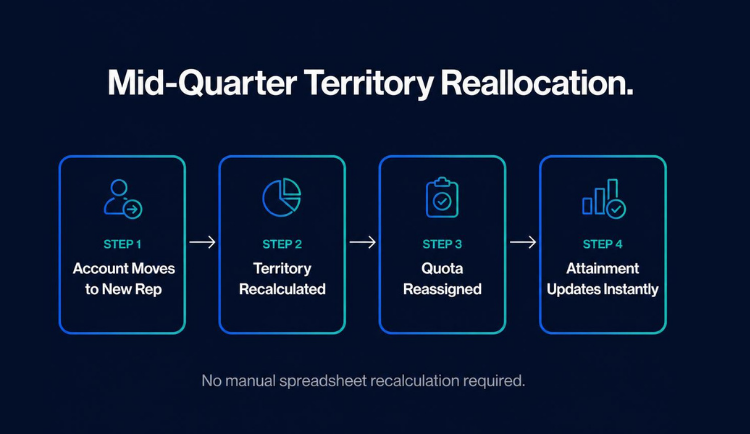
Territories shift, reps leave, and accounts move. In a spreadsheet, every change requires manual recalculation across dozens of dependent cells. The probability of error climbs with every adjustment, and a single broken formula can misstate the entire team's targets.
No connection to real performance
The worst failure is disconnection from CRM data. Attainment gets updated weekly at best, often by copying numbers out of Salesforce into the spreadsheet. That lag means the forecast is always stale, and reps stop checking a number that does not reflect deals they closed yesterday.
Standalone Tools vs. the Salesforce-Native Advantage
There are two philosophies in this market, and choosing the wrong one wastes budget. The first is the standalone quota and compensation tool. The second is the connected revenue platform where quota is one output of a broader account and territory planning process.
Standalone tools, often grouped under sales performance management or incentive compensation management, are excellent at the comp side. They calculate complex commission plans, handle accelerators and clawbacks, and produce auditable payout records, and they pair naturally with a broader sales compensation plan. If your primary pain is paying reps accurately and on time, that is where they shine.
The problem is that quota in isolation is just a number. It only becomes meaningful when it connects to where the revenue will actually come from: which accounts, which territories, which whitespace, which renewal and expansion motions. A quota of two million dollars means nothing without a credible plan showing the accounts and opportunities that add up to it. That is why many revenue teams find more value in platforms that tie quota to key account management, where the number is built from the bottom up off real account potential captured inside the CRM.
One data model, no sync lag
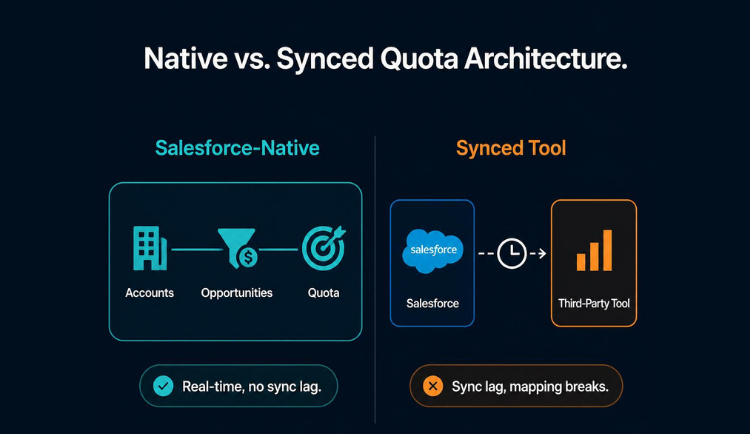
If your revenue team runs on Salesforce, the single most important architectural decision is whether your quota tool lives inside Salesforce or beside it. The difference is not cosmetic. A Salesforce-native tool reads opportunity, account, and forecast data directly from the same database your reps work in every day. There is no nightly sync, no API connector to maintain, no field mapping that breaks when an admin renames a picklist. Attainment updates the moment a deal moves stages.
Adoption follows the rep
Reps already live in Salesforce. A native tool puts quota visibility, account plans, and attainment on the same screens they use to manage deals. A bolt on tool requires a separate login and a separate habit, and tools that require new habits get abandoned.
Security and governance carry over
Native applications inherit Salesforce permissions, sharing rules, and audit trails. Your security and compliance teams do not have to vet a separate data store holding sensitive quota and territory information. In regulated verticals like life sciences and financial services, that inheritance alone can shorten a procurement cycle by months.
Vendors and Pricing in the Quota Management Space
Key vendors
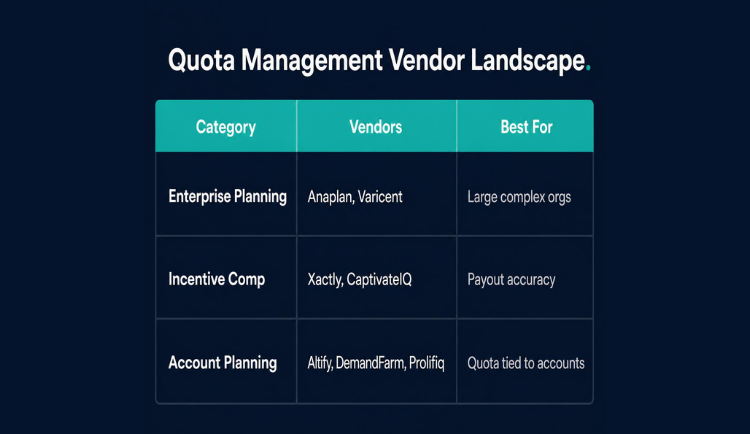
The vendor landscape spans pure compensation platforms, broad sales performance suites, and account planning tools with quota capabilities.
Salesforce Sales Planning and Spiff: Salesforce's own planning and compensation products handle territory, quota, and incentive management with the obvious benefit of platform alignment. They are strong but can be expensive once you layer in the modules.
Anaplan and Varicent: Enterprise planning powerhouses. Anaplan is exceptional at modeling complex quota scenarios across thousands of reps, and Varicent is a leader in incentive compensation. Both are heavyweight implementations better suited to very large organizations.
Xactly and CaptivateIQ: Comp focused platforms that handle quota as an input to commission calculation. Excellent for payout accuracy, lighter on the planning side.
Altify, DemandFarm, ARPEDIO, Revegy, and Kapta: Account planning platforms that frame quota in the context of account potential and whitespace. Several are Salesforce-native, and they connect the number to the plan that justifies it. This is the category most relevant to revenue teams who want quota tied to execution rather than treated as a finance artifact.
Pricing benchmarks you should expect
Pricing in this category is rarely public, but consistent ranges emerge from real deals. Treat these as planning benchmarks, not quotes.
Dedicated incentive compensation platforms like Xactly and CaptivateIQ typically run 25 to 50 dollars per payee per month, often with a floor that pushes annual contracts into the low six figures for teams of any size. Enterprise planning tools like Anaplan and Varicent are priced by workspace and complexity and routinely land in the high five to six figure range annually, with implementation services that can match or exceed the license cost.
Account planning platforms that include quota and territory context generally price per user per month in the 30 to 75 dollar range, depending on edition and vertical. Implementation for these is usually lighter, measured in weeks rather than quarters, especially when the tool is Salesforce-native and does not require building a separate data warehouse.
The hidden cost everywhere is implementation and ongoing administration. Budget for it honestly. A tool that requires a dedicated admin and a 16 week rollout has a real cost far above its sticker price. A native tool that an existing Salesforce admin can stand up in a few weeks changes the total cost of ownership materially.
Tying Quota to Territory and Account Planning
The most overlooked truth in this category is that quota cannot be managed well in isolation from territory and account planning. A quota is a hypothesis about where revenue will come from. If you set the number without mapping it to specific accounts, segments, and whitespace, you are guessing.
Connected planning flips the process. Reps and managers build account plans that quantify expansion potential, renewal value, and new logo opportunity. Those bottom up estimates roll into territory totals, which roll into team quotas. Now the number has a defensible foundation. When a rep questions their quota, you point to the account plan that produced it.

This connection also makes mid period adjustments rational. When an account moves between reps, both the quota and the underlying plan move with it. When a major account churns, the impact on attainment is visible immediately because the plan and the number are the same object. This is the structural advantage account planning platforms hold over standalone comp tools.
Want to see what a quota built from real account potential looks like instead of a spreadsheet guess? Book a demo of Prolifiq CRUSH and watch a quota roll up from live account plans in your own Salesforce org.
Implementation Pitfalls and How to Evaluate Vendors in a Trial
Setting quotas the tool cannot defend
Quota management software fails for predictable reasons, and most have nothing to do with the software itself. If your quota methodology is arbitrary, software just automates the arbitrariness faster. Fix the methodology first. Decide whether you are top down, bottom up, or blended, and document the logic before you configure anything.
Dirty CRM data
Quota tools read from your CRM. If account ownership, opportunity amounts, and close dates are unreliable, attainment will be wrong and reps will lose trust instantly. Clean the data before launch, not after.
Ignoring the field
Quotas imposed without field input get rejected, regardless of the tool. Build a process where managers review and adjust allocations before they are locked. Software should make that collaboration easier, not bypass it.
Treating it as a one time setup
Quotas change all year. Choose a tool and a process that handle mid period reallocation gracefully, and assign clear ownership for those changes.
How to evaluate vendors in a trial
Demos are designed to look perfect. Structure your evaluation around your own messy reality instead. Load real territory and account data, not the vendor's clean sample set. Run a real mid quarter scenario: move three accounts between reps and watch how quickly quota and attainment update. Test the rep view on the screens your team actually uses. Ask to see audit trails for quota changes. Confirm exactly how attainment is calculated and how often it refreshes.
For Salesforce-centric teams, ask the blunt question: does this run inside Salesforce or sync to it? Then ask how the sync handles renamed fields, custom objects, and permission changes. The answers separate tools that will feel native from tools that will feel like a second system you have to babysit.
FAQs
What is the difference between quota management and incentive compensation software?
Quota management focuses on setting, allocating, and tracking targets. Incentive compensation software focuses on calculating what reps get paid based on attainment against those targets. They overlap, but a comp tool assumes the quota already exists, while a quota platform is concerned with how the number is set and whether it is achievable. Many organizations need both, and the cleanest setups connect them so the quota flows directly into the payout calculation.
Do we need dedicated software if we already use Salesforce?
Salesforce stores opportunities and forecasts, but native quota setting and allocation are limited out of the box. Most teams supplement with either a Salesforce-native app or a connected platform. The key is to avoid pulling data out into a disconnected spreadsheet or external tool, which reintroduces all the version control and lag problems.
How long does implementation typically take?
It depends entirely on architecture. A Salesforce-native account planning platform can be live in a few weeks because it uses existing data. An enterprise planning suite like Anaplan or a full incentive comp deployment can take 12 to 16 weeks or longer, especially with complex plan logic and integrations.
How often should quotas be adjusted?
Most B2B teams set quotas annually and review quarterly, often as part of the same QBR cadence used for account and territory reviews. Mid period adjustments should happen whenever territories change materially, a rep leaves, or a major account moves. The point is not to constantly move targets but to ensure the number reflects reality so reps trust it.
What data quality issues block quota software the most?
Inaccurate account ownership, missing or wrong opportunity amounts, and unreliable close dates are the top three. Because attainment is calculated from this data, any errors directly distort the numbers reps see. Audit and clean these fields before go live.
Can account planning tools replace incentive compensation software?
Not entirely. Account planning platforms excel at tying quota to the plan that justifies it and tracking attainment in context. For complex commission structures with accelerators, splits, and clawbacks, a dedicated comp engine is usually still needed. The ideal setup connects the two.
What is a quota management system, and how is it different from quota software?
The terms are used interchangeably in the market. "System" sometimes implies a more comprehensive, ongoing process (methodology, cadence, and governance) rather than just the tool itself, but in practice buyers searching for either term are evaluating the same category of software.
The hard part of quota management is not the math. It is credibility. Reps chase numbers they believe in and ignore numbers that appear to come from a spreadsheet nobody can explain. The way you build credibility is by tying every quota to the accounts and territories that will actually produce the revenue, and by keeping that connection live inside the CRM your team already uses.
Prolifiq CRUSH is Salesforce-native account planning that does exactly this. It lets your team build account and territory plans that quantify real revenue potential, roll those plans up into defensible quota targets, and track attainment against live Salesforce data with no sync lag and no second system to maintain. Because it inherits your existing Salesforce security and runs on the screens your reps already work in, adoption follows the rep instead of fighting them.
If you want quotas your field believes in and a forecast finance can trust, book a demo and see how CRUSH connects planning to attainment.