The average enterprise B2B deal now involves between six and ten people on the buying side, according to research from Gartner. In complex deals across life sciences, financial services, and manufacturing, that number climbs higher. Yet most sellers still run their deals against a single champion and a vague sense of who else matters. When that champion leaves, gets reorganized, or simply loses internal momentum, the deal stalls and nobody on the sales team saw it coming.
A stakeholder mapping template fixes this. It forces you to name every person who touches the decision, define their role, score their influence, and document where they stand. Done well, it becomes the operating picture of a deal that the entire account team works from. Done poorly, it becomes a static org chart that collects dust inside a slide deck. The difference comes down to structure, discipline, and whether the template lives where your sellers actually work, which for most enterprise teams is Salesforce.
This guide gives you a stakeholder mapping template you can use immediately, explains each field and why it matters, and shows how to score relationships objectively instead of by gut feel. We will cover the difference between a power map and a relationship map, how to handle the people who can kill a deal without ever championing it, and how to keep the map current as deals evolve over 12 to 16 week sales cycles. We will also compare how leading account planning tools handle stakeholder mapping so you can decide whether a spreadsheet is enough or whether you need something native to your CRM.
What a Stakeholder Mapping Template Actually Does
A stakeholder mapping template is a structured framework for identifying, categorizing, and tracking every person who influences a purchasing decision. This overlaps closely with stakeholder analysis, but a mapping template is the operational artifact — the analysis is the thinking behind it. It answers four questions for each contact:
- Who are they?
- What power do they hold?
- Where do they stand on your solution?
- How strong is your relationship with them?
The value comes from making implicit knowledge explicit. Every experienced seller carries a mental model of who matters in a deal. The problem is that mental models do not transfer. When a rep goes on vacation, gets promoted, or leaves the company, that knowledge walks out the door. A documented stakeholder map turns one person's intuition into a shared asset the whole team can act on.
It also exposes gaps. When you lay out a buying committee on a template, the blank cells tell a story. No relationship with the CFO who controls budget. No coverage of the IT director who has veto power over security. These blind spots are invisible until you map them, and they are exactly where deals die. A good template is less about documenting what you know and more about surfacing what you do not.
The Core Fields Every Stakeholder Map Needs
Every effective stakeholder map tracks the same underlying data points, regardless of the visual framework you use:
- Name, title, and reporting line: capture who each person reports to (and who reports to them). Reporting lines reveal where real influence flows, which often diverges from formal titles.
- Org structure overlay: group stakeholders by department (IT, procurement, finance, operations, business unit) and map reporting lines between them. This surfaces influence you'd otherwise miss, like a director who reports directly to the executive sponsor, and shows where cross-functional groups (clinical, security, procurement) intersect and need a bridge.
- Buying role: classify each person as economic buyer, technical buyer, user buyer, coach, or champion. Prevents over-indexing on a friendly user with no budget authority.
- Influence level: score high/medium/low based on sway over the final decision. Influence is contextual to the specific deal, not the org chart.
- Sentiment: champion, supporter, neutral, skeptic, or blocker. The most volatile field; update it frequently.
- Relationship strength: none, weak, moderate, or strong. Separates people you can actually call from people you've merely emailed once.
How to Score Influence Without Guessing
Sentiment and influence ratings collapse into wishful thinking when they rely on gut feel. Sellers tend to inflate sentiment because they want the deal to look healthy. The fix is to tie each score to observable evidence.
For influence, look at three signals:
- Budget authority: can this person spend money or sign a contract without escalation?
- Decision involvement: are they invited to the meetings where the choice gets made?
- Organizational gravity: do other stakeholders defer to their opinion?
A stakeholder who scores high on two or three of these is genuinely high influence regardless of title.
For sentiment, demand behavioral proof. A champion is not someone who says nice things in a meeting. A champion takes risks on your behalf: forwards your proposal internally, defends your pricing to procurement, or tells you about competing vendors. If you cannot point to a specific action a person took for you, downgrade them from champion to supporter. This discipline keeps your map honest and keeps your forecast credible.
Power Maps Versus Relationship Maps
People use the terms interchangeably, but they serve different purposes and your template should support both views.
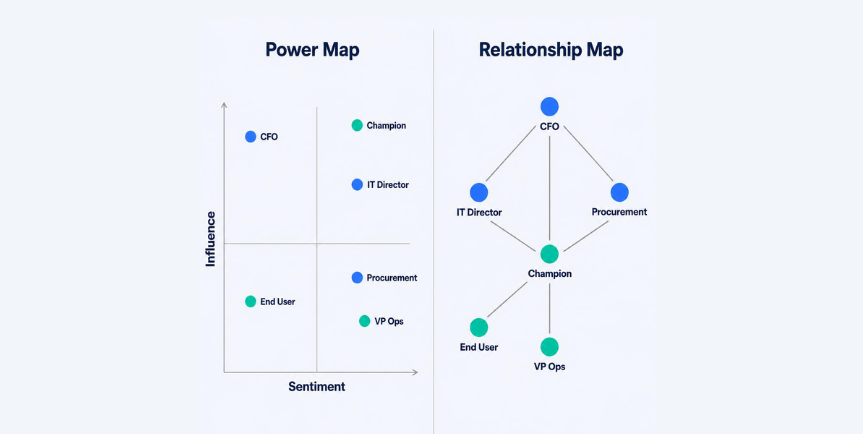
The power map
A power map plots stakeholders on two axes: influence and sentiment. Influence runs from low to high, sentiment from blocker to champion. The result is a quadrant view.
- High influence champions are your assets to protect.
- High influence blockers are your existential threats.
- Low influence supporters are nice to have but will not move the deal.
This visual instantly shows whether your support is concentrated where the power is or scattered among people who cannot help you:
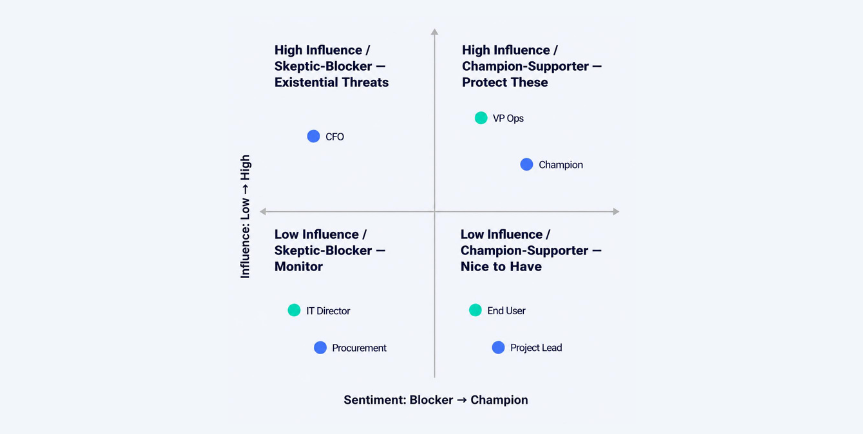
The power-interest grid: where each B2B stakeholder lands decides how you engage them.
The relationship map
A relationship map shows the connections between stakeholders, who reports to whom, who trusts whom, and where information flows. This matters because deals are won through internal advocacy you never witness. If your champion has no relationship with the economic buyer, your message has to travel through someone else, and it degrades along the way. Mapping these internal connections tells you which paths to your decision maker are open and which are blocked.
The best account planning practice combines both. The power map tells you who to focus on. The relationship map tells you how to reach them.
A Ready to Use Stakeholder Mapping Template
Here is a template structure you can build in a spreadsheet today or adapt into your CRM as part of a broader account planning template. Create one row per stakeholder with these columns:
Prefer not to build it from scratch? Grab the ready-made version: a fill-in power-interest grid with quadrant and engagement-strategy columns that calculate automatically, plus a worked example row.
- Column one: stakeholder name.
- Column two: title and department.
- Column three: reports to.
- Column four: buying role, chosen from economic buyer, technical buyer, user buyer, coach, or influencer.
- Column five: influence level, scored high, medium, or low.
- Column six: sentiment, scored champion, supporter, neutral, skeptic, or blocker.
- Column seven: relationship strength, scored none, weak, moderate, or strong.
- Column eight: relationship owner, the rep on your team who manages this contact.
- Column nine: last meaningful interaction date.
- Column ten: next action.
The last three columns are what separate a living map from a dead one. The relationship owner field assigns accountability so no stakeholder falls through the cracks. The interaction date field surfaces stakeholders who have gone quiet. The next action field forces forward motion. When a deal review opens this template, the leader can immediately see who owns the CFO relationship, when they last spoke, and what happens next.
Mapping the Buying Committee in Complex Deals
Enterprise deals rarely have a clean committee. This complexity is exactly why key account management treats the buying committee as a moving target, not a fixed list. In life sciences, a single purchase might touch clinical, regulatory, procurement, IT security, and the commercial team, each with its own agenda. In financial services, risk and compliance carry veto power that the business sponsor cannot override. Your template has to capture these cross functional dynamics.
Group stakeholders by function, then identify the dominant concern of each group. The IT security reviewer cares about data handling and integrations, not your ROI story. The CFO cares about total cost and payback period. The end user cares about whether the tool makes their day easier. A stakeholder map that ignores these differing motivations produces a one size fits all pitch that resonates with no one.
Pay special attention to the people who can say no but never say yes. Procurement and security rarely champion a deal, but they routinely kill them late in the cycle. Map them early, engage them before they become a surprise obstacle, and document their specific requirements as a field on your template.
Keeping the Map Current
The single biggest failure mode of stakeholder mapping is staleness. A map built during discovery and never updated is worse than no map because it creates false confidence. Stakeholders change roles, sentiments shift after demos, and new players enter when the deal reaches procurement.
Build a refresh cadence into your sales process. At minimum, update the map after every significant interaction and before every internal deal review. Tie updates to stages in your opportunity workflow so the map evolves with the deal. The most reliable way to keep a map current is to make it part of the tools sellers already use every day rather than a separate document they have to remember to open. This is precisely why CRM native stakeholder mapping outperforms standalone spreadsheets and slides.
Spreadsheet, Slide, or CRM Native Tool
You can build a stakeholder map in three places, and the choice has real consequences.
The spreadsheet approach
Spreadsheets are free, flexible, and fast to start. They work for a single rep managing a handful of accounts. They fail at scale because they live outside the CRM, do not update automatically, and become a manual chore that sellers abandon under quota pressure. There is also no visual power map without heavy manual formatting.
The slide approach
PowerPoint and Lucidchart produce polished visual maps for executive reviews. They look great in a QBR. But they are static snapshots, disconnected from live CRM data, and rarely reflect the deal as it stands today. They are presentation artifacts, not working tools.
The CRM native approach
Tools like Prolifiq CRUSH embed stakeholder mapping directly inside Salesforce, making them a strong fit if you're evaluating account planning software. Contacts pull from existing CRM records, maps update as data changes, and the visual power map renders automatically from the underlying scores. Pricing for these platforms typically runs from roughly 30 to 90 dollars per user per month depending on functionality and contract size.
For any team running more than a few complex deals, the native approach pays for itself by eliminating manual duplication and by surfacing risk in real time. The map becomes part of the deal, not a report about it.
Common Mistakes That Break Stakeholder Maps
Even with a solid template, teams fall into predictable traps:
- Single threading: building the entire deal on one champion and skipping the rest of the committee.
- Sentiment inflation: scoring everyone as a supporter to make the deal look healthy.
- Treating the map as a one time exercise rather than a living document.
- Mapping only the friendly faces and ignoring the blockers, which means the deal dies from a threat you chose not to see.
- Keeping the map in a place only one person can access, so the knowledge never becomes a team asset.
Avoid these and your template becomes a genuine source of deal intelligence rather than busywork.
Frequently Asked Questions
What is the difference between a stakeholder map and a buying committee?
The buying committee is the group of people who influence the purchase. A stakeholder map is the documented framework that captures who those people are, their roles, influence, sentiment, and your relationship with each. The committee is the reality; the map is your model of it.
How many stakeholders should I map per deal?
Map everyone who can meaningfully influence or block the decision, which in enterprise deals usually means six to twelve people. Mapping fewer means you are likely single threading. Mapping dozens of low influence contacts adds noise without insight, so focus on the people who actually move the deal.
How often should I update my stakeholder map?
Update it after every significant interaction and before every internal deal review. Sentiment and relationship strength are the most volatile fields and should reflect the deal as it stands today, not as it looked during discovery.
Can I do stakeholder mapping in a spreadsheet?
Yes, for a small number of accounts. Spreadsheets break down at scale because they live outside your CRM, require manual updates, and get abandoned under pressure. Teams running many complex deals get more value from a Salesforce native tool that keeps the map synced with live data.
What scoring scale should I use for influence and sentiment?
Keep it simple. Use high, medium, low for influence and a five point scale from blocker to champion for sentiment. Tie every score to observable evidence so the map stays honest rather than optimistic.
Who owns the stakeholder map?
The opportunity owner owns the overall map, but individual stakeholders should have assigned relationship owners across the account team. This ensures no key contact goes unmanaged and that coverage is shared rather than concentrated in one person.
Turn Your Stakeholder Map Into a Living Deal Asset
A stakeholder mapping template is only as valuable as it is current, shared, and tied to the deals it describes. Spreadsheets and slides give you a starting point, but they decay the moment the deal moves and they isolate critical knowledge inside one person's files. The teams that win complex enterprise deals run their stakeholder maps where they sell, inside Salesforce, updated automatically, visible to the whole account team.
Prolifiq CRUSH brings power maps, relationship mapping, and buying committee tracking directly into your CRM, so the map updates as your deals do and surfaces relationship gaps before they cost you the deal. No exports, no stale slides, no knowledge walking out the door. See how CRUSH turns stakeholder mapping into a living account planning practice at /platform/crush.