
Account manager and account executive get used interchangeably in most B2B revenue organizations, but they sit on opposite sides of the revenue lifecycle, with different success metrics, skills, compensation structures, and tooling. Confusing them costs money. An account executive running a renewal book means churn rises. An account manager hunting net new logos means pipeline dries up. Both show up in your Salesforce dashboards as missed quota, slipping retention, and forecasts nobody trusts.
The distinction matters more now than five years ago. Net revenue retention, the metric that drives enterprise valuations, lives squarely in the account manager's domain, while longer sales cycles and larger buying committees have made the account executive's job more complex. Revenue leaders building or restructuring a go-to-market motion need to know where each role starts and ends, how to staff them, and how to equip both with the right account planning and enablement infrastructure inside Salesforce.
This guide covers account manager vs account executive responsibilities, success metrics, compensation benchmarks, career paths, and the skills and handoff process that determine whether revenue gets protected. Built on the operational reality that both roles fail without a shared system of record and disciplined account planning.
The core difference: hunting versus farming
The cleanest way to understand the account manager vs account executive split is the classic hunter versus farmer framing. The account executive is the hunter. Their job is to acquire new revenue, whether that means landing brand new logos or closing expansion deals that require a full sales cycle. They live in the pipeline. They run discovery, build business cases, navigate procurement, and sign contracts.
The account manager is the farmer. Their job is to grow and protect revenue inside accounts that already belong to the company. They own renewals, drive adoption, surface expansion opportunities, and serve as the strategic point of contact after the deal closes. Where the account executive measures success in new bookings, the account manager measures success in retention and growth of an existing book.
This framing breaks down at the edges, which is where confusion creeps in. In many organizations the account manager also closes expansion deals, which makes them part hunter. In others the account executive owns the account for the first 90 days post sale before handing off. The titles overlap because the work overlaps. But the center of gravity is clear: account executives create revenue that did not exist, and account managers protect and expand revenue that does.
Account Executive vs Account Manager at a Glance
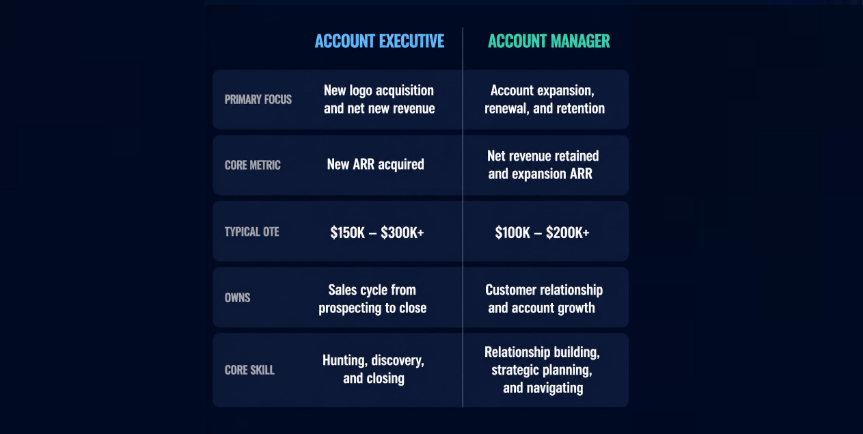
Primary focus: account executives create new revenue (hunting); account managers protect and grow existing revenue (farming).
Core metric: account executives are measured on new bookings and quota attainment; account managers are measured on net revenue retention and renewal rate.
Typical OTE in enterprise B2B SaaS: account executives run 140,000 to 320,000 dollars with a roughly 50/50 base to variable split; account managers run 100,000 to 200,000 dollars with a roughly 65/35 split.
Owns: account executives own the deal cycle through close; account managers own onboarding, renewal, and expansion.
Core skill: account executives win on discovery and deal orchestration; account managers win on relationship depth and account strategy.
Account executive responsibilities in detail
The account executive owns the deal from qualified opportunity to closed won. In a typical B2B SaaS or enterprise sales motion, that means a defined set of responsibilities.
Pipeline generation and qualification
While sales development reps often source the top of funnel, strong account executives self source a meaningful share of their own pipeline. They qualify opportunities using a framework like MEDDICC or BANT, disqualify fast, and protect their time for deals that can actually close in the quarter.
Discovery and business case development
The account executive runs discovery to uncover the prospect's pain, the cost of inaction, and the metrics that matter to the economic buyer. They translate product capability into business outcomes and build the case that justifies spend.
Multithreading and stakeholder mapping
Enterprise deals now involve buying committees of six to ten people. The account executive must map every stakeholder, understand each person's win, and avoid single threading into one champion who could leave or lose influence. This is where account executives who use structured relationship mapping inside their CRM outperform those who keep it in their heads.
Negotiation and close
The account executive manages pricing, procurement, legal redlines, and the close. They forecast their deals honestly and own the number they commit to. The job ends, formally, at signature.
Account manager responsibilities in detail
The account manager picks up where the account executive leaves off, but their work is continuous rather than transactional. If you are writing an account manager job description or just asking what an account manager actually does day to day, the sections below are it: onboarding, renewals, expansion, and relationship health, not new logo hunting.
Onboarding and adoption
The first 90 days after a sale determine whether a customer renews. The account manager, often working with customer success, ensures the product gets deployed, users get trained, and the value promised in the sale actually materializes. Low adoption is the leading indicator of churn.
Renewal management
The account manager owns the renewal. That means forecasting renewal dates, managing the commercial conversation, and securing the contract before it lapses. In a healthy book, renewals are a formality because value has been demonstrated continuously. In a neglected book, every renewal becomes a fire drill.
Expansion and whitespace
The account manager identifies whitespace: products the customer does not yet own, departments not yet using the platform, and use cases not yet adopted. They build expansion plans and either close those deals themselves or hand qualified expansion opportunities back to an account executive, depending on the model.
Relationship and risk management
The account manager maintains executive relationships, monitors account health, and acts on early warning signs of churn. They are the early warning system for the revenue base. The best account managers run formal quarterly business reviews and maintain a living account plan rather than reacting when a renewal appears on the calendar.
Success metrics: how each role is measured
The metrics make the difference unmistakable. Account executives and account managers should never be measured the same way, and compensation should follow the metric.
Account executives are measured on new bookings or net new annual recurring revenue, quota attainment, win rate, average deal size, and sales cycle length. The dominant number is quota attainment against a new business target.
Account managers are measured on gross revenue retention, net revenue retention, renewal rate, expansion revenue, and account health scores. Net revenue retention above 110 percent is the benchmark that signals a healthy account management function in B2B SaaS. Best in class organizations push past 120 percent.
A common mistake is loading an account manager with a new logo quota or grading an account executive on retention they cannot control after handoff. When the metric does not match the role's actual influence, the comp plan rewards the wrong behavior and the rep optimizes for the wrong outcome.
Compensation benchmarks for both roles
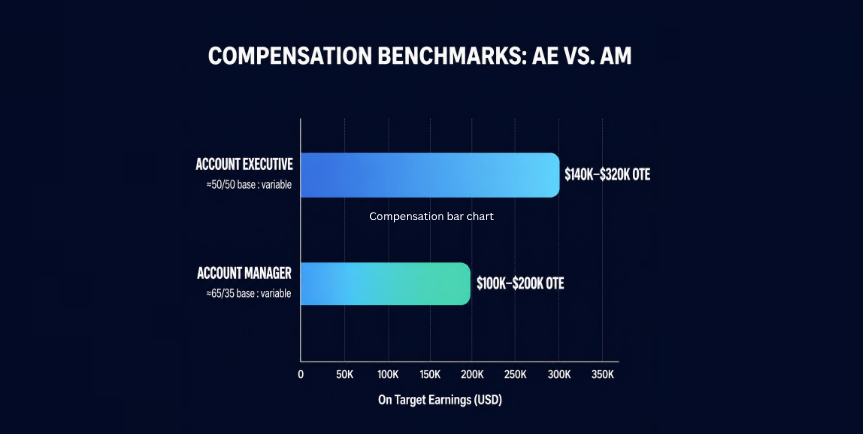
Compensation reflects the difference in revenue risk. Account executives typically carry a more aggressive variable component because they create revenue from scratch.
For enterprise B2B SaaS in the United States, account executive on target earnings commonly land between 140,000 and 320,000 dollars depending on segment, with a roughly 50 to 50 base to variable split. A strong enterprise account executive closing seven figure deals can exceed that with accelerators.
Account managers generally carry a higher base ratio because retention is steadier and more predictable than new business. On target earnings often fall between 100,000 and 200,000 dollars, with a split closer to 65 base to 35 variable. Strategic account managers managing large books or named global accounts can earn comparably to enterprise account executives.
These ranges shift by vertical. In life sciences and financial services, where deal sizes and regulatory complexity run high, both roles command premiums. The point for revenue leaders is to align variable pay with the metric the role actually controls.
Skills that separate strong performers
Account executives win on business acumen, discovery, and deal orchestration. The best ones diagnose problems before pitching solutions, build economic cases that survive procurement scrutiny, and orchestrate complex buying committees without losing momentum. They are comfortable with rejection and disciplined about pipeline hygiene.
Account managers win on relationship depth, account strategy, and consultative selling without the pressure of a transactional close. The best ones think like consultants, anticipate the customer's roadmap, and surface expansion opportunities the customer had not articulated yet. They read account health signals early and act before risk becomes churn.
Both roles share a non negotiable skill: the discipline to keep an accurate, structured account plan inside the CRM. Reps who carry the account in their head do not scale, and they leave a knowledge vacuum when they move on. Reps who maintain living account plans create durable, transferable account knowledge that survives turnover.
The handoff problem: where revenue leaks
The single largest operational failure in the account manager vs account executive relationship is the handoff. When an account executive closes a deal and tosses it over the wall to an account manager with nothing but a contract, the account manager starts blind. They do not know which stakeholders were involved, what was promised, what the customer's success criteria are, or where the political landmines sit.
This is where deals that looked great at signature turn into churn at renewal. The fix is structural, not cultural. A formal handoff requires a shared account plan that captures stakeholder maps, the original business case, success metrics, and known risks, all inside Salesforce where both roles work. When the account executive's relationship map and business case carry forward into the account manager's plan, continuity is preserved and the customer never feels the seam.
Organizations that treat the handoff as a documented process with a shared system of record retain measurably more revenue than those that rely on a quick Slack message and a calendar invite.
When you need each role and how to sequence hiring
Early stage companies often blur the roles out of necessity. A founder led sales motion has one person doing both jobs. As you scale, separate them deliberately.
Hire account executives first when you are still proving the motion and need new logos to establish product market fit. Add dedicated account managers once your installed base grows large enough that renewals and expansion represent a material revenue opportunity, typically when recurring revenue from existing customers starts to rival new business potential.
The trigger to specialize is usually a retention problem. When account executives stop hunting because they are babysitting existing accounts, or when renewals start slipping because nobody owns them, it is time to split the roles. The cost of a dedicated account management function is almost always lower than the cost of preventable churn.
How account planning ties both roles together
Whether you call it account planning, account management, or strategic account growth, both roles depend on the same underlying discipline. A current account plan answers the questions both roles need: who are the stakeholders, what is the whitespace, what is the relationship strength, what is the revenue at risk, and what is the next best action.
The problem is that account planning often lives in slide decks and spreadsheets disconnected from Salesforce. Those documents go stale within weeks, never get updated, and become useless at exactly the moment they matter, such as a renewal or an executive change. Account planning has to live where the work happens, natively inside the CRM, so that both the account executive and the account manager see the same truth and update it in real time.
This is the difference between account planning as a periodic exercise and account planning as an operating system. The first is a meeting. The second is how revenue gets protected and grown every day.
Frequently asked questions
Is an account manager higher than an account executive?
Neither role is inherently senior to the other. They are parallel functions on different sides of the revenue lifecycle. In some companies an enterprise account executive outranks an account manager in comp and seniority, while in others a strategic account manager managing global accounts is the more senior role. Seniority depends on the segment and book size, not the title.
Can one person do both jobs?
In early stage or smaller companies, yes, and often must. But as deal volume and your installed base grow, doing both creates a conflict of attention. Hunting and farming require different mindsets and time horizons, so most scaling organizations separate the roles to let each person focus.
Which role earns more money?
Enterprise account executives typically have higher earning ceilings because of aggressive variable plans and large new business quotas. However, strategic account managers with large books and strong net revenue retention can match or exceed account executive earnings, especially as companies tie more compensation to retention and expansion.
What metric matters most for account managers?
Net revenue retention is the headline metric. It captures renewals, expansion, and churn in a single number. A net revenue retention rate above 110 percent indicates a healthy account management function, and above 120 percent is best in class for B2B SaaS.
How do account executives and account managers avoid stepping on each other?
Clear ownership rules and a shared account plan. Define exactly who owns the renewal, who owns expansion, and at what point the account executive hands off. When both roles work from the same account plan inside Salesforce, overlap turns into collaboration instead of conflict.
Do account managers carry quotas?
Most do, but the quota is usually expansion and retention based rather than new logo based. They are accountable for growing the book and protecting it, measured in net revenue retention and expansion revenue rather than net new bookings.
Equip both roles with account planning that lives in Salesforce
The account manager vs account executive debate ultimately comes down to one operational truth: both roles fail without a shared, current account plan inside the system where they already work. The account executive needs stakeholder maps and business cases that carry forward. The account manager needs whitespace, relationship health, and renewal visibility. Neither can rely on slide decks that go stale or knowledge trapped in someone's head.
Prolifiq CRUSH delivers Salesforce native account planning that gives account executives and account managers a single source of truth. Relationship maps, whitespace analysis, and account plans live inside Salesforce, so the handoff is seamless and the account knowledge survives turnover. Revenue teams in life sciences, financial services, manufacturing, and technology use CRUSH to protect and grow their most strategic accounts without leaving the CRM. See how CRUSH powers account planning for both roles.