Every B2B revenue team eventually hits the same wall. Reps fill the pipeline with deals that feel real, the forecast looks healthy, then close quarter arrives and half of it slips or dies. The cause is rarely effort. It is qualification. Most teams either do not have a consistent framework for separating real opportunities from polite interest, or they have one that no longer fits the deals they actually run. That is why the debate between BANT and MEDDIC keeps resurfacing in sales kickoffs, enablement reviews, and CRO planning sessions.
BANT, born inside IBM in the 1960s, asks four blunt questions: does the prospect have Budget, Authority, Need, and a Timeline. MEDDIC, developed at PTC in the 1990s during a period of explosive growth, goes deeper into the mechanics of how enterprise deals actually get bought. The two are not simply old versus new. They serve different deal shapes, different sales cycles, and different organizational maturity levels. Choosing wrong costs you forecast accuracy and rep productivity. Choosing right gives your managers a shared language for inspecting deals and your reps a repeatable way to disqualify fast.
This article breaks down both frameworks in detail, compares them head to head across the dimensions that matter, and gives you a clear decision path for which one belongs in your sales process. We will also cover how to operationalize either framework inside Salesforce so qualification stops being a slide and starts being a system.
What BANT Actually Measures
BANT is a four part checklist designed for speed. It exists to answer one question early: should a rep spend more time on this deal or not. Each letter is a gate.
Budget asks whether the prospect has money allocated or accessible for a purchase. Authority asks whether you are talking to someone who can sign or strongly influence the signature. Need asks whether there is a real business problem your product solves. Timeline asks when the prospect intends to make a decision.
The strength of BANT is its bluntness. A rep can run a discovery call, score the deal across all four dimensions, and decide in under thirty minutes whether to advance it. For transactional and mid market sales motions where deals close in 30 to 90 days and involve one or two decision makers, BANT is fast and effective.
Where BANT Falls Short
BANT was built for an era when one person held the budget and made the call. In modern enterprise B2B, the average buying group includes 6 to 10 people according to Gartner, and budget often does not exist until the buyer is convinced the problem is worth solving. Asking about budget too early in a complex deal can kill momentum or surface a fake number. BANT also says nothing about your competition, your champion, or the buyer's internal decision process. It tells you whether a deal is qualified to pursue, not how to win it.
What MEDDIC Actually Measures
MEDDIC is an acronym for Metrics, Economic Buyer, Decision Criteria, Decision Process, Identify Pain, and Champion. Some teams extend it to MEDDICC, adding Competition, or MEDDPICC, adding Paper Process. It was designed for high value, complex enterprise sales where deals take 6 to 18 months and involve large buying committees.
Metrics force the rep to quantify the economic impact of solving the problem. Economic Buyer identifies the person who controls the money and cares about ROI. Decision Criteria documents what the buyer will use to evaluate options. Decision Process maps the steps, approvals, and stakeholders involved in getting to signature. Identify Pain digs into the business pain that justifies action. Champion identifies the internal advocate who sells for you when you are not in the room.
Why MEDDIC Wins Complex Deals
MEDDIC is diagnostic, not just a checklist. It exposes the gaps in a deal. If a rep cannot name the economic buyer, that is a red flag the deal is being run too low in the organization. If there are no quantified metrics, the buyer has no business case and will deprioritize the purchase. MEDDIC turns qualification into deal coaching, which is why it has become the default framework for enterprise SaaS sales teams at companies like Snowflake, MongoDB, and Splunk. The tradeoff is that MEDDIC requires more discipline and more information. It is heavier to run, and it does not fit a 30 day transactional cycle.
BANT vs MEDDIC: The Head to Head Comparison
The clearest way to choose is to compare the frameworks across the dimensions that drive sales outcomes.
Dimension
BANT
MEDDIC
MEDDPICC
tr>
Deal complexity
td>
1-2 stakeholders
Large buying committees
Large committees plus procurement and legal
tr>
Sales cycle
td>
30-90 days
90 days to 18 months
6-18+ months
tr>
Deal size (ACV)
td>
Under $50K
Above $100K
Above $100K, competitive or regulated deals
tr>
Forecast accuracy
td>
Weak. Timeline field is a guess
Strong. Named economic buyer, mapped process, active champion
Strongest. Adds competition and paper process visibility
tr>
Rep ramp time
td>
Days
About 90 days to internalize
90+ days, more coaching overhead
tr>
Best fit
td>
Transactional, SDR-qualified leads
Enterprise SaaS, complex committees
Enterprise deals with heavy procurement or active competitive threats
tr>tbody>
The Hybrid Reality: Most Teams Use Both
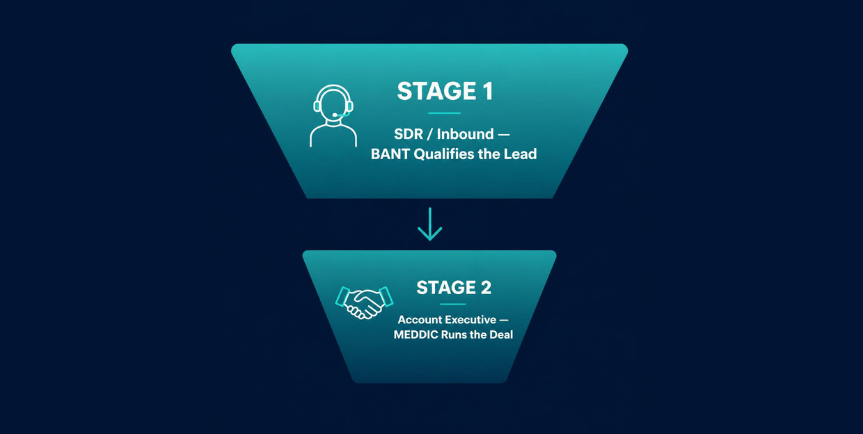
The framing of BANT versus MEDDIC as an either or choice is misleading. High performing revenue organizations frequently use both at different stages of the funnel. SDRs and inbound teams use BANT to qualify whether a lead is worth routing to an account executive. The AE then applies MEDDIC across the full sales cycle to qualify, coach, and close the opportunity.
This layered approach respects the strengths of each. BANT is a fast filter at the top of the funnel. MEDDIC is a deal management discipline once an opportunity is real. A common pattern looks like this: an SDR confirms there is a need, a rough budget, a relevant contact, and a plausible timeline. That earns a meeting. The AE then spends the next several months building out metrics, finding the economic buyer, documenting decision criteria, mapping the decision process, deepening the pain, and developing a champion.
The risk of running both poorly is confusion. If your team does not clearly define which framework applies at which stage, reps default to whatever feels comfortable, and your CRM fills with inconsistent qualification data. The fix is to encode the handoff explicitly in your sales process and your Salesforce stages.
How Qualification Frameworks Break Down in the Real World
Both frameworks fail for the same reason: they live in a methodology slide deck instead of the system reps work in every day. A rep gets MEDDIC training at sales kickoff, nods along, and then goes back to their pipeline where nothing prompts them to fill in the economic buyer or document the decision process. Within a quarter, the framework has evaporated.
The companies that actually get value from BANT or MEDDIC do three things. First, they make the framework fields a required part of opportunity records in Salesforce, not optional notes. Second, they tie deal inspection in pipeline reviews directly to the framework, so a manager asks every week who the economic buyer is and what the decision criteria are. Third, they use the framework to disqualify, not just to qualify. The point of MEDDIC is to find the holes in a deal early enough to either fix them or walk away.
The Account Planning Connection
Qualification frameworks become far more powerful when connected to structured account planning. MEDDIC's champion and economic buyer fields are essentially relationship mapping. Its decision process is essentially a buying committee map. When you run account planning that captures org charts, relationship strength, white space, and stakeholder influence, you are already collecting the inputs MEDDIC depends on. Separating qualification from account planning forces reps to enter the same intelligence twice in two different places. Integrating them means one source of truth.
Choosing the Right Framework for Your Team
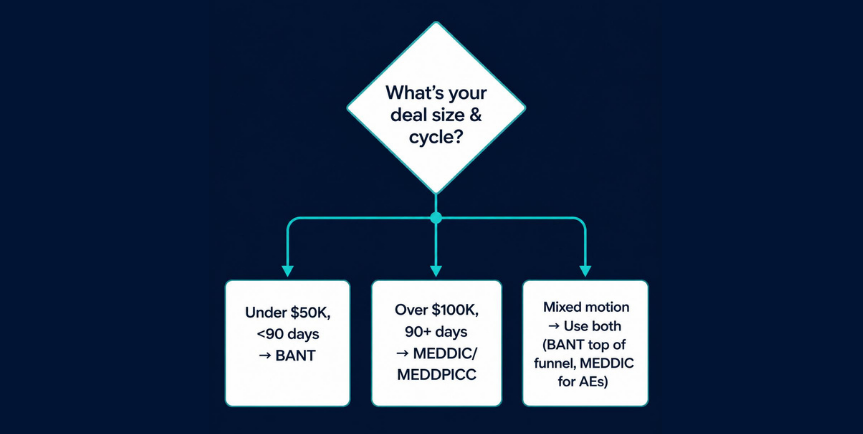
Use this decision logic. If your average deal is under 50,000 dollars, closes in under 90 days, and involves one or two stakeholders, start with BANT. It is fast, easy to teach, and proportionate to the deal size.
If your average deal is over 100,000 dollars, closes in 90 days or longer, and involves a buying committee, adopt MEDDIC or MEDDPICC. The added rigor pays for itself in forecast accuracy and win rate.
If you run a mixed motion with both transactional and enterprise deals, layer the two. BANT at the top of the funnel for routing and prioritization, MEDDIC for the enterprise opportunities your AEs own. Define the boundary clearly and enforce it in your CRM.
Whatever you choose, the framework only works if it is operationalized. A framework that lives in a training deck is worthless. A framework encoded in your Salesforce opportunity record, surfaced in pipeline reviews, and tied to account planning becomes a durable competitive advantage.
Common Mistakes Teams Make With Both Frameworks
The first mistake is treating qualification as a one time event. Reps qualify on the first call and never revisit it. Deals change. The economic buyer leaves, the timeline slips, a competitor enters. Qualification has to be continuous.
The second mistake is qualification theater. Reps fill in the fields to satisfy their manager without genuinely understanding the deal. A MEDDIC scorecard full of guesses is worse than no scorecard because it creates false confidence in the forecast.
The third mistake is failing to disqualify. Both BANT and MEDDIC exist as much to remove bad deals as to advance good ones. Teams that only ever score deals up and never walk away clog the pipeline with deals that will never close, which destroys forecast accuracy and wastes rep capacity.
The fourth mistake is choosing a framework that does not match the deal. Running BANT on a 500,000 dollar enterprise deal leaves you blind to the decision process. Running full MEDDPICC on a 10,000 dollar transactional deal adds friction the deal does not need.
Frequently Asked Questions
Is MEDDIC better than BANT?
Not universally. MEDDIC is better for complex, high value enterprise deals with long sales cycles and large buying committees. BANT is better for fast, transactional deals with one or two stakeholders. The right answer depends on your deal profile. Many teams use both at different funnel stages.
What is the difference between MEDDIC, MEDDICC, and MEDDPICC?
MEDDIC is the original six element framework. MEDDICC adds Competition as a seventh element. MEDDPICC adds both Competition and Paper Process, which covers legal, procurement, and contract steps. The longer versions matter most for large enterprise deals where procurement and competitive dynamics significantly affect the outcome.
Is MEDDIC spelled MEDICC?
No. The framework is MEDDIC (Metrics, Economic Buyer, Decision Criteria, Decision Process, Identify Pain, Champion). MEDICC without the second D is an unrelated healthcare nonprofit and has nothing to do with sales qualification.
What is BANT and MEDDIC?
BANT and MEDDIC are the two most widely used sales qualification frameworks. BANT checks Budget, Authority, Need, and Timeline to quickly filter leads. MEDDIC goes deeper, scoring Metrics, Economic Buyer, Decision Criteria, Decision Process, Identify Pain, and Champion to qualify and coach complex enterprise deals.
Can BANT and MEDDIC be used together?
Yes, and many high performing teams do exactly this. SDRs and inbound teams use BANT to quickly qualify whether a lead warrants a meeting. Account executives then apply MEDDIC across the full sales cycle to qualify, coach, and close the opportunity. The key is defining clearly which framework applies at which stage.
Which framework produces better forecast accuracy?
For enterprise deals, MEDDIC produces significantly better forecast accuracy because it scores the strongest predictors of close: a named economic buyer, a documented decision process, and an active champion. BANT's timeline field is a weak predictor since prospects routinely provide optimistic dates that slip.
How long does it take to roll out MEDDIC?
Expect 90 days for reps to internalize MEDDIC well enough to apply it consistently, and 6 to 12 months for it to become embedded in deal reviews and forecasting. Rollout is faster when the framework is built directly into your CRM and pipeline review cadence rather than taught only in a sales kickoff session.
Does qualification framework choice affect win rate?
Yes. Teams that match their framework to their deal complexity and then enforce it consistently see measurable improvements in win rate and reductions in slipped deals. The improvement comes less from the framework itself and more from the discipline of consistent, continuous qualification.
Turn Your Qualification Framework Into a System
BANT and MEDDIC both fail when they live in a slide deck instead of the system your reps work in. The frameworks only deliver forecast accuracy and higher win rates when their fields are required in your opportunity records, surfaced in every pipeline review, and connected to the account intelligence your reps already maintain.
This is exactly what Prolifiq CRUSH delivers. As a Salesforce native account planning platform, CRUSH lets you embed qualification directly into the records and account plans your team already uses. Map the economic buyer and champion through relationship and org charting. Document decision criteria and decision process inside structured account plans. Surface qualification gaps in real time so managers can coach deals instead of guessing at forecasts. Because CRUSH runs entirely inside Salesforce, your qualification data and your account intelligence live in one source of truth instead of scattered across spreadsheets and slide decks.
If you are tired of frameworks that evaporate after kickoff, see how Prolifiq turns BANT and MEDDIC into an operational system your team actually uses. Explore Prolifiq CRUSH and start qualifying deals where the work already happens.