Why Most Sales Kickoffs Fail to Move the Number
The average company spends between $1,500 and $3,000 per rep on a sales kickoff. For a 200 person revenue org, that is a $400,000 to $600,000 event when you add travel, venue, speakers, and lost selling days. Yet most sales kickoffs produce nothing measurable. Reps fly in, sit through 30 PowerPoint decks, drink at the awards dinner, fly home, and revert to exactly what they were doing the week before. The energy lasts about nine days.
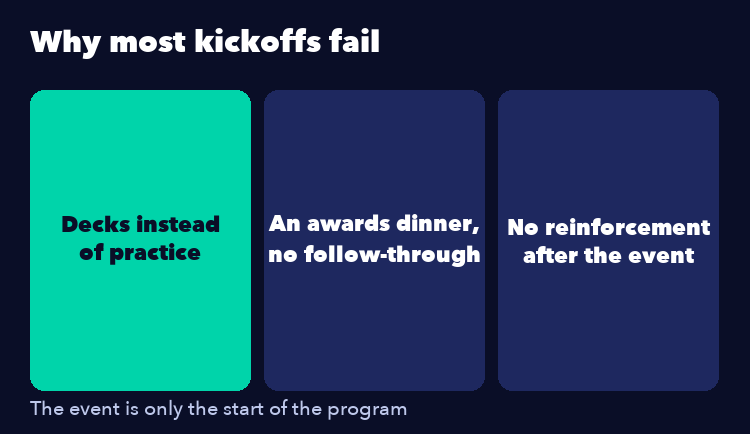
The problem is not that kickoffs are unnecessary. A well run sales kickoff is the single best opportunity all year to reset priorities, retrain the field on a new message, and align selling motions with the company strategy. The problem is that most SKOs are designed as entertainment and information dumps rather than as behavior change events. Leadership measures success by attendance and energy in the room, not by quota attainment in Q1 and Q2.
This guide treats the sales kickoff as a revenue program, not a party. We will cover how to set objectives that tie to pipeline, how to build an agenda that respects adult learning, how much to budget, how to handle remote and hybrid formats, what to measure, and how to make the lessons stick long after reps return to their territories. If you are responsible for planning an SKO this year, the difference between a forgettable event and one that lifts attainment comes down to the decisions you make in the next several sections.
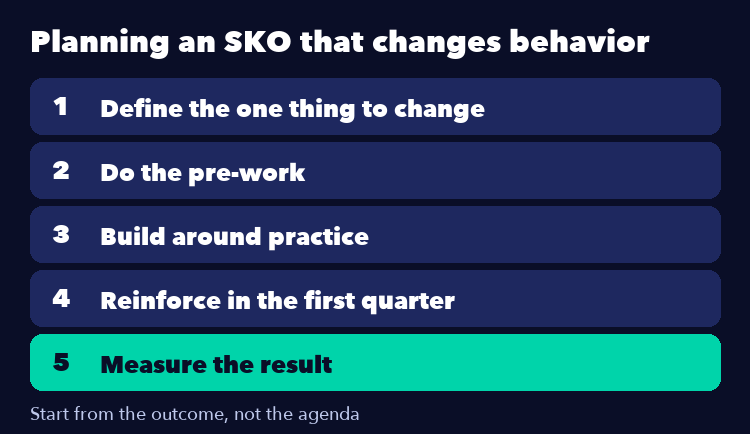
Define the One Thing Your SKO Must Change
Every effective sales kickoff has a single, dominant theme that every session ladders up to. Not three themes. One. If your reps cannot summarize the point of the kickoff in a single sentence on the flight home, the event failed.
Start by asking what one behavior change would most improve revenue this year. Maybe it is selling a new product into the existing base. Maybe it is moving upmarket to larger accounts. Maybe it is improving multithreading because too many deals die on a single champion. Whatever it is, that becomes the spine of the agenda.
Translate strategy into rep behavior
Executives think in strategy. Reps think in what they do on Monday. Your job is to translate. "Expand into enterprise" means nothing to a rep. "Build a multi stakeholder account plan for your top five accounts and identify three new buying contacts in each" is something a rep can act on. Write every objective as an observable behavior, then design sessions that teach and rehearse that behavior.
Set a measurable target
Attach a number to the theme. If the goal is account expansion, the metric might be a 20 percent increase in average accounts touched per rep within 90 days. Without a metric you cannot prove ROI, and you cannot defend next year's budget.
Build the Agenda Around Practice, Not Presentation
The biggest mistake in sales kickoff design is filling the agenda with one way communication. Adults retain roughly 10 percent of what they hear in a lecture and 75 percent of what they practice. Yet the typical SKO is 80 percent lecture.
Flip the ratio. Aim for at least half your agenda to be active: role plays, deal reviews, account planning workshops, certification drills, and small group problem solving. Keynotes and product announcements still matter, but cap them. No general session block should run longer than 90 minutes without an interactive component.
A sample three day structure
Day one: vision and context. The CEO and CRO set the strategy, the market reality, and the one thing. Keep it tight. End with breakout sessions where reps discuss what the strategy means for their own territory.
Day two: skills and execution. This is the working day. Run product certification, messaging workshops, competitive battlecard drills, and account planning sessions. Reps should leave day two with a started plan for at least one real account.
Day three: reinforcement and commitment. Reps present their plans, get coached, and commit to specific actions with dates. Close with awards and recognition, which work better at the end because they reward the year rather than distract from the learning.
Get the Pre Work Right
The kickoff itself is too short to teach foundational content. Push the basics into pre work so the live event can focus on practice. Send reps short videos, product overviews, and reading two to three weeks ahead. Make completion a requirement, not a suggestion, and have managers verify it.
The best pre work has reps arrive with something half built. Ask every rep to bring a draft account plan for their largest opportunity, or a filled out competitive comparison, or their pipeline gaps documented. When reps show up with work in progress, the live sessions become about refinement and coaching rather than starting from zero. This single change dramatically increases the value of in person time.
Sales Kickoff Budget Benchmarks
Budget varies widely by company size and format, but here are realistic ranges for an in person B2B sales kickoff.
For a fully in person multi day event, expect $1,500 to $3,000 per attendee covering venue, food, lodging, and basic production. Add $500 to $1,500 per person for travel depending on geography. Outside keynote speakers run $10,000 to $50,000 each, with celebrity or bestselling author speakers reaching $75,000 and beyond.
A hybrid event reduces travel and venue costs but adds production complexity. Professional broadcast quality streaming for a hybrid SKO typically costs $20,000 to $100,000 depending on the number of remote sites and production polish.
A fully virtual kickoff can be run for $200 to $600 per attendee, mostly in platform, production, and facilitation costs. The savings are real, but so is the engagement penalty, which we cover later.
Where to spend and where to cut
Spend on facilitation, content design, and small group coaching. Cut on extravagant venues, elaborate sets, and entertainment that does not reinforce the theme. A modest venue with great content beats a luxury resort with mediocre sessions every time.
Choosing the Right Format: In Person, Virtual, or Hybrid
In person remains the gold standard for relationship building, energy, and the informal hallway conversations that often deliver the most value. If your theme depends on culture, collaboration, or new team formation, prioritize in person.
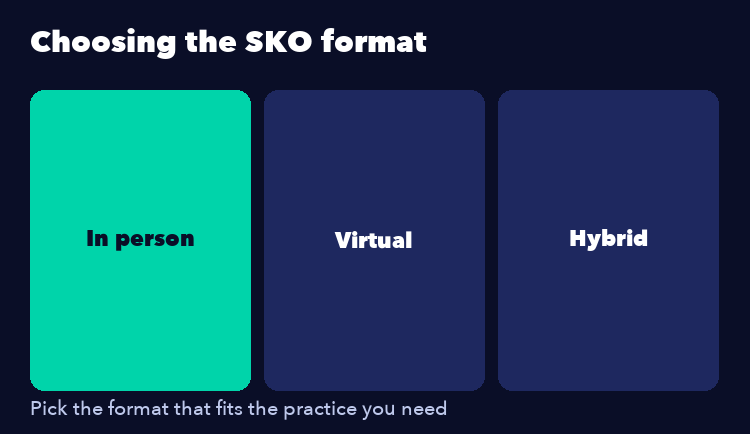
Virtual works for content delivery and is far cheaper, but engagement drops sharply after the first 90 minutes. If you go virtual, break the agenda into shorter sessions across multiple days rather than cramming everything into one marathon. Two half days will beat one full day for retention.
Hybrid is the hardest to execute well. Remote attendees almost always feel like second class participants. If you must run hybrid, assign a dedicated facilitator to the remote audience whose only job is to bring them into the conversation, and never let the in person room ignore the screen.

Make Product and Competitive Content Stick
Reps cannot sell what they cannot explain. Use the sales kickoff to certify the field on new products and updated competitive positioning. Certification means more than watching a demo. It means each rep delivers the pitch and gets scored against a rubric.
Run live competitive drills
Set up stations where reps must handle objections about specific competitors. In our world, that means rehearsing how to respond when a prospect mentions Altify, DemandFarm, Revegy, or ARPEDIO. Make the drills realistic and uncomfortable. Reps who fumble a competitive question in a safe room will not fumble it in a deal.
Tie content to the CRM
Whatever messaging and battlecards you roll out at the kickoff should live where reps work, which is Salesforce. If your enablement content sits in a separate portal that reps never open, the kickoff investment evaporates within weeks. Surface the new content inside the opportunity record so it appears at the moment of need.
Account Planning Should Be the Centerpiece
For enterprise B2B teams, the highest leverage activity at any sales kickoff is collaborative account planning. Most reps treat account plans as a once a year compliance exercise filled out the night before a QBR. The kickoff is the moment to change that.
Dedicate a multi hour block to building real account plans for real accounts. Have reps map the org chart, identify white space, document relationship strength, and define the next three plays for their top accounts. Pair them with managers and peers for live coaching. When reps leave with a started, validated plan, they are far more likely to maintain it.
The plans built at the kickoff should not live in slides or spreadsheets. They should live in Salesforce where they can be tracked, updated, and tied to pipeline. A plan that lives outside the system of record is a plan that dies by February.
The First Quarter Reinforcement Plan
The work that determines SKO ROI happens after everyone goes home. Behavior change requires repetition, and a single event cannot deliver it. Build a 90 day reinforcement plan before the kickoff even starts.
Equip frontline managers with coaching guides tied to the kickoff theme. Add the new behaviors to the weekly one on one agenda. Schedule monthly refresher sessions that revisit the messaging and the account planning discipline. Track the behaviors in your CRM dashboards so leadership can see adoption, not just sentiment.
Managers are the multiplier. If managers do not reinforce the theme, nothing sticks. Spend dedicated time at the kickoff training managers on how to coach the new behaviors, ideally in a manager only session before the full team arrives.
How to Measure Sales Kickoff Success
Stop measuring SKO success with a satisfaction survey. Energy and enjoyment are inputs, not outcomes. Measure what changed in the business.
Leading indicators
In the 30 to 60 days after the kickoff, track behavior metrics tied to your theme: account plans created, new contacts added, multithreaded deals, new product opportunities created, and certification pass rates. These tell you whether the behavior change is happening.
Lagging indicators
Over one to two quarters, measure the revenue outcomes: pipeline created in the target motion, win rate changes, average deal size, and quota attainment versus the same period last year. Compare against pre kickoff baselines so you can isolate the effect.
Document these metrics and present them when you ask for next year's budget. An SKO that can prove a measurable lift in attainment gets funded. One that can only show smiling photos does not.
Common Sales Kickoff Mistakes to Avoid
Avoid the death by PowerPoint trap where every department gets a slot and reps sit passive for two days. Avoid stacking too many themes so nothing lands. Avoid scheduling the awards and party in a way that overshadows the learning. Avoid rolling out content that does not live in Salesforce. And avoid treating the kickoff as a standalone event rather than the launch of a quarter long program. Most importantly, avoid skipping manager enablement, because managers are who make or break adoption after the lights go down.
Frequently Asked Questions
When should we hold our sales kickoff?
Most B2B companies hold SKO in January or early February to align with the calendar fiscal year and reset the field for the new annual quota. If your fiscal year differs, hold it within the first two weeks of your new year. Earlier is better so reps can act on the new priorities while the quarter is still open.
How long should a sales kickoff be?
Two to three days for an in person event is standard. Three days allows enough room for practice and coaching without burning excessive selling time. For virtual, spread the equivalent content across multiple half days to protect engagement.
How much does a sales kickoff cost per person?
In person events typically run $1,500 to $3,000 per attendee plus $500 to $1,500 in travel. Virtual events run $200 to $600 per attendee. Outside keynote speakers add $10,000 to $50,000 or more.
What is the ideal ratio of presentation to interaction?
Aim for at least 50 percent active learning through role plays, workshops, and account planning. Adults retain far more from practice than from lectures, so limit any single general session to 90 minutes before adding an interactive element.
How do we make sure the kickoff content sticks?
Build a 90 day reinforcement plan, train managers to coach the new behaviors, surface enablement content inside Salesforce where reps work, and track behavior adoption in your CRM dashboards. Reinforcement after the event matters more than the event itself.
Should we use an outside keynote speaker?
An outside speaker can energize the room, but only if their message reinforces your theme. A generic motivational talk with no connection to your strategy is a waste of budget. Brief any speaker thoroughly on your one thing.
How do we measure ROI on a sales kickoff?
Track leading indicators like account plans created and new contacts added in the first 60 days, then lagging indicators like pipeline, win rate, and attainment over one to two quarters, comparing against pre kickoff baselines.
Turn Your Kickoff Into a Year Round Revenue Program
The hardest part of any sales kickoff is making the new behaviors survive past February. The teams that succeed are the ones that put account planning and enablement content directly into Salesforce so the discipline launched at the kickoff becomes part of the daily workflow rather than a binder that gathers dust.
Prolifiq CRUSH is Salesforce native account planning that lets reps build, maintain, and execute the exact account plans they start at your kickoff, right inside the system of record. Plans stay current, white space stays visible, and managers can coach against real data instead of stale slides. When you pair CRUSH with ACE for Salesforce native enablement, the messaging and battlecards you roll out at the kickoff show up at the moment of need on every opportunity. If you want your next sales kickoff to drive measurable attainment instead of nine days of energy, see how Prolifiq CRUSH turns kickoff plans into year round execution.