Most B2B revenue teams are leaving money inside their own customer base. They pour budget into new logo acquisition while existing accounts, the ones that already trust them, drift toward renewal at flat spend or quietly churn. This is backwards. Bain & Company research has shown that increasing customer retention by just 5 percent can boost profits by up to 95 percent, and selling to an existing customer is far cheaper and far more predictable than landing a new one. Yet the discipline of systematically growing accounts remains underdeveloped at most organizations. Reps treat their book of business as a renewal queue rather than a growth portfolio. Without a documented account strategy, expansion happens by accident instead of by design.
An account growth strategy fixes this. It is a deliberate, repeatable system for expanding revenue, footprint, and relationship depth inside accounts you already own. It is not the same as account-based marketing, which focuses on acquisition. It is not the same as a renewal motion, which focuses on retention. Account growth sits in between and beyond both, treating each strategic account as a market unto itself with untapped buying centers, adjacent use cases, and stakeholders you have never met.
The teams that win at this do three things well. They have visibility into where whitespace actually exists. They have a structured plan for each account that is reviewed and updated, not written once and forgotten. And they execute against that plan with the same rigor they apply to a new business pipeline. This article breaks down how to build that capability, the frameworks that support it, the metrics that prove it works, and the tools that make it operational at scale.
What an Account Growth Strategy Actually Is
An account growth strategy is a documented plan to increase revenue from a specific set of existing accounts over a defined time horizon, usually 12 to 18 months. It identifies the gap between what an account currently spends and what it could spend if you fully penetrated every buying center, product line, and use case. Then it lays out the specific actions, relationships, and milestones required to close that gap.
The key word is specific. A vague intention to grow an account is not a strategy. A strategy names the divisions you have not sold into, the executives you need to reach, the competitive incumbents you need to displace, and the timeline for each move. It assigns ownership. It sets targets in dollars, not adjectives.
Growth versus retention
Retention keeps the revenue you have. Growth adds revenue you do not have yet. The two are related but require different motions. Retention is risk management. Growth is opportunity capture. A healthy account program tracks both, but conflating them causes reps to coast on renewals and call it success. If an account renews at the same spend three years running, that is not growth. That is stagnation wearing a renewal badge.
Why Existing Accounts Outperform New Logos
The math favors expansion. Acquiring a new customer can cost five to seven times more than expanding an existing one. Existing accounts close faster because trust, contracts, and procurement relationships already exist. They convert at higher rates because you have proof of value. And they carry lower risk because you understand their environment. McKinsey research on key-account management backs this up: companies that manage their largest accounts well can improve key-account revenue by 5 to 10 percent or more while maintaining margins.
Net revenue retention, or NRR, has become the single most watched metric in B2B SaaS for exactly this reason. A company growing NRR above 120 percent is expanding faster inside its base than it loses to churn, which means it can grow even with zero new logos. Investors reward this. Boards demand it. And it is impossible to achieve without a deliberate account growth strategy because it does not happen by accident.
The compounding effect
Account growth compounds. An account that expands 20 percent annually doubles in roughly four years. Spread across a portfolio of strategic accounts, this compounding becomes the most reliable growth engine a revenue organization has. New logo acquisition is lumpy and expensive. Expansion is steady and efficient.
Mapping Whitespace and Opportunity
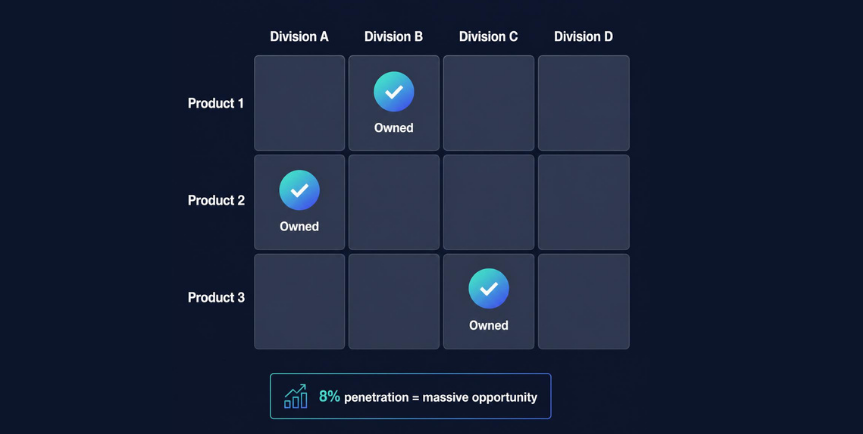
Every account growth strategy runs on the same four-step process, regardless of industry: (1) map the whitespace to see what you are missing, (2) build a living account plan that turns the map into targets, (3) map stakeholders so you know who has to say yes, and (4) execute and review on a fixed cadence so the plan stays current. The sections below walk through each step. You cannot grow what you cannot see. Whitespace mapping is the foundation of any account growth strategy. It means cataloging every product you sell against every buying center in the account and marking which combinations you own, which you have lost, and which you have never touched.
For a large enterprise account this matrix can be enormous. A manufacturing conglomerate might have a dozen divisions across multiple geographies, each a potential buyer for several of your product lines. If you sell three products into one division of a twelve division company, you are penetrating roughly 8 percent of the available footprint. That is not a mature account. That is an enormous opportunity disguised as a closed deal.
Building the whitespace matrix
Start with the account org structure. List business units, subsidiaries, and geographies. Then list your products or solution categories. At every intersection, mark current spend, competitive presence, and relationship strength. The empty cells are your roadmap. Prioritize them by deal size, ease of entry, and strategic value. This exercise alone often surfaces millions in addressable expansion that nobody on the team had quantified.
Building an Account Plan That Drives Action
A whitespace map shows the opportunity. An account plan turns it into action. The best account plans are living documents inside your CRM, not slide decks that get rebuilt once a quarter for a review meeting.
A strong account plan contains the account's strategic objectives, your revenue targets, the key relationships and their status, the active and planned opportunities, the competitive landscape, and the specific next actions with owners and dates. It connects your growth goals to the account's actual business priorities, because expansion only happens when you help the customer achieve something they care about.
Tie growth to the customer's goals
Reps who pitch their own quota lose. Reps who tie their expansion proposal to the customer's stated initiatives win. If the account is pursuing a digital transformation, frame your additional product as accelerating that transformation. The account plan should document the customer's objectives explicitly so every expansion play maps to a goal the customer already owns.
Relationship Mapping and Stakeholder Coverage
Most account loss and stalled growth traces back to thin relationships. A single champion leaves and the account goes cold. Or you are deeply connected to one division and invisible to the rest of the enterprise. Relationship mapping fixes the blind spots.
Map every relevant stakeholder by role, influence, and disposition toward you. Identify champions, detractors, economic buyers, and the people you have never met but need to. Score the strength of each relationship honestly. A coverage gap on an economic buyer is a deal you do not actually control, no matter how friendly your champion is.
Multithreading is non-negotiable
Single-threaded accounts are fragile. Research consistently shows that deals with more engaged stakeholders close at higher rates and expand more. For strategic accounts, you should have multiple relationships across multiple levels and functions. The account growth strategy should explicitly target new relationship development in any account where coverage is concentrated in one or two people.

Choosing the Right Account Growth Framework
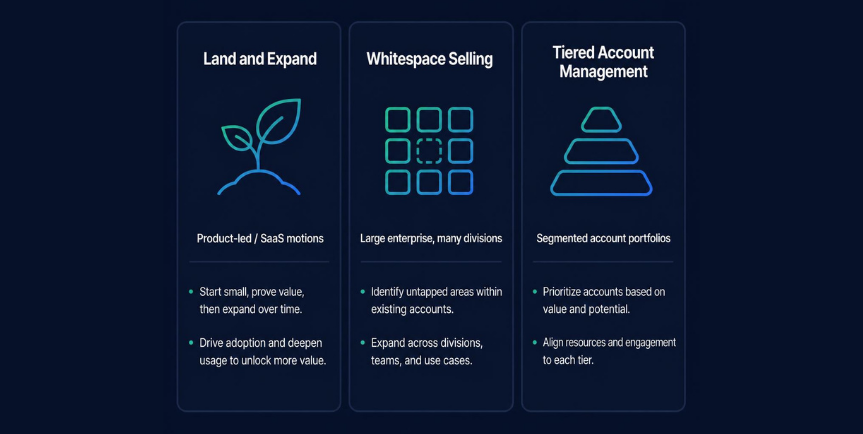
Several frameworks structure how teams pursue expansion. Each has strengths and the right choice depends on your sales motion.
Land and expand
You enter with a small initial deal, prove value, then expand into adjacent teams and use cases. This works well for product-led and SaaS motions where a single team can adopt quickly and become a reference for the rest of the organization.
Whitespace selling
You map the full product-to-buying-center matrix and systematically fill empty cells. This suits large enterprise accounts with many divisions and a broad product portfolio.
Tiered account management
You segment accounts into tiers by potential and assign investment accordingly. Top tier accounts get dedicated planning, executive sponsorship, and quarterly business reviews. Lower tiers get lighter touch programs. This concentrates effort where the payoff is highest.
The Tooling That Makes Growth Operational
Account growth at scale requires more than spreadsheets and goodwill. The discipline lives or dies on whether the planning, mapping, and execution happen inside the systems reps already use. If account plans live in a separate document or a forgotten slide deck, they will not be maintained and they will not drive behavior.
This is why Salesforce-native account planning has become the standard for serious revenue teams. When the account plan, whitespace map, and relationship map all live inside the CRM, they update with real data, surface in the rep's daily workflow, and give leadership a single view of growth across the portfolio.
Comparing the category
The account planning category includes several vendors. Altify is a long-established player now part of Upland, known for opportunity and relationship management. DemandFarm focuses on account intelligence and whitespace visualization. ARPEDIO emphasizes relationship mapping and stakeholder analytics. Revegy and Kapta round out the field with planning and customer success angles. Prolifiq's CRUSH differentiates as a fully Salesforce-native solution, meaning there is no separate system to maintain and the data stays where reps already work. For Salesforce-centric organizations, native architecture removes the adoption friction that kills most planning initiatives.
Metrics That Prove the Strategy Works
A strategy you cannot measure is a hope. These are the metrics that show whether your account growth strategy is working.
Net revenue retention is the headline number. Above 100 percent means your base is growing net of churn. Best in class B2B SaaS companies sustain 120 percent or higher.
Account penetration measures the percentage of available whitespace you have captured. Rising penetration shows you are filling the matrix.
Expansion pipeline tracks the dollar value of identified growth opportunities inside existing accounts. This should be a distinct pipeline from new business.
Stakeholder coverage measures relationship depth and breadth. Track the number of engaged contacts per strategic account and the coverage of key buying roles.
Time to expansion tracks how quickly new accounts move from initial deal to first expansion. Shorter cycles indicate a healthy land and expand motion.
Common Mistakes That Stall Account Growth
Even well-intentioned programs fail in predictable ways. The most common is treating account planning as an annual event rather than a continuous process. Plans written in January and ignored until December produce nothing.
The second mistake is single-threading. Relying on one champion makes the entire account fragile and caps expansion at whatever that one person can authorize.
The third is confusing renewal with growth. A flat renewal is not success. If leadership rewards renewals without distinguishing expansion, reps will optimize for the easy win.
The fourth is poor tooling. When the plan lives outside the CRM, it dies. The data goes stale, the rep stops updating it, and leadership loses visibility.
The fifth is failing to tie expansion to customer outcomes. Reps who push product for quota's sake erode trust. Reps who solve the customer's stated problems earn the right to grow.
Operationalizing the Strategy Across the Team
A strategy that lives only with your best reps is not a strategy, it is talent. To scale account growth you need to systematize it. That means a standard account plan template every rep uses, a regular cadence of plan reviews, and leadership engagement in top tier accounts.
Establish a review cadence
Strategic accounts should get a quarterly review where the plan is updated, progress against targets is assessed, and next actions are committed. Lower tier accounts can be reviewed less often. The cadence forces the plan to stay current and keeps growth on the agenda.
Align compensation
If you want expansion, pay for expansion. Build expansion targets into quotas and accelerate commission on growth above the renewal baseline. Compensation drives behavior more than any process document. When reps earn more for growing accounts than for renewing them flat, they prioritize growth.
Related reading: cross selling strategies.
Frequently Asked Questions
What is the difference between account growth strategy and account-based marketing?
Account-based marketing focuses on acquiring or initially engaging target accounts through coordinated marketing and sales outreach. Account growth strategy focuses on expanding revenue inside accounts you already own. ABM is largely about getting in the door. Account growth is about everything that happens after you are in.
How long does it take to see results from an account growth strategy?
Expansion typically moves faster than new business because trust and contracts already exist. With a solid whitespace map and account plan, teams often see expansion opportunities surface within the first quarter and close additional revenue within 12 to 16 weeks. Building the discipline across the whole team and seeing it reflected in net revenue retention takes two to four quarters.
Which metric matters most for account growth?
Net revenue retention is the most important single metric because it captures expansion net of churn across the entire base. For frontline execution, account penetration and expansion pipeline are the leading indicators that predict NRR before it shows up in the financials.
Do we need dedicated account planning software?
If you manage strategic accounts at any scale, yes. Spreadsheets and slide decks do not stay current and do not surface in daily workflow. Salesforce-native tools like Prolifiq CRUSH keep the plan, whitespace map, and relationship map inside the CRM where reps already work, which is the difference between a plan that drives behavior and one that gets ignored.
How do we prioritize which accounts to invest in?
Tier your accounts by growth potential and strategic value. Estimate the whitespace dollar opportunity, assess relationship strength and ease of expansion, and weigh strategic factors like reference value or market influence. Concentrate dedicated planning and executive sponsorship on the top tier, and apply lighter programs to the rest.
How do we grow an account where we only have one contact?
Start with relationship mapping to identify the stakeholders and buying centers you have not reached. Use your existing champion to facilitate introductions, and bring executive sponsors into the relationship to build peer level connections. Multithreading is both a risk reducer and a growth enabler, so any single-threaded account should have new relationship development as its first priority.
What is a good net revenue retention benchmark?
For B2B SaaS, 100 percent NRR means your base is holding steady net of churn. Solid performers reach 110 percent. Best in class companies sustain 120 percent or higher, meaning expansion alone drives meaningful growth even before adding new customers.
Turn Your Existing Accounts Into Your Best Growth Engine
Your installed base is the most efficient growth opportunity you have, but only if you pursue it with a real strategy and the right tooling. Whitespace maps, account plans, and relationship maps that live in scattered documents will never drive consistent expansion. They have to live where your reps work.
Prolifiq CRUSH is built fully native to Salesforce, so your account planning, whitespace mapping, and relationship mapping all happen inside the CRM your team already uses. No separate system, no stale data, no abandoned slide decks. Just a single source of truth for growing every strategic account in your portfolio. Explore Prolifiq CRUSH and see how Salesforce-native account planning turns your existing accounts into your most reliable growth engine.