Most B2B revenue leaders agree on one thing: it costs far less to expand an existing account than to win a new one. Harvard Business Review puts the cost of acquiring a new customer at anywhere from five to 25 times the cost of keeping an existing one. The widely cited Marketing Metrics research adds that the probability of selling to an existing customer is 60 to 70 percent, versus 5 to 20 percent for a new prospect. Yet most sales teams still pour their energy into net new logos and treat cross selling as something that happens by accident.
That is the core problem. Cross selling rarely fails because the opportunity does not exist. It fails because nobody owns it, nobody plans for it, and nobody can see what an account already buys versus what it could buy. A rep closes a deal, moves on to the next quota number, and the white space in the account sits untouched for years. Meanwhile a competitor walks in through a side door and lands the adjacent product you should have sold months ago.
This guide covers what cross selling means in a B2B context, nine cross selling strategies that work, real-world examples, how to run upselling and cross selling strategies inside Salesforce, and the metrics that prove it is working.
What Is Cross Selling in B2B?
Cross selling is the practice of selling a different, complementary product or service to a customer who already buys from you. In B2B, that usually means placing a second or third product into an account, or taking a product you already sell to one division into another buying center inside the same company.
B2B cross selling looks nothing like the "frequently bought together" box on a retail site. Deals involve multiple stakeholders, separate budgets, and procurement cycles. A single enterprise customer may contain a dozen buying centers, each with its own decision maker and priorities. That is why cross selling in B2B depends on account intelligence, not product recommendations.
Cross selling vs upselling
Cross selling places a different product into an account. Upselling moves a customer to a higher tier, a larger seat count, or a premium version of something they already own. Upselling usually follows usage signals, like a customer hitting a seat limit. Cross selling follows relationship and need mapping across buying centers. We break down when to lead with each in our guide to upsell vs cross sell.
Why cross selling outperforms net new acquisition
When you cross sell into an account that already trusts you, you skip the most expensive early funnel work: building awareness, earning credibility, vendor onboarding, and risk assessment. The contract and the relationship already exist.
Cross selling also compounds. A customer who buys one product might churn over a price dispute. A customer who runs three of your products across two departments is far stickier, because removing you becomes an organizational project instead of a renewal decision. That is why net revenue retention has become the metric boards and investors watch most closely in B2B SaaS, and why a strong land and expand motion is worth more than a few extra new logos.
9 Cross Selling Strategies That Drive B2B Revenue
The strategies below build on each other. The first three help you find the opportunity, the middle three help you win it, and the last three make cross selling repeatable across the team.
1. Map the account before you sell anything
You cannot cross sell into territory you have not mapped. The most common reason cross selling fails is that the rep only knows the corner of the account where the original deal happened. They sold to IT and have no idea who runs procurement, finance, or the regional business units that also need the product.
Strong account mapping captures three things: the org structure, the buying centers, and the relationships you have versus the ones you need. A buying center is a distinct group with its own budget, priorities, and buying committee. A global manufacturer might have separate buying centers for North American operations, EMEA supply chain, and a corporate digital transformation office. Each one is a separate cross sell motion.
2. Run a white space analysis every quarter
White space analysis is the systematic identification of products a customer could buy but has not yet. The simplest version is a grid: products down one axis, buying centers or divisions across the other. Every empty cell is a potential cross sell.
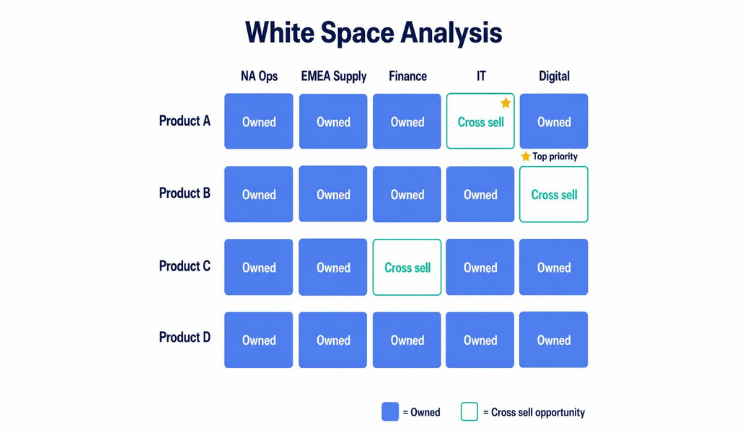
Not all empty cells are equal. Score each one by product fit, the strength of your relationship in that buying center, and the urgency of the business need. A product that solves a problem the customer flagged in a quarterly business review should outrank a theoretically adjacent product nobody has asked for. Focus reps on the three or four highest scoring cells rather than a dozen long shots.
3. Use relationship mapping to find a warm path in
Cross selling into a new buying center requires a warm path, not a cold call into your own customer. Relationship mapping shows who you know, how strong each relationship is, and who can introduce you to the decision maker in the division you want to reach.
A satisfied champion in the division you already serve is your most valuable cross sell asset. They can vouch for you internally, make introductions, and give you context on the new buying center's priorities. Map influence alongside hierarchy too, since the official decision maker often defers to a technical evaluator or a respected operations lead.
4. Time the cross sell with trigger events
The best cross sell moments cluster around trigger events: a successful implementation milestone, a strong QBR, an upcoming renewal, growth in the customer's own business, a leadership change, or a publicly announced initiative that your second product supports.
The worst time to cross sell is when adoption of the first product is shaky or a support escalation is open. Pitching a second purchase to a frustrated customer signals that you care more about quota than their success.
5. Lead with a business problem, not a product
Cross sell conversations that open with "we also sell X" rarely go far. Start with a problem the new buying center already has, show how a peer division solved a similar problem with your first product, then bridge to the adjacent product. Every cross sell should be grounded in a real customer need, which protects the trust that makes future expansion possible.
6. Align sales, customer success, and marketing
Cross selling fails when ownership is fuzzy. Sales thinks customer success owns expansion, customer success thinks it is a sales motion, and marketing runs campaigns that ignore the install base.
Decide explicitly who owns cross sell revenue, write it down, attach compensation to it, and build the handoffs into your CRM. A common model keeps expansion revenue with the account executive while customer success surfaces signals through the customer success plan and warms relationships. Marketing's job is to seed awareness of the adjacent product inside the divisions you want to reach, using account based campaigns aimed at the install base.
7. Package and price for expansion
Your packaging either invites cross selling or blocks it. Bundles, multi product discounts, and platform pricing make it easy to add a second product. Rigid per product contracts with a full procurement cycle for every addition kill momentum.
Negotiate master agreements that let customers add products without restarting procurement. Every week of contracting friction is a week a competitor can use to insert themselves.
8. Equip reps with cross sell enablement
Reps cannot cross sell products they do not understand. If your account executives know the flagship product cold but cannot explain the value of the second and third, cross selling stalls no matter how good the white space looks.
Build a sales enablement content strategy specifically for the cross sell motion: talk tracks, proof points, and battle cards that bridge from what the customer already owns. Salesforce-native tools like Prolifiq ACE put that collateral inside the opportunity record, so reps are never hunting through a shared drive for the case study that closes the deal.
9. Build cross selling into your account planning rhythm
The last strategy ties the rest together. Cross selling works when it is part of a recurring process, not a year end scramble. Review white space, relationship gaps, and trigger events in every account plan and every QBR. Capture account knowledge in a shared system so it does not vanish when a rep leaves or a territory is reassigned. An account planning template with a dedicated expansion section is the simplest way to start.
B2B Cross Selling Examples
These scenarios show how the strategies above play out in different industries.
Manufacturing: from one plant to the whole region
A supplier sells quality inspection software to one plant in a global manufacturer's North American operations. After a strong six month implementation review (a trigger event), the champion introduces the rep to the EMEA supply chain lead, who has the same defect tracking problem. The white space grid shows four more plants and two adjacent products that no one has pitched.
SaaS: from sales to customer success
A company buys a sales engagement platform for its sales team. The vendor's customer success manager notices the customer's CS team manually tracking renewals in spreadsheets. With an introduction from the VP of Sales, the vendor cross sells its customer success module into a separate buying center with its own budget.
Medical devices: from one department to the health system
A device company sells monitoring equipment to a hospital's cardiology department. Relationship mapping reveals that the health system's procurement office standardizes purchasing across 12 hospitals. By mapping influence in procurement and clinical leadership, the rep expands from one department to a system-wide agreement that includes consumables and service contracts.
Financial services: from one line of business to another
A bank buys a compliance reporting tool for its commercial lending group. A new regulatory initiative (a trigger event) creates the same reporting need in wealth management. Because the vendor's account plan already maps the wealth management leadership team, it reaches the right buyer first.
Upselling and Cross Selling Strategies in Salesforce
If your account data lives in Salesforce, your cross selling strategy should too. Spreadsheets and slide decks go stale the moment they are saved, and they hide the white space from everyone except the rep who built them. Here is how to run upselling and cross selling strategies inside the CRM.
Model the account the way it actually buys
Use Salesforce account hierarchies to represent divisions, regions, and subsidiaries as related accounts. When each buying center is its own record, you can see which ones own which products and where the gaps are. Tracking white space in your CRM turns the quarterly grid into a live view.
Separate expansion from new business
Create a distinct opportunity type or record type for cross sell and upsell deals. This lets you report on expansion pipeline, win rate, and cycle time separately from new logos, which is the only way to know whether your cross selling motion is improving.
Automate trigger alerts
Use Salesforce Flow to alert the account owner when cross sell signals line up: high product usage, a clean support record, and an upcoming renewal. When the signal lives next to the account plan, the next best action is obvious instead of something a rep has to piece together.
Keep relationships and plans in the same place
Salesforce relationship mapping keeps champions, detractors, and unknowns attached to the account record, so a warm path into a new buying center is visible to the whole team. This is where Prolifiq CRUSH and Prolifiq MAPS come in: account plans, white space, and relationship maps live natively in Salesforce and update as the account changes.
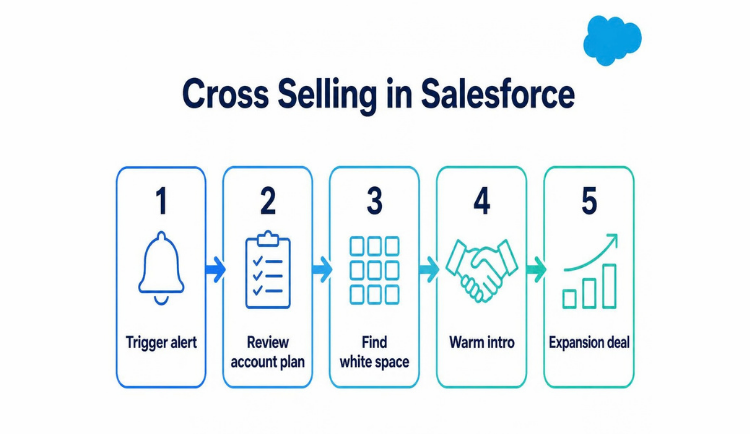
See how Prolifiq CRUSH surfaces white space and cross sell opportunities without leaving Salesforce.

How to Measure Cross Selling Success
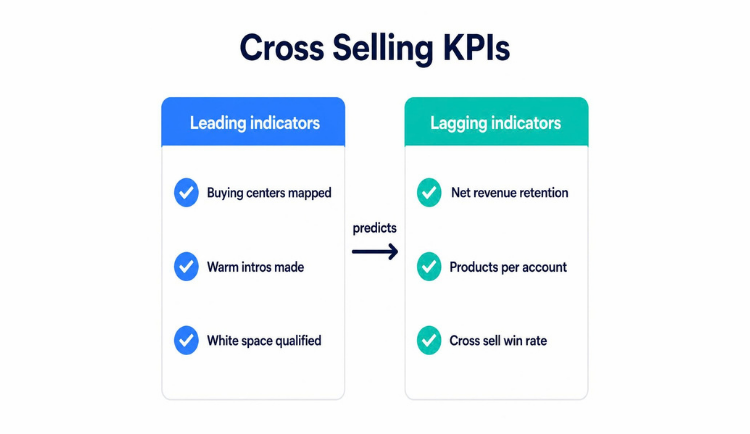
If you do not measure cross selling, you cannot improve it. Track these lagging indicators to see whether the motion is producing revenue:
- Net revenue retention
- Products per account
- Cross sell pipeline created
- Cross sell win rate
- Time from initial land to first expansion
Then watch the leading indicators that predict next quarter's results: number of buying centers mapped, warm introductions made, and white space opportunities qualified. A team that maps more buying centers this quarter will cross sell more next quarter. Salesforce reports for account planning can put both sets of numbers on one dashboard.
Common Cross Selling Mistakes to Avoid
- Cross selling before delivering value. If the first product has not proven itself, the second pitch damages trust.
- Treating it as a year end scramble. Cross selling needs a continuous rhythm tied to account plans and QBRs.
- Trapping account knowledge in one rep's head. When that rep leaves, the relationships and white space go with them.
- Pitching products that do not fit. Forcing a product on a buying center to hit a number erodes the trust that makes future expansion possible.
- Ignoring the install base in marketing. Your easiest pipeline sits inside customers who already know your brand.
Frequently Asked Questions
What is cross selling in B2B?
Cross selling in B2B is selling a different, complementary product or service to an existing customer, often by expanding from one buying center into another inside the same company. It relies on account mapping and relationships rather than simple product recommendations.
What is the difference between cross selling and upselling?
Cross selling places a different product into an account, while upselling moves a customer to a higher tier or larger volume of something they already own. Upselling follows usage signals, and cross selling follows relationship and need mapping across buying centers.
How do I identify cross selling opportunities in existing accounts?
Run a white space analysis. Build a grid with your products on one axis and the account's buying centers on the other. Every empty cell is a potential cross sell. Score each by product fit, relationship strength, and urgency, then focus on the top three or four.
When is the best time to cross sell?
Cross sell from a position of demonstrated value. The best moments follow trigger events such as a successful implementation milestone, a strong QBR, an upcoming renewal, a leadership change, or a new strategic initiative. Avoid cross selling when adoption is weak or a support escalation is open.
Who should own cross selling, sales or customer success?
Decide explicitly and attach compensation to the decision. A common model keeps expansion revenue with the account executive while customer success surfaces signals and warms relationships. Clarity and clean CRM handoffs matter more than which team owns it.
How does Salesforce support upselling and cross selling strategies?
Salesforce can model buying centers with account hierarchies, separate expansion deals with their own opportunity type, and trigger alerts with Flow. Native account planning apps add white space analysis and relationship maps to the account record so the whole team can see the next cross sell.
Make Cross Selling a Repeatable Motion With Prolifiq
Cross selling stops being luck when your team has the maps, relationships, and white space intelligence to run it as a discipline. Prolifiq CRUSH is a Salesforce-native account planning platform built for exactly this. Your revenue team can map buying centers, visualize relationships, surface white space, and act on trigger events without leaving Salesforce. Paired with Prolifiq ACE for in-context enablement, reps get the right cross sell content at the moment they need it.
Ready to turn your install base into a predictable expansion engine? Book a demo to see how account planning drives cross sell revenue.