Most B2B revenue teams spend the bulk of their energy chasing net new logos while ignoring the largest untapped revenue source they already own: their existing accounts. White space analysis is the discipline of mapping what a customer currently buys against everything they could buy, then systematically targeting the gaps. The space between those two numbers is your white space, and for most enterprise sellers it represents three to five times more revenue potential than the original deal.
The problem is that white space analysis is usually done badly or not at all. Sellers eyeball an account, remember a few open opportunities, and call it a plan. Sales leaders ask for cross-sell numbers in QBRs and get anecdotes instead of data. The result is predictable: products that should have been sold into an account two years ago are still sitting on the shelf, and a competitor walks in through a door your own team never noticed was open.
Done properly, white space analysis turns account expansion from guesswork into a repeatable, data-driven process. It tells you exactly which products are missing from which divisions, which buying centers have never been touched, and which accounts deserve more investment. This guide covers what white space analysis is, how to build the matrix, how to prioritize the gaps, which tools support it, and how to operationalize it inside your CRM so it actually drives pipeline instead of dying in a spreadsheet.
What Is White Space Analysis?
White space analysis is a structured method for identifying revenue opportunities within an existing customer account by comparing current product penetration against total addressable potential. The term comes from visualizing an account as a grid. On one axis you list the customer's business units, divisions, geographies, or buying centers. On the other axis you list your product or service portfolio. Each cell in the grid is either filled (they buy this product in this unit) or empty. The empty cells are the white space.
That visual makes the opportunity obvious in a way no narrative ever could. A global manufacturing customer might buy your flagship product in North America but nowhere else, leaving EMEA and APAC as wide open white space. A financial services client might use one of your five product lines across its retail bank but none in commercial lending or wealth management.
White Space Versus Pipeline
White space is not the same as pipeline. Pipeline is what your reps are actively working. White space is the full universe of theoretical opportunity, most of which has no opportunity record attached to it yet. The job of white space analysis is to convert the highest value white space into real, qualified pipeline. Confusing the two is why so many expansion programs stall.
Why white space analysis matters more than ever
The economics of B2B selling have shifted hard toward retention and expansion. Acquiring a new enterprise customer costs five to seven times more than expanding an existing one, and existing customers convert at three to four times the rate of cold prospects. When growth budgets tighten, the smartest revenue teams stop pouring money into top of funnel and start mining the accounts they already won.
White space analysis is the engine that makes that pivot work. Without it, expansion is reactive and accidental. With it, you can forecast expansion revenue, set account level growth targets, and hold reps accountable for penetration the same way you hold them accountable for quota.
The Net Revenue Retention Connection
For SaaS and subscription businesses, net revenue retention is now the metric investors care about most. A company with 120 percent NRR grows even if it never closes another new logo. White space analysis is how you get there. Every percentage point of NRR above 100 comes from cross-sell, upsell, and expansion into white space you deliberately mapped and pursued. Teams that treat white space as an afterthought rarely break 105 percent NRR. Teams that operationalize it routinely hit 115 to 130 percent.
How to Build a White Space Matrix
The white space matrix is the core artifact. Building one is straightforward in concept and demanding in execution. Start with a single strategic account and follow this sequence.
Step One: Map the Buying Centers
List every distinct unit within the account that can make an independent buying decision. These might be business divisions, product lines, regional entities, or functional departments. A large enterprise can easily have 15 to 40 buying centers. This step matters because revenue lives at the buying center level, not the corporate logo level. Treating a Fortune 500 company as one buyer is the single most common white space mistake.
Step Two: List Your Full Portfolio
Lay out every product, module, service, and SKU you sell. Include adjacent offerings the customer may not even know you provide. The whole point is to surface gaps, and you cannot see a gap for a product you forgot to list.
Step Three: Populate Current State
Mark each cell with the actual deployment status. Many teams use a simple color code: green for active, yellow for in progress, red for churned, and blank for never sold. Pull this data from your CRM, billing system, and account team knowledge. Accuracy here determines everything downstream.
Step Four: Score the Gaps
Not every blank cell is a real opportunity. Score each gap on fit and likelihood. A wealth management product has zero fit in a manufacturing division. Filter those out so your team focuses only on credible white space.
White Space Matrix Template
A white space matrix template does not need to be complicated to be useful. The simplest version is a grid: list every buying center down the left column, list every product or service across the top row, and mark each intersection green, yellow, red, or blank for active, in progress, churned, or never sold. Build it in a tool connected to your CRM so the matrix reflects real account data instead of going stale the week after you build it.
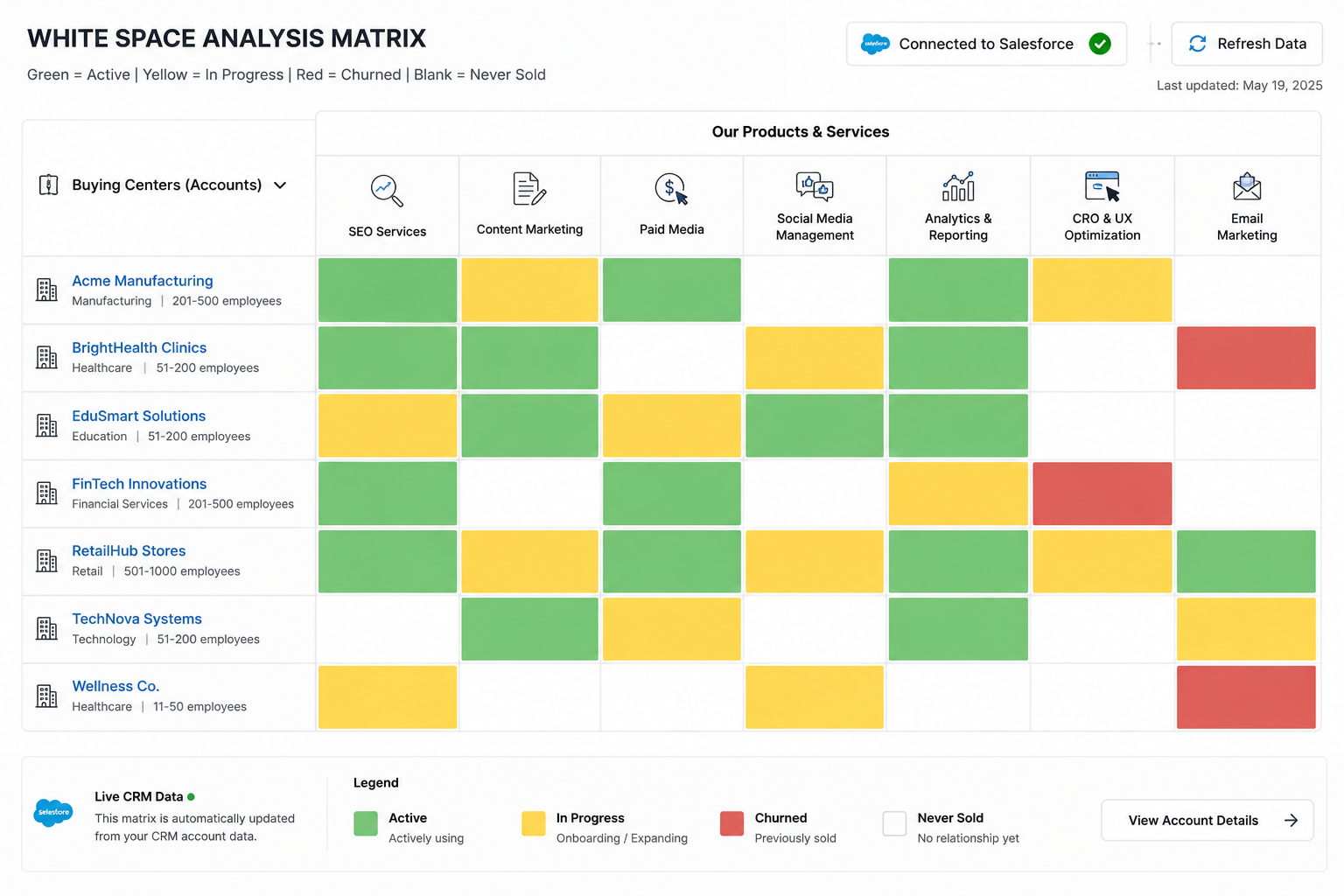
Here is a small example for one financial services account. Each row is a buying center, each column is a product, and every cell is one of four states. Blank or white space cells are the opportunities to score next.
To build the same grid for your own accounts, start with our account planning template and connect the matrix to your CRM so it stays current.

Prioritizing White Space and Avoiding Common Mistakes
A typical strategic account will surface dozens of white space cells. You cannot chase them all, so prioritization is where white space analysis earns its keep. Use a weighted model that considers deal size, win probability, strategic value, and time to close:
- Deal size: the estimated annual contract value of filling the gap.
- Win probability: blends product fit, existing relationship strength, and any active triggers like a contract renewal or new executive sponsor.
- Strategic value: whether landing this product opens further doors, for example a platform product that creates pull for three add on modules.
- Time to close: separates the quick wins from the multi year campaigns.
The Land and Expand Sequence
Smart teams sequence white space rather than attacking it randomly. Land a foothold product in a new buying center, prove value, then expand laterally into adjacent products and vertically into related divisions. A common pattern in technology accounts is to win a single department, deliver a measurable outcome in 90 days, then use that proof to convert four neighboring departments within the same fiscal year. Sequencing turns a scattered list of gaps into a coherent account growth plan.
Common white space analysis mistakes
The most frequent failure is treating white space as a one time exercise. Accounts change constantly. New divisions are acquired, sponsors leave, contracts renew, and competitors enter. A white space map built once and never updated is worthless within two quarters. White space analysis must be a living process embedded in account planning, refreshed at least quarterly for strategic accounts.
The second mistake is doing the analysis in a spreadsheet disconnected from your CRM. The moment your white space data lives outside Salesforce, it stops influencing rep behavior. Reps work in the CRM, opportunities live in the CRM, and forecasts come from the CRM. White space that is not connected to that system of record never converts to pipeline.
Ignoring the Relationship Layer
White space is not just about products. It is also about people. A gap you can technically fill but where you have no relationship in the relevant buying center is far harder than a gap where you already have an executive champion. The best white space analysis overlays relationship maps onto the product matrix, so you can see not just what to sell but who can help you sell it.
White Space Analysis Examples by Industry
The mechanics are universal, but the highest value white space differs sharply by vertical.
Life Sciences
In life sciences, white space often sits across therapeutic areas and research sites. A vendor selling into one clinical division of a pharma company may have zero presence in adjacent therapeutic areas or in the company's manufacturing and quality functions. Mapping by site and function reveals enormous untapped potential that account level views completely hide.
Financial Services
Financial services firms are highly siloed by line of business. Retail banking, commercial lending, wealth management, and capital markets buy independently, often with no awareness of what sister divisions purchase. White space analysis that maps each line of business separately consistently uncovers six and seven figure expansion opportunities.
Manufacturing and Technology
Manufacturing accounts sprawl across plants, geographies, and product lines, making geographic white space a primary lever. Technology customers expand through product modules and team by team adoption, making the land and expand sequence especially powerful.
White Space Analysis Tools and Software
You can start white space analysis in a spreadsheet, but spreadsheets break down fast at enterprise scale. Once you are managing white space across dozens of strategic accounts with multiple buying centers each, you need purpose built account planning software. Several vendors compete in this category.
The Main Players
- Altify: offers account planning with relationship and white space mapping but carries a heavier implementation footprint.
- DemandFarm: focuses specifically on key account management with strong white space visualization.
- ARPEDIO: a Salesforce-native option emphasizing relationship mapping and opportunity planning.
- Revegy: provides account and opportunity mapping with revenue planning.
- Kapta: targets customer success driven account management.
The critical differentiator is whether the tool is genuinely native to your CRM. Bolt on tools that sync data back and forth introduce lag, duplication, and adoption friction. Salesforce-native account planning keeps the white space matrix, the relationship map, and the opportunity records in one system, so reps never leave the platform they already live in.
Several vendors in this list are compared head to head in our key account management software guide and in our relationship mapping tools roundup. Revegy was acquired by Dura Software in 2022, so confirm its current availability. Features change, so verify with each vendor.
Connecting White Space to Account Planning and Measuring Success
White space analysis is not a standalone activity. It is one pillar of a complete account plan that also includes relationship mapping, opportunity management, and stakeholder strategy. The white space matrix tells you where the revenue is. The relationship map tells you who can unlock it. The opportunity plan tells you how you will pursue it. The account plan ties all three together into a single quarterly operating rhythm.
When these pieces live in separate tools, account planning collapses into a static slide deck that gets updated once a year for the QBR. When they live together inside the CRM, account planning becomes a continuous, data-driven process that genuinely moves expansion revenue. That integration is the difference between a white space report and a white space program.
Measuring white space program success
Track a handful of metrics to know whether your white space program is working.
- Penetration rate: the percentage of addressable white space cells you have converted, by account and across the portfolio.
- Expansion pipeline: the dollar value of opportunities originating from white space analysis.
- Win rate on white space deals: should run higher than your new logo win rate because you are selling into known, trusted accounts.
- NRR uplift: track the net revenue retention uplift attributable to white space driven expansion.
If these numbers are not moving after two quarters, your analysis is probably stuck in spreadsheets and not influencing rep behavior.
Related reading: cross selling strategies.
Frequently Asked Questions
What is white space analysis in sales?
White space analysis in sales is the process of mapping what a customer currently buys against everything they could buy, then targeting the gaps. It identifies cross-sell and upsell opportunities inside existing accounts by comparing current product penetration to total addressable potential across all the customer's buying centers.
The output is a prioritized list of expansion opportunities that converts into qualified pipeline.
How is white space analysis different from TAM analysis?
TAM analysis estimates the total addressable market across all potential customers in a market. White space analysis operates inside a single existing account, mapping unrealized revenue across that customer's divisions and product gaps. TAM informs market strategy; white space informs account strategy.
How often should you update a white space matrix?
Refresh strategic account white space at least quarterly, and immediately after major triggers like an acquisition, a leadership change, a contract renewal, or a competitive entry. Accounts change constantly, and a stale matrix produces false confidence and missed opportunities.
What tools are best for white space analysis?
For enterprise teams, Salesforce-native account planning tools work best because they keep white space data connected to live CRM records. Options include Prolifiq CRUSH, Altify, DemandFarm, ARPEDIO, and Revegy. The key criterion is whether the tool is genuinely native to your CRM rather than a bolt on that requires syncing.
Who should own white space analysis?
Account executives and strategic account managers own the analysis for their accounts, supported by sales operations who maintain data quality and leadership who sets penetration targets. In organizations with customer success teams, CS often contributes relationship and adoption data critical to scoring gaps accurately.
How do you prioritize white space opportunities?
Score each gap on deal size, win probability, strategic value, and time to close. Filter out gaps with poor product fit, then sequence the remainder using a land and expand approach: secure a foothold, prove value quickly, and expand into adjacent products and divisions from a position of proven results.
What is white space in business?
White space in business refers to any revenue opportunity that exists inside a market, industry, or customer relationship but has not been captured yet, the gap between what is currently being sold or served and what could be. In B2B sales specifically, white space usually means the products, divisions, or buying centers within an existing account where you have no presence yet, even though the account itself is already a customer.
For the broader definition outside sales, see white space in business; for CRM setup, see white space in your CRM.
White space analysis only drives revenue when it lives where your reps work. Prolifiq CRUSH is Salesforce-native account planning that builds your white space matrix, relationship maps, and opportunity plans directly inside the CRM your team already uses every day. No syncing, no separate logins, no static slide decks that go stale the moment the QBR ends.
With CRUSH, your team maps every buying center, scores every product gap, and converts the highest value white space into qualified pipeline, all without leaving Salesforce. Revenue leaders get real visibility into account penetration and expansion forecasts instead of anecdotes. If you are serious about growing net revenue retention from the accounts you already own, white space analysis is where to start. See how CRUSH operationalizes it at /product/account-management-software.