
Economic Buyer: Definition, How to Identify Them, and How to Win Them Over
The Economic Buyer is the person with final authority to release budget for your deal. They can say yes when everyone else says no — and no when everyone else says yes.
That's the whole definition. The hard part isn't understanding it. It's finding this person, since they rarely announce themselves, and building enough credibility to earn their time.
This page covers how to identify the Economic Buyer, how they differ from the other roles in the room, how to engage them well, and the mistakes that lose deals at this stage. It's part of our MEDDPICC sales methodology guide — if you're new to the framework, start there.
How to identify the Economic Buyer
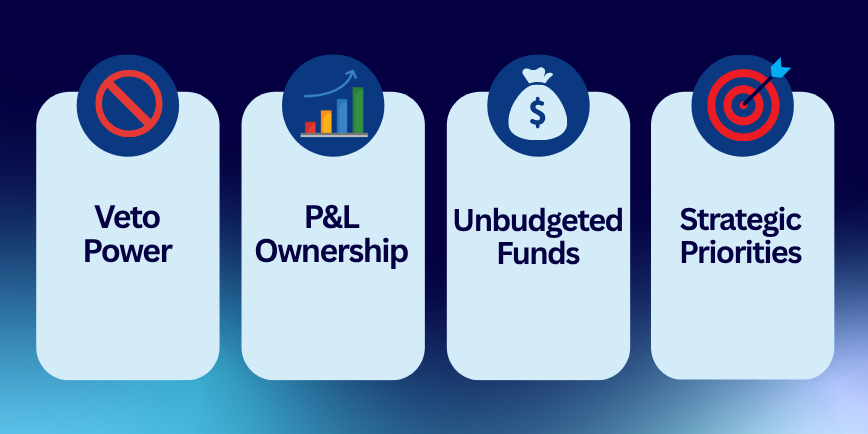
Title alone won't tell you. A VP can be the EB in one org and a rubber stamp in another; a director can hold real budget authority in a flat company. Look for the signal underneath the title instead.
They have veto power. Regardless of what every other stakeholder wants, the deal doesn't move without their sign-off — and it stops the moment they say no.
They own P&L, not just a budget line. The EB's incentives track the business outcome, not the project. They're accountable for what the spend returns, not just for spending it well.
They can find money that isn't budgeted. A real EB can often approve discretionary spend outside the formal budget cycle when the case is strong enough. A budget holder usually can't.
Their priorities sound strategic, not operational. Ask what a stakeholder cares about. If the answer is feature-level or process-level, you're talking to an influencer. If it's framed in terms of company priorities, revenue, or risk, you're closer to the EB.
If you're not sure, your champion is the fastest way to find out — see below.
Economic Buyer vs. Champion vs. Technical Buyer vs. budget holder
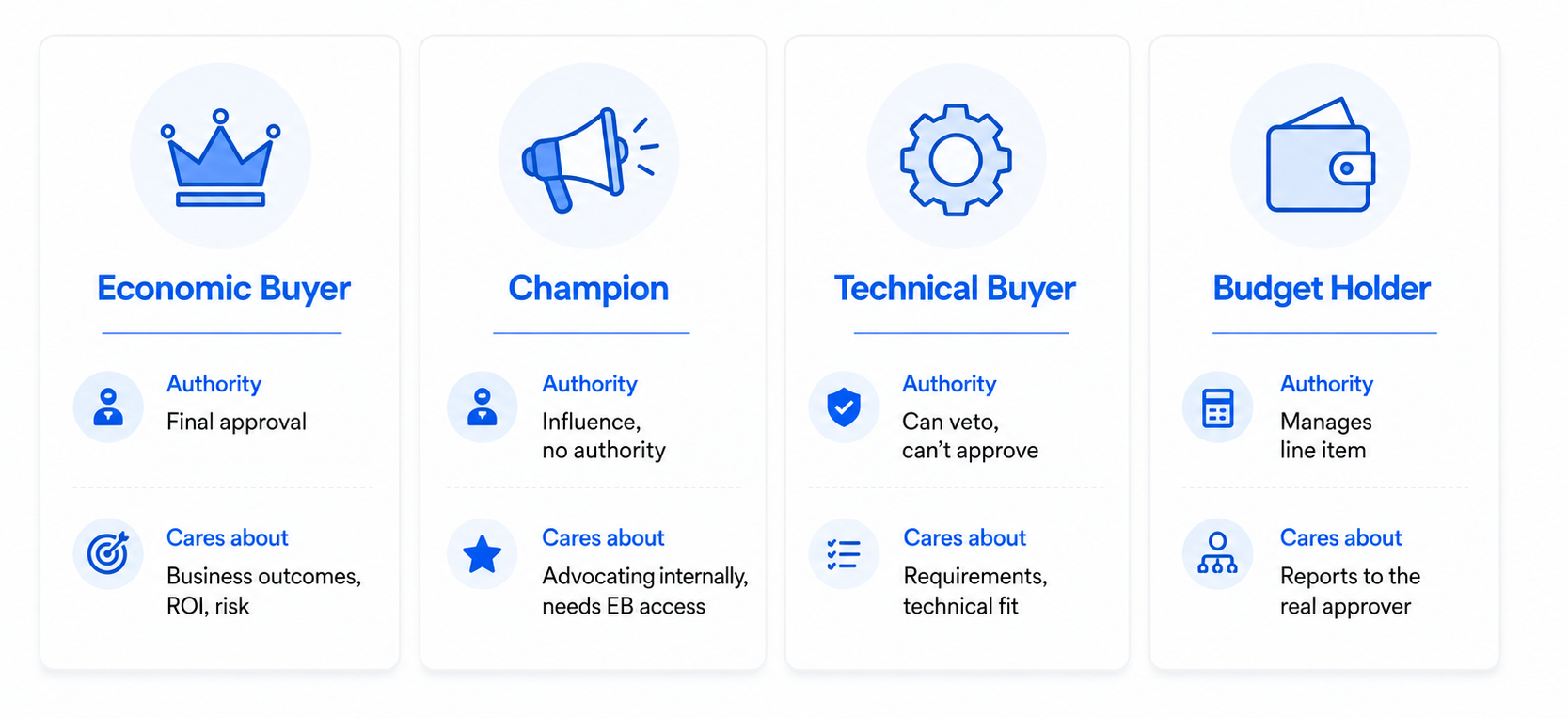
These four roles get confused constantly, and mixing them up is one of the more expensive MEDDPICC mistakes. They're not interchangeable, and a deal can have all four as different people.
Economic Buyer — has final authority to approve spend. Cares about business outcomes, ROI, and risk. Usually not involved day-to-day.
Champion — has influence, not authority. Advocates for you internally, and critically, should have real access to the Economic Buyer. A champion who can't get you to the EB, or won't try, is worth re-qualifying.
Technical Buyer — evaluates whether your solution meets requirements. Can't say yes, but can absolutely say no — a technical buyer with unresolved objections will stall a deal the EB never even hears about.
Budget holder — manages the line item the spend comes from. Sometimes this is the EB. Often it isn't — the budget holder answers to the person who actually approves the spend, which is your real target.
The fastest way to lose a deal at this stage is to treat a strong relationship with any of the first three as a substitute for the fourth.
How to engage the Economic Buyer
Getting the meeting is only half the problem. What you do with it decides the deal.
Get there through your champion. A champion who's unwilling or unable to introduce you to the EB is a signal worth taking seriously — about the champion, not just the EB.
Speak in their language. That means decision criteria framed as business outcomes — cost, time to value, risk — not product features. An EB conversation that turns into a demo has usually already gone wrong.
Lead with the problem, not the pitch. The EB doesn't need to be convinced your product is good. They need to be convinced the problem is worth solving now, at this cost, with this vendor.
Bring your metrics, not your feature list. If you've done the work in metrics qualification earlier in the deal, this is where it pays off — a number the EB can defend to their own leadership beats any amount of product detail.
Don't disappear after signature. The best reps keep a light touch with the EB post-close — sharing outcomes, not just check-ins. It costs little and it's often the difference between a renewal conversation that starts warm and one that starts from zero.
Common mistakes
Assuming the loudest stakeholder is the EB. Enthusiasm and authority aren't the same thing. The person driving the day-to-day evaluation is very often not the one who can approve the spend.
Treating "Economic Buyer" as always one person. Sometimes it's a committee, a board, or an investment group. Qualify for that early rather than discovering it at the paper process stage.
Skipping the EB because the champion says it's not necessary. It's one of the most common reasons strong-looking deals slip in the forecast — the champion isn't wrong to like you, but they're not always right about what their own approval chain requires.
Talking product instead of outcome. The fastest way to lose an EB's attention is to explain what your tool does instead of what changes for their business if they buy it.
Where this fits in MEDDPICC
Economic Buyer is the "E" in MEDDPICC, sitting alongside Metrics, Decision Criteria, Decision Process, Identify Pain, Champion, Competition, and Paper Process. It's rarely qualified in isolation — a strong champion relationship is usually what gets you access to the EB in the first place, and clear metrics are what make that meeting worth having. For the full framework, see our MEDDPICC methodology guide.
Summary
- The Economic Buyer is the person with final authority to approve spend — the one who can say yes when others say no.
- Title doesn't reliably identify them. Veto power, P&L ownership, and access to unbudgeted funds do.
- They're not your champion, your technical buyer, or your budget holder — treating any of those as a substitute is a common way deals stall late.
- Engage them through your champion, speak in outcomes rather than features, and don't go quiet once the deal closes.
FAQ
Is the Economic Buyer always the most senior person in the room?
Not necessarily. Seniority correlates with authority but doesn't guarantee it — a flatter org can put real budget authority with a director, while a VP elsewhere may need sign-off from someone else.
What if the Economic Buyer is a committee, not a person?
Common in procurement-heavy or public-sector deals. Qualify who chairs it, whether it decides by consensus or a single vote, and who can veto — the committee still has an effective EB even when the room is large.
Can the Champion and the Economic Buyer be the same person?
Rarely, and it's worth treating as a flag rather than a shortcut when it seems to be the case. Champions typically have influence without final authority; if someone appears to have both, confirm they can actually approve spend rather than just sponsor the project internally.