Why Stakeholder Analysis Decides Whether Enterprise Deals Close
The average enterprise B2B purchase now involves between 6 and 10 decision makers, according to Gartner research, and that number climbs higher in regulated verticals like life sciences and financial services. Each of those people has different priorities, different fears, and different definitions of success. When a deal stalls or dies in the late stages, it is rarely because the product was wrong. It is because a seller mapped one champion, ignored a hidden detractor, and walked into a procurement review blind.
Stakeholder analysis is the discipline of identifying every person who can influence a buying decision, understanding what each one wants, and building a deliberate plan to move them. It is not a one time exercise you do at the start of a quarter. It is a living model of the buying committee that gets updated every time someone joins, leaves, or shifts position. Done well, it turns a chaotic enterprise pursuit into a sequence of manageable conversations.
Most revenue teams treat stakeholder analysis as a mental note or a few lines in a CRM contact field. That is why win rates on competitive deals hover around 25 percent for many organizations. The teams that consistently beat that number have made stakeholder mapping a structured, repeatable part of their account planning process. This guide walks through exactly how to do it, what frameworks to use, what tools to evaluate, and how to avoid the mistakes that quietly sink seven figure pursuits.
What Stakeholder Analysis Actually Means in B2B Sales
Stakeholder analysis is the systematic process of identifying, categorizing, and prioritizing the individuals and groups who have a stake in a purchasing decision. In a sales context it goes beyond the org chart. It captures the informal influence networks, the personal motivations, and the political dynamics that the official reporting structure never reveals.
A complete analysis answers four questions for every person in the deal. Who are they and what is their formal role? What do they personally gain or lose if this purchase happens? How much power do they have to advance or block the decision? And what is their current attitude toward your solution? When you have clear answers across the full committee, you can build a plan that addresses the right people in the right order with the right message.
The Difference Between Contacts and Stakeholders
A contact is anyone whose business card you have. A stakeholder is anyone who can change the outcome of the deal. Those are not the same set. A junior analyst who runs the evaluation spreadsheet may have more practical influence than a VP who signs off at the end. Treating every contact as equally important wastes time. Treating only the senior titles as important loses deals. Stakeholder analysis forces you to distinguish access from influence.
The Five Core Stakeholder Roles to Map
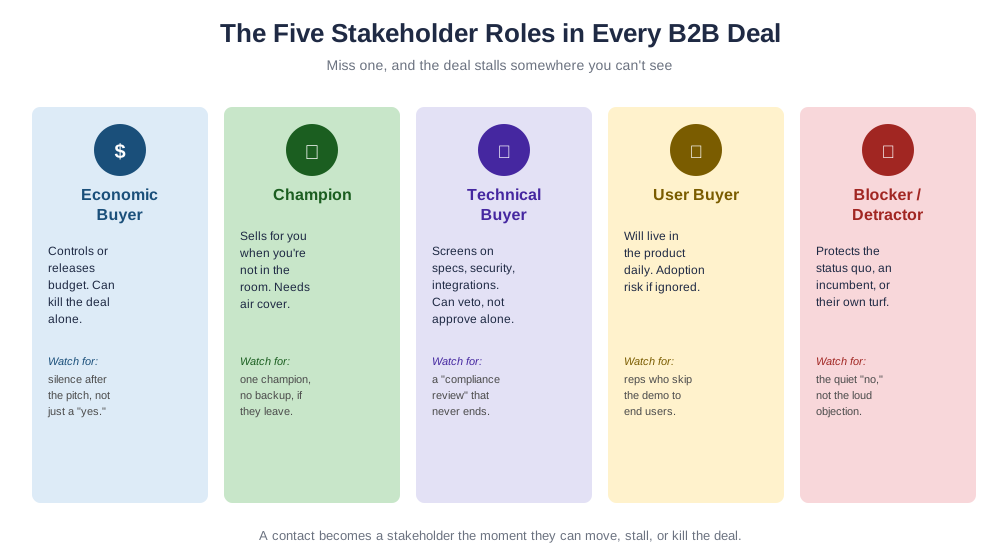
Decades of complex sales research, from Miller Heiman to Challenger, converge on a similar set of buying roles. You need to identify each one explicitly.
Economic Buyer
This is the person who controls the budget and gives final approval. They care about return on investment, risk, and strategic fit. In a large enterprise this is often a VP or C level executive who appears late. The economic buyer rarely participates in product demos, which is exactly why sellers under map them.
Champion
The champion wants you to win and has the credibility and willingness to sell on your behalf internally. A real champion has power, is actively promoting you, and gains personally from your success. Many sellers mistake a friendly contact for a champion. The test is simple: will this person spend political capital for you when you are not in the room?
Technical and User Buyers
Technical buyers evaluate whether the solution meets specifications, security requirements, and integration needs. User buyers are the people who will actually use the product daily and judge it on usability. Both can veto a deal even if they cannot approve one.
Blockers and Detractors
Someone in the account prefers the status quo, favors a competitor, or sees your win as a personal loss. Ignoring blockers is the single most common cause of late stage surprises. You do not always need to convert them. Sometimes you only need to neutralize their influence by isolating their objections.
How to Build a Stakeholder Power Interest Grid
The power interest grid is the most practical visual tool for prioritizing stakeholders. You plot each person on two axes. One axis measures their power to affect the decision, from low to high. The other measures their level of interest in the outcome, from low to high. The grid creates four quadrants that dictate your engagement strategy.
Want the ready-made version? Our free stakeholder mapping template includes a fill-in power-interest grid, with quadrant and engagement-strategy columns that calculate automatically.
Get the free stakeholder mapping template
High power and high interest stakeholders are the people you manage closely. These are your economic buyers and champions, and they get the most of your attention. High power and low interest stakeholders must be kept satisfied. They can kill the deal if disturbed but will not engage deeply, so you give them concise, relevant updates. Low power and high interest stakeholders should be kept informed. They are often your daily users and detail level evaluators who can build momentum from the bottom up. Low power and low interest stakeholders require only monitoring.
The grid is not static. A user buyer who starts with low power can gain influence after a successful pilot. A high power executive can lose interest if a competing priority emerges. Update the grid at every deal review. A printed grid from week one that never changes is worse than no grid at all because it creates false confidence.
Mapping Relationships and Influence Networks
The org chart tells you who reports to whom. The influence map tells you who actually trusts and listens to whom. These two diagrams are different, and the gap between them is where deals are won and lost.
To build an influence map, draw lines between stakeholders that represent relationships. Note who mentored whom, who came from the same prior employer, who openly disagrees with whom, and whose opinion the economic buyer asks for before deciding. Often you will find that a mid level director carries enormous weight because the CFO trusts their judgment from a decade of working together. That director is your real path to the budget, even though the org chart would never tell you. For a step by step framework on building this out, see our guide to relationship mapping.
The Hidden Detractor Problem
Influence mapping surfaces the people you would otherwise miss. A security architect with no formal authority over the purchase can sink your deal in a single procurement meeting if their concerns are not addressed. Map the connections, identify who feeds the decision makers, and you will see these risks before they detonate.
Scoring Stakeholder Sentiment and Coverage
Once you have identified the players, score two things. First, score each stakeholder's sentiment toward your solution on a simple scale: champion, supporter, neutral, skeptic, or detractor. Second, score your coverage, meaning how strong and recent your relationship with each person is.
The combination reveals your true position. A deal where the economic buyer is neutral and your only champion is a low power user is far weaker than your forecast category suggests. By scoring coverage you also expose single threaded deals. If your entire relationship runs through one person, you have a critical risk. That person could leave, change roles, or lose internal standing, and your deal evaporates overnight. Healthy enterprise deals have at least three to four genuine relationships across different functions and levels.

Running Stakeholder Analysis Inside Your CRM
The biggest failure mode in stakeholder analysis is that it lives in a slide deck or a spreadsheet outside the system of record. Within weeks it goes stale, the rep who built it gets promoted, and the institutional knowledge walks out the door. Stakeholder data belongs where your team already works, which for most enterprise revenue teams means Salesforce.
When stakeholder maps live natively in your CRM, several things become possible. Managers can review committee coverage during deal inspection without asking for a separate file. Account handoffs preserve the relationship history. And you can run reports across the entire pipeline to find single threaded deals or accounts with no mapped economic buyer. That portfolio level visibility is impossible when analysis is trapped in static documents. Stakeholder analysis and account mapping should live in the same view, not two disconnected exercises your reps have to keep in sync by hand.
Why Salesforce Native Matters
Bolt on tools that sync to Salesforce introduce lag, data conflicts, and integration maintenance. A Salesforce native solution stores stakeholder data on standard and custom objects directly, so contact roles, influence relationships, and sentiment scores are part of the same record your reps already update. There is no second system to log into and no sync to break. Prolifiq's relationship map turns this stakeholder analysis into a living, Salesforce-native view your whole team can see and update.
Stakeholder Analysis Tools and Vendor Landscape
Several vendors offer relationship and stakeholder mapping capabilities for B2B sales. Understanding the differences helps you choose based on how deeply the tool integrates with your existing workflow.
For a deeper breakdown of pricing, architecture, and feature depth across these vendors, see this comparison of relationship mapping tools.
Comparing the Main Options
Altify offers relationship mapping as part of a broader opportunity and account management suite, and tends to suit large enterprises willing to invest in a full methodology rollout. DemandFarm provides org charting and relationship mapping with a focus on key account management, and is often chosen by teams that want strong visual mapping. ARPEDIO is Salesforce native and emphasizes relationship mapping and whitespace analysis. Revegy focuses on visual account and opportunity maps for complex deals. Kapta leans toward customer success and account management rather than new logo pursuit.
Pricing across these tools generally ranges from roughly 30 to 150 dollars per user per month depending on the suite and contract size, with enterprise agreements often bundled across account planning, opportunity management, and analytics. The right choice depends less on feature checklists and more on whether the data lives where your team works and whether reps will actually maintain it. A tool with beautiful maps that nobody updates is worthless.
Common Stakeholder Analysis Mistakes
Even experienced teams repeat the same errors. The first is single threading, relying on one relationship for the entire deal. The second is confusing access with influence, spending all your time with the friendly contact who has no power. The third is mapping once and never updating, which produces dangerously stale plans.
The fourth mistake is ignoring detractors because they are uncomfortable to engage. Avoiding a known skeptic does not make them disappear. It guarantees they ambush you later. The fifth is failing to map the economic buyer because they are hard to reach. If you cannot name the person who will approve the budget and describe what they care about, you do not have a qualified deal regardless of what the stage field says.
Building a Repeatable Stakeholder Cadence
Stakeholder analysis only delivers results when it becomes a habit. Build it into your existing rhythms. At deal qualification, require a named economic buyer and at least one identified champion. At every deal review, update the power interest grid and sentiment scores. Before any major milestone, such as a proposal or executive presentation, audit your coverage to confirm you are multi threaded.
Managers should inspect stakeholder coverage as a standard part of pipeline review, not as a special exercise. When a rep says a deal will close, the right follow up question is not just about budget and timeline. It is who specifically supports this, who opposes it, and what is your plan for each one. That question, asked consistently, changes seller behavior and tightens forecasts across the entire team.
Frequently Asked Questions
What is stakeholder analysis in B2B sales?
Stakeholder analysis is the structured process of identifying every person who can influence a buying decision, understanding their motivations and power, and building a plan to engage each one. It maps the full buying committee rather than relying on a single contact, which is essential in enterprise deals that involve 6 to 10 or more decision makers.
What is a power interest grid?
A power interest grid plots each stakeholder on two axes, their power to affect the decision and their interest in the outcome. The four quadrants tell you how to engage each person, from managing high power high interest stakeholders closely to simply monitoring low power low interest ones. It is the most practical prioritization tool for complex deals.
How many stakeholders should I map in an enterprise deal?
Map everyone who can advance or block the decision, which typically means 6 to 10 people in a mid sized enterprise deal and more in regulated industries. The goal is not a long list but accurate coverage. At minimum you need a named economic buyer, at least one genuine champion, the relevant technical and user buyers, and any known detractors.
How is stakeholder analysis different from an org chart?
An org chart shows formal reporting relationships. Stakeholder analysis adds the informal influence networks, personal motivations, and political dynamics that determine real decisions. Often the person with the most influence over a purchase is not the most senior title on the org chart but someone the decision maker personally trusts.
How often should I update stakeholder maps?
Update them at every deal review and before any major milestone. Stakeholder dynamics change constantly as people join, leave, gain influence, or shift their sentiment. A map built once and never revisited creates false confidence and is a leading cause of late stage surprises.
What tools support stakeholder analysis?
Options include Altify, DemandFarm, ARPEDIO, Revegy, Kapta, and Prolifiq CRUSH. The most important criterion is whether the tool lives inside your CRM so the data stays current. Salesforce native solutions keep stakeholder data on the same records your team already maintains, avoiding the staleness that kills standalone tools.
Why do deals fail despite good stakeholder analysis?
The most common reasons are single threading on one relationship, confusing a friendly contact with a true champion, and ignoring detractors. Even a thorough initial map fails if it is not updated as the committee evolves. Discipline in maintaining the analysis matters more than the quality of the first version.
Turn Stakeholder Analysis Into Closed Revenue
Stakeholder analysis is only as valuable as your ability to keep it current and act on it. When relationship maps, influence networks, and sentiment scores live in static slides, they go stale and your team flies blind into the deals that matter most. When they live inside Salesforce, every manager and rep sees the full picture in real time.
Prolifiq CRUSH brings stakeholder mapping, relationship analysis, and account planning directly into Salesforce, so your buying committee data sits on the same records your team already uses every day. No second system, no broken syncs, no stale decks. Reps map the committee once and keep it alive through normal CRM work, and managers inspect coverage and risk across the entire pipeline. See how CRUSH helps revenue teams build multi threaded deals and forecast with confidence at /product/account-management-software.