
A RevOps strategy is the plan that connects your ideal customer, your team's capacity and your account data into one go-to-market motion. It tells every seller which accounts to work, how much effort each deserves and what to measure along the way. Done well, your revenue operations strategy becomes a revenue operations framework reps can run. Done badly, it is a spreadsheet nobody opens after kickoff.
This guide draws on a panel of revenue operations leaders and a sales leader who wears both hats at a growing software company. It covers the foundation, the RevOps tech stack, account segmentation, the handoff to reps, RevOps alignment across teams, and the RevOps KPIs that show whether the plan is working. The RevOps best practices below come straight from people running the function. For a general definition of the function, see what is revenue operations from Salesforce.
What is a RevOps strategy?
A RevOps strategy aligns marketing, sales and customer success around shared targets, shared data and one operating model. Instead of each team planning separately, RevOps sets the ideal customer profile, sizes the teams, defines how leads become revenue and sets the cadence for reviewing progress. That alignment is the core of RevOps: one set of definitions, one source of truth and one plan. If you are still sorting out how the function differs from sales operations, read our comparison of sales ops vs RevOps first.
Build the RevOps framework: ICP, capacity and operating model
Start the foundation before the fiscal year begins. The panel's checklist had four parts:
- Targets. Your ideal customer profile, personas and the size of your total, serviceable and obtainable market. This tells the go-to-market team where to point.
- Capacity. The right marketing roles and program spend, plus sales roles and ratios such as SDRs to AEs and solutions engineers to sellers.
- Operating model. The full lifecycle with conversion rates from lead to opportunity to close, checked against the benchmarks you need and the coverage you can afford.
- Cadence. A rhythm of pipeline and forecast reviews that lets you coach and correct during the year. Our guide to sales forecasting covers the review side.

Plan from the bottom up as well as the top down. Many companies set a number from the top and work backward. Pairing it with a bottoms-up view from the field exposes capacity gaps early.
One panelist added the lens that shapes everything else: what customer acquisition cost can you tolerate? A venture-backed startup chasing its next round optimizes for customer count. A services firm cares about cost per customer. That answer decides whether you go after large enterprise accounts, the mid-market or both.
Choose a RevOps tech stack your reps will use
The panel gave three rules for a RevOps tech stack:
- Automate what you can. Reps should do as little data entry as possible.
- Integrate your systems. Treat the CRM as the source of truth and connect marketing automation, finance and project management to it.
- Validate inputs. Force the minimum data you need and fill the rest automatically.
Then add the rule most teams skip: be prescriptive about when each tool is used. The sales leader on the panel put it plainly. If you hand sellers a tool without a reason and clear criteria, they stay with their old habits, and the tool that gets used 1 to 5 percent of the time is the one cut at budget time. Write down which deals, accounts or stages trigger each tool. That written guidance is the start of your RevOps playbook.
Also keep the stack small. Every extra tool adds configuration work for a small operations team.

Segment accounts so reps know where to spend time
Not every account deserves the same effort, so account segmentation is where strategy becomes behavior. A common model has three tiers:
- A accounts. One-to-one coverage with outbound and account-based marketing. A rep can realistically work about 10 of these per quarter, and building roughly three tailored account plans per month is a workable pace.
- B accounts. One-to-many. Opportunistic inbound plus air cover from performance marketing, demand generation and events.
- C accounts. Pure inbound. Work them if they come to you.
The sales leader added a point worth copying: stop segmenting only on employee count or revenue. Include what you sell. A 250-person company with 200 seats of upside can be more strategic than a Fortune 100 account with a small footprint that will never expand. Track the buying roles, use cases and upside in the CRM from the start, and use white space analysis to size the opportunity. If you plan territories as part of this step, see sales territory planning.
Hand reps the plan, and let them challenge it
RevOps grades accounts at scale, but reps see things data providers cannot. Build a way for sellers to push back:
- Use an intake form (a Salesforce case, a Jira ticket or an Asana form) where reps request an upgrade or downgrade with a reason code and a short explanation.
- Review requests and move the accounts that are validated.
- Watch the volume. A spike in requests usually means the scoring model is wrong.
- Leave a feedback window early in planning. Reps tend to submit on the last day.
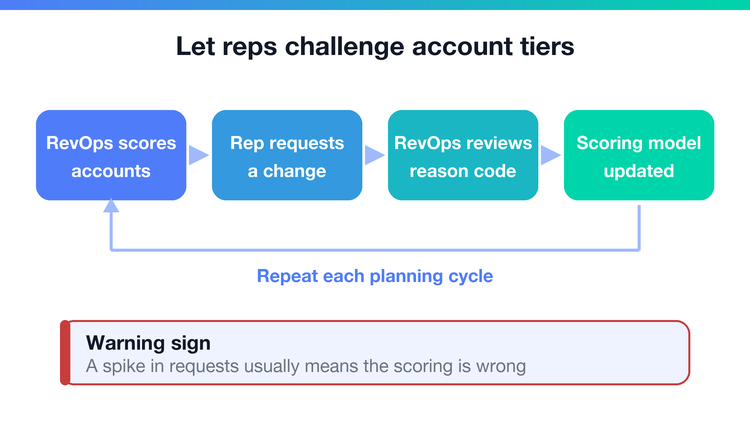
Over time, fold the reasons reps give into the model, such as a prior conversation, a competitor in place or a known initiative. Firmographics alone (revenue, size, location) tell you little until someone talks to the account. Intent data and AI research tools add signals you could not see before. Each strategic account should then get a documented plan. See the account planning process and RevOps account planning for how to structure it.
Where RevOps stays involved once a deal is open
RevOps does not step back at stage two. The panel described two kinds of involvement. Indirect work covers forecasting, pipeline management calls and the data that feed them. Direct work covers pricing and discount rules, deal rooms that pull in product, legal and finance, contract review when you are on the buyer's paper, and quote-to-cash tooling. The warning from the panel: RevOps should quarterback from behind the scenes, not drift into basic reporting that an entry-level analyst can handle. Our guide to deal management covers the process side.
RevOps alignment across marketing, sales and customer success
RevOps alignment is the reason the function exists. When marketing, sales and customer success each use their own definitions, nobody agrees on what a qualified account or a healthy pipeline looks like. Share the ICP, the account tiers and the plan with every team, so marketing builds programs for A and B accounts, sales works them, and customer success knows which accounts carry expansion upside.
RevOps KPIs that show the strategy is working
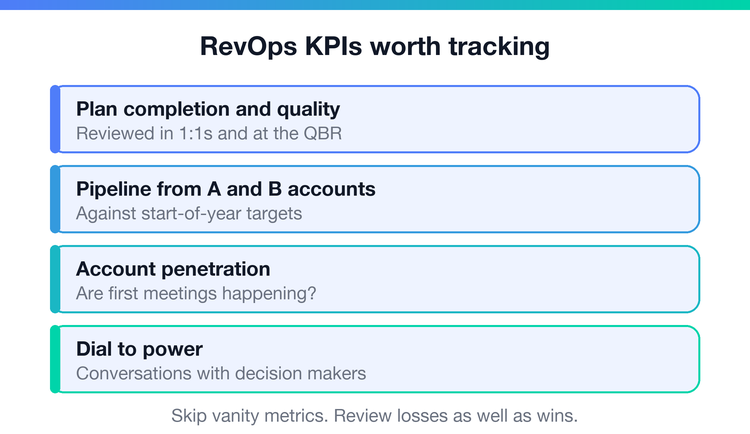
Skip vanity numbers. The RevOps metrics the panel watched:
- Account plan completion and quality, reviewed in one-on-ones or at the quarterly business review.
- Pipeline generated from A and B accounts against the targets set at the start of the year.
- Account penetration. Are first meetings happening, and with whom?
- Dial to power. Instead of counting calls, count conversations with people who hold authority.
- Qualitative QBR answers. What worked, what did not and what help is needed. More ideas are in our sales operations metrics guide.
Also run a bottoms-up postmortem every year. Include losses, because why you lost teaches as much as why you won.
A simple RevOps roadmap and playbook to start this quarter
You do not need new software to begin. Pull your last 10 closed-won deals and note who was involved, why they bought and how large the account could become. That gives you the start of an ICP, a segmentation model and a data set that improves each quarter. Then tier your accounts, write the criteria for when each tool is used and put a review cadence on the calendar. A plan reps can execute beats a perfect one they ignore. For your top tier, move on to strategic account planning.
Turn the plan into account plans reps use. Prolifiq CRUSH is Salesforce native account planning, so tiers, stakeholder maps and plans live in the same system as your pipeline. Explore Prolifiq CRUSH to see how RevOps teams roll out account planning without another tool for reps to learn.
RevOps strategy FAQ
What is a RevOps strategy?
A RevOps strategy is a plan that aligns marketing, sales and customer success around one ideal customer profile, one operating model and shared metrics so the whole go-to-market team works from the same data.
What should a RevOps framework include?
At minimum: ICP and market sizing, team capacity and ratios, a lifecycle model with conversion rates, a tech stack, account segmentation and a review cadence for pipeline and forecast.
What are RevOps best practices?
Set the ICP and capacity before the year starts, plan from the bottom up as well as the top down, keep the tech stack small and integrated, tier accounts with a way for reps to challenge them, and review a few meaningful KPIs on a fixed cadence.
What is a RevOps tech stack?
It is the set of systems RevOps owns, usually a CRM as the source of truth, marketing automation, data enrichment, forecasting and account planning tools. Keep it small, integrated and tied to clear usage criteria.
What is a RevOps playbook?
A RevOps playbook is the written guide that tells teams how the strategy runs in practice: which accounts get which coverage, which tools are used at which stage, how reps request tier changes and how reviews happen.
What are the most important RevOps KPIs?
Pipeline coverage and conversion rates by stage, account plan completion and quality, penetration of target accounts, and how many conversations reach decision makers. Pick a few and review them on a fixed cadence.
How do you segment accounts in a RevOps strategy?
Score accounts on fit and upside, group them into A, B and C tiers, assign coverage plays to each tier and give reps a way to request changes with a reason code. See our guide to account segmentation.
How often should you review a RevOps strategy?
Review pipeline and forecast on a regular operating cadence, and revisit the strategy itself at least once a year, with a mid-year health check. Plan early so there is time to adjust.
How is RevOps different from sales ops?
Sales operations supports the sales team. RevOps spans marketing, sales and customer success. Read sales ops vs RevOps for a full comparison.