
A complex sale is a high-value deal with a long sales cycle and many people involved in the buying decision. Instead of one buyer approving a quote, you work with users, managers, executives, procurement and legal, and sometimes a corporate parent. Complex selling takes a different process, different metrics and far more relationship work than a transactional sale.
This guide covers the complex sales process from first contact to expansion. It draws on a panel of sales, sales operations and account management leaders in healthcare and life sciences, where deals are among the most complicated. You will learn how to map the decision making unit, avoid depending on one contact, manage long sales cycles with multiple stakeholders, and measure progress without vanity metrics. For background reading, see the general definition of a complex sale on Wikipedia.
What is a complex sale?
A complex sale is any deal where the product, price or organization makes the decision hard to reach. Three traits usually show up together:
- Many stakeholders. Different people use, influence, approve and pay for the product, and they often disagree.
- A long sales cycle. Deals do not move in a straight line through the sales cycle stages. People leave, budgets shift and priorities change.
- Multiple paths to value. Different divisions, locations and product lines can each buy, so one win can lead to many more.
Because of this, you cannot treat the account as a transaction. Your process, your metrics and your relationships all need to match the length of the deal. A complex B2B sale is also usually an enterprise sale, so the same habits apply to your enterprise sales process.
Map the decision making unit and stakeholders in sales
A list of contacts is not enough. The group of people who take part in a purchase is often called the decision making unit, or DMU. Visualize it, even if it is only a slide, so everyone on your team sees the same picture and can work on it together. Show who reports to whom, who influences whom, who is a champion and who may block the deal.
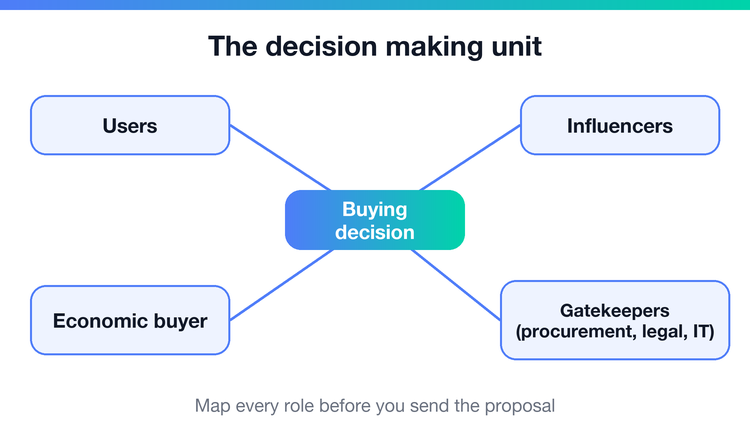
Stakeholders in sales usually fall into a few roles: users who work with the product daily, influencers who shape the shortlist, economic buyers who own the budget, and gatekeepers in procurement, legal and IT. Two tactics from the panel stand out:
- Use your internal network. Ask who on your team already knows the executive or influencer you need. Warm introductions move deals faster than cold outreach.
- Know the account, not just the contact. Follow news about mergers, acquisitions and quarterly results so you can speak about their business. Do not rely on the customer to tell you every challenge.
To build the map, start with our guides to stakeholder mapping, stakeholder analysis and the buying committee. Then use relationship mapping to record how strong each relationship is. Our executive relationship mapping guide covers the senior contacts that decide complex deals.
Manage a long sales cycle without single-threading
The panel's closing warning is easy to underrate: do not depend on one person. It is comfortable to work with the one contact who likes you, but people change roles, get laid off and leave. If your only relationship walks out, the deal does too. This is called single-threading, and it is the most common way a long sales cycle stalls.
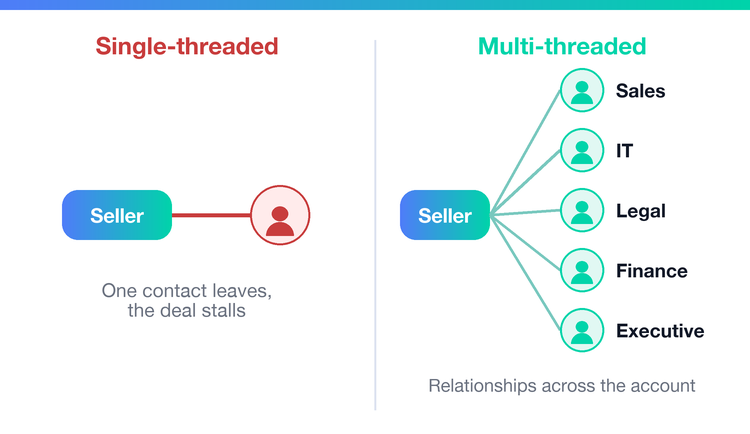
Add contacts across functions and levels, and keep adding them throughout the cycle. Make sure the customer never has to repeat the same story to four different people. That also means introducing the account managers and customer success team before the formal handoff, so the relationship carries over without a reset.
Long sales cycles also need momentum. Agree on next steps and dates with the buyer after every meeting, keep a shared plan, and revisit your stakeholder map whenever someone joins or leaves. A qualification framework helps you see which roles are still missing. Methodologies such as MEDDPICC prompt you to confirm the champion and the economic buyer early, and our deal qualification framework guide compares the options.

Build a plan the customer also buys into
The best reps in the panel's experience always had a plan with a direction, even if it changed. Three habits showed up:
- Walk before you run. After winning a division, invest in making it successful before racing to expand into 15 more opportunities. A satisfied pilot group becomes an advocate and a reference.
- Agree on a cadence with the customer. Quarterly business reviews, monthly check-ins or weekly calls, whichever serves them best. It is usually tighter during implementation and looser later. Our quarterly business review guide has a format.
- Zoom out regularly. Reps get buried in daily requests. Managers should ask what they would talk about if they were not fixing today's problem, then block time for that conversation.
Write the plan down. Our account planning process shows how, a mutual action plan keeps the buyer committed to the same steps, and strategic account management covers the broader discipline.
Make it scalable with tiers and a shared process
One strong account manager is not a strategy. To scale, define tiers by customer revenue or potential, and set the interaction plan for each tier. For example, every customer in the top tier gets a quarterly business review, no matter who owns the account. The key account management framework shows one way to set tiers.
The panel recommended thinking in terms of people, process and technology, in that order:
- Name who is responsible, accountable, consulted and informed.
- Whiteboard the process before any tool is configured.
- Then put it into your CRM or planning tool to drive accountability.
Teams that start with the tool end up with low adoption because nobody agrees on the plan.
Complex sales training for your team
Complex sales training works best when it mirrors real deals. Practice building a stakeholder map for a live account, role-play a conversation with an executive sponsor, and review lost deals to find where the team single-threaded. Pair each rep with a deal that has several stakeholders and review the plan together in your account planning meetings.
Measure what matters in a long sales cycle
Complex deals are not transactional, so transactional metrics mislead. Open rates, for example, do not show whether anyone replies. Better measures from the panel:
- Referrals and introductions. Someone who introduces you to a colleague trusts you.
- Net revenue retention, not just renewal rate. An account that renews at 100 percent but adds products can show 120 percent. See net revenue retention for the formula.
- Stakeholders on the plan. Deals with 10 mapped stakeholders tend to win more often and close faster than deals with two.
- Win rate and time to close on planned versus unplanned accounts. More ideas are in our account planning KPIs guide.
Keep incentives aligned too. If pay is tied only to the final number, you may still want a small number of meaningful activity measures that drive the right behavior. Align sales, marketing and product on the same account goals so the customer sees one team, and use white space analysis to show which divisions and products to pursue next.
Complex sales in healthcare and life sciences
Healthcare and life sciences add extra layers: large networks, frequent acquisitions, clinicians who use the product and corporate groups that decide. The community is also small and people move between companies, so trust and reputation travel with them. Treat everyone, from the receptionist to the executive, with the same respect. For industry-specific detail, read our guides to healthcare key account management and pharma key account management, plus the key account management process.
Run complex deals from one view. Prolifiq CRUSH is Salesforce native account planning, so stakeholder maps, relationship strength and account plans live in the same system as your pipeline. Explore Prolifiq CRUSH to see how teams keep many-stakeholder deals on track.
Complex sales FAQ
What is a complex sale?
A complex sale is a high-value deal with many stakeholders, a long sales cycle and a buying decision that takes several steps to reach. Complex selling relies on relationships, planning and patience more than on a single pitch.
How is a complex sale different from a transactional sale?
A transactional sale has one or two buyers, a short cycle and a standard price. A complex sale involves a buying group, custom requirements, longer timelines and a need to keep winning internal support after the first meeting.
What is the complex sales process?
It usually runs from research and first contact through discovery, stakeholder mapping, solution design, evaluation, negotiation, handoff and expansion. Because the stages overlap and repeat, a written account plan and a shared plan with the buyer keep the deal on track.
How long is a complex sales cycle?
It varies by industry and deal size, but a long sales cycle often runs for months and sometimes more than a year. Measure your own average and track how many stakeholders are engaged at each stage.
How do you shorten a long sales cycle?
You rarely shorten it by pushing harder. Add stakeholders early, agree on dated next steps in a mutual action plan, surface blockers such as legal or security review sooner, and keep your champion equipped to sell internally.
What is the decision making unit?
The decision making unit is the group of people who influence or approve a purchase, such as users, influencers, economic buyers and gatekeepers. Mapping it early shows who you still need to reach.
What does single-threading mean in sales?
Single-threading means relying on one contact inside the account. If that person changes jobs or loses influence, the deal stalls. Multi-threading adds relationships across functions and seniority levels.
Which methodology works best for complex deals?
Qualification frameworks such as MEDDIC and MEDDPICC are common because they force you to confirm the champion, the economic buyer and the decision process. See our MEDDIC sales process guide to compare them.
What tools help with complex sales?
A CRM with contact roles, a stakeholder or relationship map, an account plan and a mutual action plan cover most needs. Keeping them inside Salesforce avoids a second source of truth.