A stakeholder engagement plan is a document that lists the people who can influence a decision or project, records how engaged each one is today, and sets the actions, messages, and owners to move them where you need them. In sales, it is the working plan that follows a stakeholder map.
This guide gives you a stakeholder engagement plan template you can copy, explains the engagement levels, walks through five steps to build one, and shows a sample stakeholder engagement plan for a B2B deal.
What Is a Stakeholder Engagement Plan?
A stakeholder map tells you who is involved. A stakeholder engagement plan tells you what to do about it. It is the next step after stakeholder mapping and stakeholder analysis, and it turns research into specific actions with owners and dates.
Project managers use the same document for change programs and rollouts. In B2B sales, the stakeholders are your buying committee: the economic buyer, the champion, technical evaluators, users, and anyone who can block the deal. Gartner research puts a typical enterprise buying group at six to ten people, so a plan for one contact is not a plan.
Stakeholder Engagement Plan Template
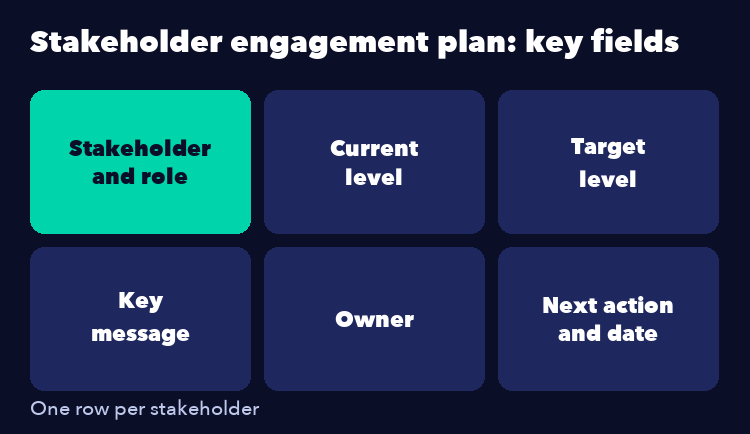
Use one row per stakeholder. Start with the fields below, then add columns your team needs.
| Field | What to record |
|---|---|
| Name and title | Who they are |
| Role in the decision | Economic buyer, champion, evaluator, user, blocker |
| Influence and interest | High, medium, or low for each |
| Current engagement level | Unaware, resistant, neutral, supporting, or leading |
| Target engagement level | Where you need them to be |
| Objective | What you want from this person |
| Key message | What matters to them, in their terms |
| Channel and frequency | Meeting, email, call, executive visit, and how often |
| Owner | The person on your team responsible |
| Next action and date | The specific next step |
Smartsheet publishes downloadable stakeholder engagement plan templates if you prefer a file. A shorter version works for most deals: stakeholder, role, current level, target level, next action, owner, and date. If you want a version to copy, our stakeholder mapping template covers the people and the influence grid, and this plan adds the actions.
Stakeholder Engagement Levels
Rate every stakeholder on the same scale so the plan is comparable across people and deals. A widely used scale, described by Asana, has five levels:
- Unaware: does not know about the initiative or its impact.
- Resistant: knows about it and pushes back.
- Neutral: aware, but neither supports nor opposes.
- Supporting: aware and backs the initiative.
- Leading: aware and actively working to make it succeed.

In a sale, your champion should be at supporting or leading, and the economic buyer should be at least neutral before a proposal goes out. A blocker at resistant is a risk to plan around, not a detail to leave out. On your largest accounts, an executive sponsor can take on the most senior stakeholders.

How to Build a Stakeholder Engagement Plan in 5 Steps
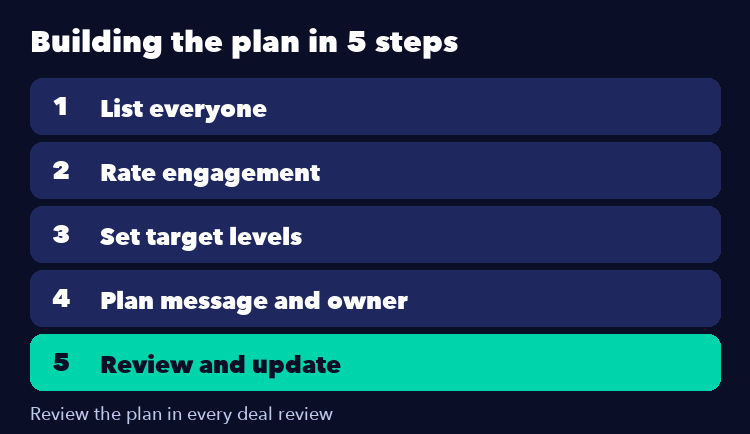
1. List everyone with a stake
Include the obvious decision makers and the quiet influencers: finance, procurement, legal, IT, and the people who will use the product. Ask your champion who else will have a say. Our guide to sales relationship mapping covers champions and blockers.
2. Rate influence, interest, and current engagement
Score each person on influence and interest, then mark their current engagement level. Be honest. If you have never spoken to someone, they are unaware or neutral, not supporting.
3. Set a target level for each key stakeholder
Not everyone needs to be a leader. Decide who must move and by how much. Moving a blocker to neutral can matter more than moving a supporter to leading.
4. Plan the message, channel, and owner
Write what each person cares about in their own terms: cost and risk for finance, integration for IT, daily workload for users. Pick the channel, set a frequency, and name one owner so nothing is assumed.
5. Review and update
Review the plan in every deal or account review, and update it when someone changes role or a new person enters the deal. Feedback from stakeholders is the signal that tells you the plan is working.
Sample Stakeholder Engagement Plan
Here is a short sample stakeholder engagement plan for an enterprise software deal. The names and details are illustrative.
| Stakeholder | Role | Current | Target | Next action | Owner | Date |
|---|---|---|---|---|---|---|
| VP Operations | Champion | Supporting | Leading | Give her a one-page business case she can share | AE | This week |
| CFO | Economic buyer | Neutral | Supporting | Request a 30-minute call with our CRO to cover ROI and risk | Sales director | Next 2 weeks |
| IT director | Technical evaluator | Resistant | Neutral | Run a security and integration review with a solutions engineer | SE | Before the demo |
| Procurement lead | Blocker risk | Unaware | Neutral | Ask the champion for an introduction and share standard terms early | AE | Within 3 weeks |
| End users (3) | Users | Neutral | Supporting | Pilot session with two team leads and collect feedback | CS lead | Pre-signature |
The plan makes the gaps obvious. Procurement is unaware, the IT director is resistant, and neither has an owner who has spoken to them yet. That is the work for the next two weeks. Pair the plan with a mutual action plan so the buyer sees the same steps, and keep the account plan as the home for it.
Mistakes to Avoid and How to Keep the Plan Current
- Only planning for friends. A plan with no resistant or unaware stakeholders is probably missing people.
- Confusing title with influence. A director with access to the CEO can matter more than a VP who is rarely in the room.
- No owners. A task without a named person usually does not happen.
- One-time plans. Buying groups change. Review the plan at every deal review.
- Keeping it outside the CRM. A plan in a slide deck goes stale and cannot be reported on.
Prolifiq is Salesforce-native, so relationship maps, influence and support levels, and next steps sit on the account and opportunity records where your team already works. See relationship mapping for the full method.
Frequently Asked Questions
What is a stakeholder engagement plan?
A document that lists the people who can influence a decision, records how engaged each one is, and sets the actions, messages, and owners to move them to the level you need.
What should a stakeholder engagement plan template include?
Stakeholder name and role, influence and interest, current and target engagement level, objective, key message, channel and frequency, owner, and next action with a date.
What is the difference between a stakeholder map and a stakeholder engagement plan?
A stakeholder map shows who is involved and how much influence they have. The engagement plan sets what you will do about each person.
How do you measure stakeholder engagement?
Rate each stakeholder against a fixed scale, such as unaware, resistant, neutral, supporting, and leading, and track movement toward the target level over time.
How often should a stakeholder engagement plan be updated?
Review it in every deal or account review, and update it whenever someone changes role or a new person joins the buying group.
Can a stakeholder engagement plan be used in sales?
Yes. In B2B sales, the stakeholders are the buying committee, and the plan keeps multi-threaded deals organized with named owners and dates.
A plan is only as useful as the data behind it. See how Prolifiq keeps relationship maps and stakeholder plans in Salesforce, so your team always works from the current picture.