An executive sponsor is a senior leader who backs a specific account, deal, or initiative with their time and authority. In sales, the term covers a vendor executive paired with a key customer to build a peer relationship, and the customer executive who champions the purchase internally.
Executive sponsorship works because decisions of any size end up on an executive's desk. This guide explains the executive sponsor role, when an account needs one, how to build an executive sponsor program, and how to pick the right person.
What Is an Executive Sponsor?
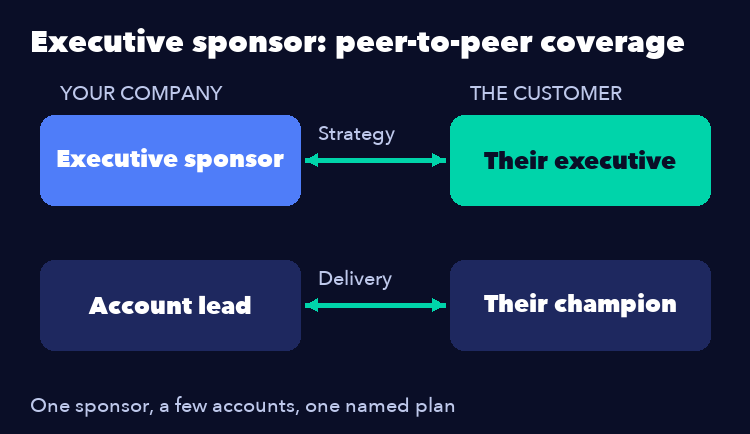
Executive sponsorship means a leader above the account team commits to a relationship on purpose. They do not run the day-to-day. They open doors, remove blockers, and show the customer that leadership cares about the outcome.
There are two sponsors in a healthy enterprise deal. Your executive sponsor sits on your side and talks to the customer's senior people. The customer's executive sponsor sits on their side, owns the business problem, and clears the way internally. The best deals have both. Lucid also covers executive sponsorship programs from a customer-success angle. A plain economic buyer conversation is much easier when your sponsor is a peer of theirs.
Executive sponsor vs champion vs economic buyer
These roles overlap but they are not the same person. A champion has influence and advocates for you. The economic buyer holds the budget. An executive sponsor is a senior leader who backs the initiative, and that can be the economic buyer or someone close to them. Map all three so you know which role each person plays, using a relationship map, and plan how to move each one with a stakeholder engagement plan.
Executive Sponsor Role and Responsibilities
The executive sponsor role is narrow on purpose. If the sponsor does the account manager's job, both of them are doing it badly. The core responsibilities are:
- Build a peer relationship. Meet the customer's executives on a regular rhythm, quarterly for most accounts, and talk about their goals instead of your product.
- Open doors. Get access that the account team cannot get alone, such as the CEO, CFO, or a business unit head.
- Remove blockers. Step in when a deal or an escalation is stuck on something that needs executive authority.
- Back the account plan. Review the plan with the account lead, and commit internal resources when it needs them.
- Watch for risk. Hear it first when the customer's priorities change or a competitor gets close.
What the sponsor should not do is run the commercial conversation or pitch. Sponsor visits that turn into attempts to close a deal the account lead could not close tend to undermine the account lead and annoy the customer.
When an Account Needs an Executive Sponsor
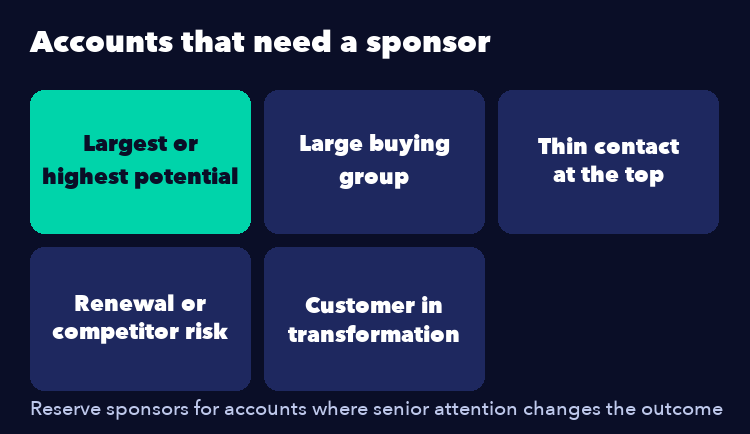
You cannot sponsor everything. Reserve the program for accounts where senior attention changes the outcome. Good triggers are:
- The account is among your largest, or has clear potential to be.
- The buying group is large, which research from Gartner puts at six to ten people for a typical enterprise purchase.
- The relationship is thin at the top, with no contact above director level.
- A renewal or expansion is at risk, or a competitor is circling.
- The customer is mid-transformation and wants a partner, not a vendor.
These are usually your key or strategic tier accounts. See strategic account planning for how to choose them, and key account management strategy for the wider operating model.

How to Build an Executive Sponsor Program
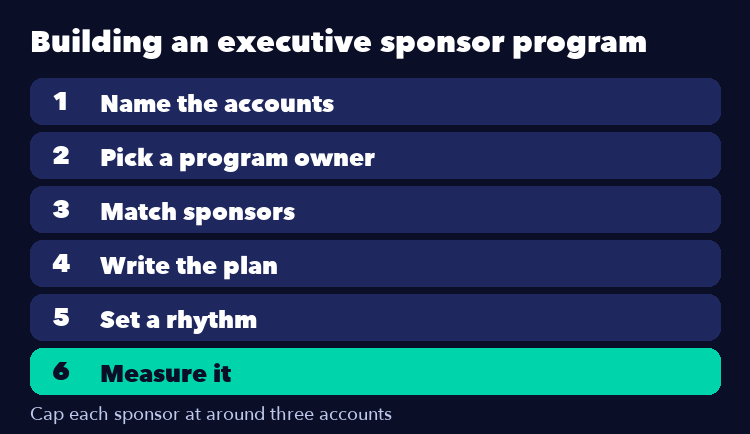
1. Name the accounts
Pick a short list. Keep it small enough that each sponsor can do the job properly, and a common guideline is to cap each sponsor at around three accounts.
2. Choose a program owner
Someone must own the program day to day, usually in sales leadership or revenue operations. Without an owner, the visits drift and stop within two quarters.
3. Match sponsors to accounts
Ask the account lead who the customer would respect. The account lead knows the account best, so they should have a strong say in the pairing.
4. Write the plan
For each account, record the goal, the executives you want to reach, and the first three actions. Keep it in the account plan so the whole team sees it.
5. Set a rhythm and brief the sponsor
Quarterly executive touchpoints work for most accounts. Before each one, give the sponsor a one-page brief with recent wins, open issues, and what to ask.
6. Measure it
Track the number of sponsored accounts with an executive meeting in the last quarter, retention and expansion on those accounts, and how many executives at the customer you can name. Many programs struggle to show a direct revenue link, so pair the numbers with account health trends from your customer health score.
How to Choose the Right Executive Sponsor
Match on three things: seniority, relevance, and time. The sponsor should be at or above the level of the customer's executive, have a reason to care about the customer's business, and be able to commit to the cadence. A technical customer may respond better to a product or engineering leader than to a sales executive. For the customer side, look for someone who owns the business problem and can explain it in terms of the company's goals. Our guide to executive relationship mapping shows how to find them, and C-suite relationship mapping covers the top of the org chart.
Common Executive Sponsor Mistakes
- Sponsors as closers. Bringing an executive in only when a deal is stuck makes the visit look transactional.
- Too many accounts. A sponsor with ten accounts has a relationship with none of them.
- No brief. An executive who walks in cold wastes the meeting and the customer's time.
- Bypassing the account lead. The account lead should be in every conversation and should hear what was said.
- No follow-up. Log the notes and next steps in the account plan the same day.
Keeping the sponsor, the account lead, and the customer contacts visible in one place is the practical fix for most of these. Prolifiq is Salesforce-native, so relationship maps and account plans sit on the account record where sponsors and account teams work from the same view.
Frequently Asked Questions
What is an executive sponsor?
A senior leader who backs an account, deal, or initiative with their time and authority. In sales, it can mean your own executive paired with a key customer, or the customer executive who champions the purchase internally.
What does an executive sponsor do?
They build a peer relationship with the customer's executives, open doors the account team cannot, remove blockers that need executive authority, and review the account plan. They do not run the day-to-day relationship.
What is the difference between an executive sponsor and a champion?
A champion advocates for you internally and usually has influence but not final authority. An executive sponsor is a senior leader with the authority and standing to back the initiative.
How many accounts should an executive sponsor have?
A small number, often three or fewer, so each relationship gets real attention.
What is an executive sponsor program?
A structured program that pairs senior leaders with a short list of key accounts, sets a regular meeting rhythm, and tracks the results.
How often should an executive sponsor meet the customer?
Quarterly works for most key accounts, with extra contact around renewals and major changes.
Executive sponsorship only pays off when the account team has a plan the sponsor can step into. See how Prolifiq keeps plans, relationship maps, and next steps in Salesforce so sponsors and account teams work from the same view.